
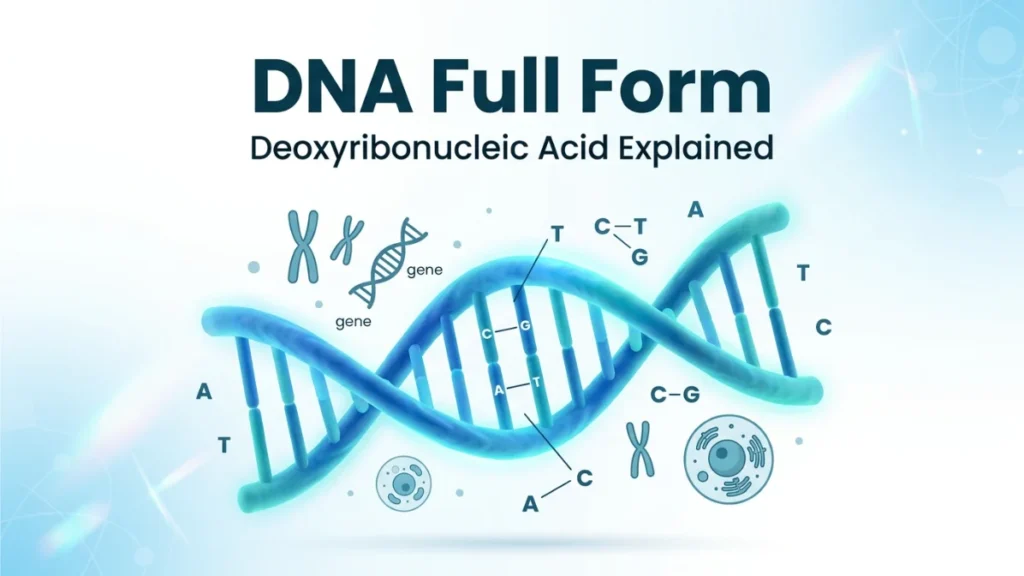

DNA full form is Deoxyribonucleic Acid. It is the molecule that stores genetic instructions in living organisms. In simple words, DNA tells cells how to grow, work, repair themselves, and pass traits from parents to children.
You can think of DNA as the body’s instruction manual. It doesn’t look like a book, of course. It sits inside cells as a long chemical code made of four bases: A, T, C, and G. These letters stand for adenine, thymine, cytosine, and guanine. Their order creates biological instructions.
DNA matters because it connects biology, inheritance, medicine, forensics, ancestry, and life itself. Every living thing with DNA uses it to store information. Humans, animals, plants, bacteria, and fungi all depend on genetic material in one way or another.
Quick answer: DNA stands for Deoxyribonucleic Acid, the hereditary material that carries genetic information in living organisms.
DNA Full Form Quick Answer
The full form of DNA is Deoxyribonucleic Acid.
| Term | Meaning |
|---|---|
| DNA full form | Deoxyribonucleic Acid |
| DNA stands for | Deoxyribonucleic Acid |
| DNA meaning | A molecule that stores genetic information |
| DNA meaning in biology | Hereditary material found in living organisms |
| DNA pronunciation | Dee-en-ay |
| Main function | Stores and passes genetic instructions |
| DNA structure | Double helix |
| DNA bases | Adenine, Thymine, Cytosine, Guanine |
| DNA base letters | A, T, C, G |
| Found in humans | Mostly inside the cell nucleus |
| Related term | RNA, genes, chromosomes, genome |
DNA is an abbreviation, not a casual nickname. Scientists use the short form because Deoxyribonucleic Acid is long and technical. In classrooms, medical labs, forensic reports, and genetics discussions, people almost always say DNA.
What Is the Full Form of DNA?
The full form of DNA is Deoxyribonucleic Acid. This name describes the chemical nature of the molecule.
Let’s break it down.
Deoxy refers to deoxyribose, a sugar found in DNA. This sugar is different from the ribose sugar found in RNA.
Ribonucleic connects DNA to nucleic acids. Nucleic acids are large biological molecules that store and transfer genetic information.
Acid refers to its chemical properties. DNA contains phosphate groups, which give it an acidic nature.
So, when someone asks, “What does DNA stand for?” the answer is simple:
DNA stands for Deoxyribonucleic Acid.
In biology, this full name matters because it separates DNA from RNA, proteins, fats, carbohydrates, and other molecules inside living cells. Belongs to a special group of molecules called nucleic acids.
DNA Meaning in Simple Words
DNA is the molecule that carries the instructions of life. It tells cells what to do and helps living things pass traits from one generation to the next.
A simple definition of DNA would be:
DNA is the genetic material inside living cells that stores instructions for growth, development, function, and reproduction.
That sounds scientific, but the idea is easy to understand.
Imagine a recipe book in a kitchen. The book doesn’t bake the cake by itself. However, it tells the baker what ingredients to use, how much to add, and what steps to follow. DNA works in a similar way. It stores instructions that cells use to make proteins and carry out life processes.
Here’s another simple comparison:
| Example | What It Represents |
|---|---|
| Recipe book | DNA |
| Recipe | Gene |
| Ingredients | Chemical bases |
| Kitchen workers | Cell machinery |
| Finished dish | Protein or biological result |
DNA doesn’t control everything about a person like a magic remote. Environment, lifestyle, nutrition, age, and many other factors also matter. Still, DNA plays a central role in biology because it carries inherited information.
DNA Meaning in Biology
In biology, DNA means the hereditary material that carries genetic information in living organisms.
The word hereditary means something passes from parents to offspring. Your DNA helps explain why you may share features with your parents, siblings, or grandparents. It also helps explain why every person has a unique biological identity.
DNA contains instructions for making proteins. Proteins help build body tissues, support chemical reactions, move substances inside cells, fight infections, and perform thousands of other jobs.
DNA also helps cells divide properly. Before a cell divides, it copies its DNA. This process helps each new cell receive the genetic instructions it needs.
In short, DNA in biology connects three big ideas:
- Information
- Inheritance
- Cell function
Without DNA, complex life as we know it would not work.
DNA Definition
A clear DNA definition is:
DNA, or Deoxyribonucleic Acid, is a long molecule made of nucleotides that stores genetic information in living organisms.
This definition includes three important points.
First, DNA is a molecule. That means it is made of atoms arranged in a specific structure.
Second, DNA is made of nucleotides. These are the building blocks of DNA.
Third, DNA stores genetic information. This information helps cells make proteins, divide, repair, and pass traits to the next generation.
A student-friendly definition can be even simpler:
DNA is the instruction code inside cells that tells living things how to grow and function.
Both definitions are correct. The first one fits biology textbooks. The second one works better for beginners.
DNA Full Name and DNA Acronym Meaning
The DNA full name is Deoxyribonucleic Acid.
DNA is also an acronym. An acronym forms from the first letters of a longer term. In this case:
| Letter | Word |
|---|---|
| D | Deoxyribo |
| N | Nucleic |
| A | Acid |
People use DNA as a short form because the full name is long. The abbreviation also works globally. Whether someone studies biology, medicine, genetics, agriculture, or forensic science, DNA means the same thing.
The DNA acronym meaning should not be confused with a brand name, test name, or disease name. DNA is a biological molecule.
Pronunciation
DNA is pronounced as:
Dee-en-ay
People say each letter separately. It is not pronounced as one word.
The full form, Deoxyribonucleic Acid, is pronounced like this:
dee-OK-see-rye-bo-noo-KLEE-ik AS-id
Students often find the full name tricky at first. That’s normal. The short form DNA exists for a reason.
Where Is DNA Found?
DNA is found inside living cells. In humans, animals, plants, and other eukaryotic organisms, most DNA sits inside the nucleus.
The nucleus works like a control center. It protects DNA and helps manage cell activity. DNA does not float around randomly. It stays organized with proteins and forms structures called chromosomes.
Humans also have a small amount of DNA inside mitochondria. Mitochondria help cells produce energy. This mitochondrial DNA is separate from the DNA found in the nucleus.
Here’s a simple breakdown:
| Location | Type of DNA | What It Means |
|---|---|---|
| Nucleus | Nuclear DNA | Contains most genetic information |
| Mitochondria | Mitochondrial DNA | Helps mitochondria function |
| Bacteria | Circular DNA | Found in the cell region called nucleoid |
| Some viruses | DNA or RNA | Some viruses use DNA as genetic material |
In human body cells, DNA is usually stored in the nucleus. However, mature red blood cells are an exception because they lose their nucleus and do not contain nuclear DNA.
Human DNA Information
Human DNA is huge when measured as information. A human genome contains about 3 billion base pairs. These base pairs form the chemical code that makes genetic instructions possible.
Most human body cells contain 46 chromosomes, arranged in 23 pairs. One set usually comes from the mother and one set comes from the father.
Here are some key facts:
| Human DNA Fact | Detail |
|---|---|
| Human chromosome count | 46 chromosomes in most body cells |
| Chromosome pairs | 23 pairs |
| Human genome size | About 3 billion base pairs |
| Protein-coding genes | About 20,000 |
| DNA length per cell | Roughly 2 meters if stretched out |
| DNA similarity among humans | More than 99% similar |
| Mitochondrial DNA size | 16,569 base pairs |
| Mitochondrial genes | 37 genes |
That “2 meters per cell” fact surprises many people. DNA fits inside a tiny cell nucleus because it coils, folds, and packs tightly around proteins. It’s like fitting a long thread into a microscopic spool.
Small differences in DNA help make people unique. Those differences can influence traits such as eye color, hair type, blood group, and certain inherited risks. Still, DNA does not act alone. Your body and life experiences also respond to environment, habits, nutrition, and chance.
Structure of DNA
The structure of DNA is one of the most famous ideas in biology. DNA has a double helix structure. That means it looks like a twisted ladder.
The sides of the ladder are made of sugar and phosphate groups. The steps are made of pairs of nitrogen bases.
A simple diagram looks like this:
Sugar-Phosphate Side        Sugar-Phosphate Side
        |                           |
        A ------------- T
        |                           |
        C ------------- G
        |                           |
        G ------------- C
        |                           |
        T ------------- A
        |                           |
Twisted ladder shape = Double helix
The double helix shape helps DNA stay stable. It also helps DNA copy itself during cell division. Each strand can act as a guide for building a new matching strand.
Components of DNA
DNA is made of smaller units called nucleotides. Each nucleotide has three parts:
- Deoxyribose sugar
- Phosphate group
- Nitrogen base
These parts connect again and again to form a long DNA strand.
| DNA Component | Role |
|---|---|
| Deoxyribose sugar | Forms part of DNA’s backbone |
| Phosphate group | Connects sugars and supports the backbone |
| Nitrogen base | Stores genetic information through its sequence |
The sugar and phosphate groups create the outer backbone. The bases face inward and pair with bases on the opposite strand.
This structure gives DNA both strength and flexibility. It can store information, copy itself, and remain stable for long periods.
Nucleotides in DNA
Nucleotides are the building blocks of DNA.
Each nucleotide works like a letter in a biological alphabet. The order of these letters creates instructions that cells can read and use.
DNA uses four main nitrogen bases:
| Base Name | Letter |
|---|---|
| Adenine | A |
| Thymine | T |
| Cytosine | C |
| Guanine | G |
These four bases may look simple, but their order creates a massive amount of information. Just like 26 letters can create thousands of books, four DNA letters can create the genetic instructions for living organisms.
The power lies in the sequence.
A short DNA sequence might look like this:
ATGCGTACCTGAThat sequence may seem random. Inside a cell, however, base order can carry biological meaning.
Double Helix Structure of DNA
The double helix structure of DNA means DNA has two strands twisted around each other. These two strands run in opposite directions and stay connected through base pairs.
The pairing rules are specific:
| Base | Pairs With |
|---|---|
| Adenine | Thymine |
| Thymine | Adenine |
| Cytosine | Guanine |
| Guanine | Cytosine |
Adenine always pairs with thymine. Cytosine always pairs with guanine.
This pairing matters because it helps DNA copy itself correctly. If one strand has A, the matching strand should have T. If one strand has C, the matching strand should have G.
Base pairing also explains how DNA can store information in a stable way. The sequence on one strand helps determine the sequence on the other.
DNA Sequence Meaning
A DNA sequence is the exact order of bases in a DNA molecule.
For example:
A T G C C A T T G AThis order is not decoration. It carries information.
A DNA sequence can include genes, control regions, and other sections that influence how cells work. Some sequences help code for proteins. Other sequences help regulate when genes turn on or off. Some sections have functions scientists still study.
Here’s the simple idea:
DNA sequence = the order of A, T, C, and G bases.
That order acts like biological code. Cells read parts of it to make useful molecules, especially proteins.
Genetic Code Meaning
The genetic code explains how cells translate information from DNA and RNA into proteins.
Proteins are made of amino acids. Cells read genetic information in groups of three bases called codons. Each codon usually points to a specific amino acid or a stop signal.
For example, the codon AUG in RNA often acts as a start signal and codes for methionine.
DNA itself does not jump out and build proteins directly. The cell first uses DNA to make RNA. Then ribosomes read RNA instructions to assemble amino acids into proteins.
A simplified flow looks like this:
DNA → RNA → ProteinThis flow is often called the central idea of molecular biology. It helps explain how genetic information becomes real biological action.
Function of DNA
The main function of DNA is to store and pass genetic information.
DNA works like a long-term storage system for biological instructions. Cells use these instructions to make proteins, regulate processes, and produce new cells.
The major functions of DNA include:
- Storing genetic information
- Passing traits from parents to offspring
- Helping cells make proteins
- Guiding growth and development
- Supporting cell division
- Helping repair and maintain body tissues
- Creating biological variation through small genetic differences
DNA does not perform every job alone. It works with RNA, enzymes, proteins, and many cell structures. Still, DNA sits at the center of heredity and genetics.
DNA Stores Genetic Information
DNA stores information through the order of its bases. The four bases, A, T, C, and G, form long sequences.
A gene is a section of DNA that carries instructions for making a functional product, often a protein. Proteins then carry out many jobs inside the body.
For example, some genes help make proteins involved in eye color. Others help build enzymes, hormones, immune system molecules, or structural proteins.
The storage system is compact but powerful. A tiny cell nucleus can hold billions of base pairs because DNA folds and packs neatly into chromosomes.
DNA Passes Traits From Parents to Children
DNA plays a key role in inheritance. Children receive DNA from their biological parents. This is why family members often share certain traits.
Examples of inherited traits include:
- Eye color
- Hair color
- Hair texture
- Blood group
- Certain facial features
- Some inherited health risks
- Biological sex chromosomes
However, heredity is not always simple. Many traits come from several genes working together. Some traits also depend heavily on environment.
For example, height depends on many genes, but nutrition and health during childhood also matter. Skin tone, metabolism, body build, and many other traits involve complex genetic and environmental influences.
So, DNA passes instructions. Life adds the fine print.
DNA Helps Cells Make Proteins
Proteins are workhorses inside living organisms. They build structures, speed up chemical reactions, send signals, fight germs, and move materials around cells.
DNA helps make proteins through a two-step process:
- Transcription: A gene’s DNA information is copied into RNA.
- Translation: The RNA message is read to build a protein.
A simple diagram:
Gene in DNA
   ↓
RNA message
   ↓
Protein
   ↓
Cell function
This process explains why DNA is so important. It stores the instructions that cells need to build useful molecules.
DNA Replication Meaning
DNA replication means DNA makes a copy of itself.
This process happens before cell division. When one cell divides into two, each new cell needs a full set of genetic instructions. DNA replication makes that possible.
A simple way to picture it:
Original DNA
   ↓
Two strands separate
   ↓
Each strand builds a matching strand
   ↓
Two DNA molecules form
A zipper analogy works well here. DNA “unzips” between the base pairs. Each half then helps build a matching half. The result is two DNA molecules, each with one old strand and one new strand.
DNA replication must be accurate. Mistakes can cause mutations. Some mutations have little or no effect. Others can affect traits, cell behavior, or health.
Importance of DNA
The importance of DNA goes far beyond biology class. DNA helps explain inheritance, identity, disease research, evolution, agriculture, and forensic science.
DNA matters because it stores the information needed for life. It also helps scientists understand how organisms grow, change, and relate to one another.
Here’s why DNA is important:
| Area | Why DNA Matters |
|---|---|
| Biology | Explains heredity and cell function |
| Medicine | Helps study genes and inherited conditions |
| Forensics | Helps identify people from biological evidence |
| Ancestry | Helps compare genetic markers |
| Agriculture | Helps improve crop and animal breeding research |
| Evolution | Helps compare species and study relationships |
| Education | Helps students understand life at the molecular level |
DNA is not just a lab topic. It affects real life in quiet, constant ways.
Role of DNA in Humans
DNA plays several major roles in humans.
It helps guide development from a single fertilized egg into a complete human body. It helps cells specialize into skin cells, nerve cells, muscle cells, liver cells, and many other types. Nearly all these cells contain the same DNA, but they use different parts of it.
That’s an important point.
A skin cell and a brain cell usually contain the same genetic library. However, they read different chapters. This selective use of genes helps cells perform specialized jobs.
DNA also helps with repair. Cells constantly deal with damage from normal body processes, sunlight, chemicals, and random errors. DNA repair systems help fix many mistakes. These systems are not perfect, but they protect cells from serious problems.
DNA and Hereditary Material
DNA is called hereditary material because it passes biological information from one generation to the next.
Parents pass DNA to children through reproductive cells. Sperm and egg cells each carry half the usual chromosome number. When they combine, the new cell receives a complete set of genetic instructions.
In humans:
| Cell Type | Chromosome Number |
|---|---|
| Most body cells | 46 chromosomes |
| Sperm cell | 23 chromosomes |
| Egg cell | 23 chromosomes |
| Fertilized egg | 46 chromosomes |
This system helps maintain the correct chromosome number across generations.
DNA also changes slightly over time through mutation and recombination. These changes create variation. Without genetic variation, populations would struggle to adapt across generations.
Genetic Material Meaning
Genetic material means the substance that stores hereditary information in an organism.
For most living organisms, that material is DNA. In some viruses, genetic material can be RNA instead.
Genetic material must do several things well:
- Store information
- Copy itself
- Pass from one generation to another
- Allow variation
- Support biological function
DNA fits these requirements. It stays stable enough to protect information, yet flexible enough to allow changes over time.
Genes and DNA Relationship
Genes and DNA are closely related, but they are not the same thing.
A gene is a section of DNA. DNA is the full molecule. Genes are parts of that molecule that carry specific instructions.
Think of DNA as a long instruction book. Genes are individual recipes inside it.
| Term | Simple Meaning |
|---|---|
| DNA | The full genetic molecule |
| Gene | A section of DNA with instructions |
| Protein | A molecule often made using gene instructions |
| Trait | A feature influenced by genes and environment |
A gene may help create a protein. That protein may affect a trait or cell process.
For example, some genes help produce proteins involved in blood type. Others help make enzymes that digest food or repair DNA.
Genes do not work in isolation. Many traits involve many genes, and those genes interact with the environment.
Chromosome and DNA Relationship
Chromosomes are organized structures made of DNA and proteins.
DNA is extremely long. Cells need a way to package it. Chromosomes solve that problem.
A chromosome contains one long DNA molecule wrapped around proteins called histones. This packaging helps DNA fit inside the nucleus and stay organized.
Here’s the relationship:
Cell
  ↓
Nucleus
  ↓
Chromosome
  ↓
DNA
  ↓
Gene
  ↓
Base sequence
Most human body cells have 46 chromosomes. These chromosomes hold the DNA that carries most genetic instructions.
Genome, Chromosomes, DNA, and Genes
These terms often confuse beginners. A simple table clears things up.
| Term | Meaning | Example |
|---|---|---|
| Genome | Complete set of genetic information | All DNA in a human cell |
| Chromosome | Packed DNA structure | Chromosome 1, chromosome 2 |
| DNA | Molecule that stores genetic code | Deoxyribonucleic Acid |
| Gene | Section of DNA with instructions | Gene for a protein |
| Base | Chemical letter in DNA | A, T, C, G |
A library analogy also helps:
- Genome = the whole library
- Chromosomes = bookshelves or books
- DNA = the written material
- Genes = useful chapters
- Bases = letters in the text
This analogy isn’t perfect, but it makes the relationship easier to remember.
DNA Structure and Function
DNA’s structure and function fit together beautifully.
Its structure helps it store information, copy itself, and stay stable. The double helix shape protects the bases inside. The base-pairing rule helps DNA replicate. The sugar-phosphate backbone gives the molecule support.
Structure supports function in three big ways:
| Structure Feature | Function Benefit |
|---|---|
| Double helix | Protects genetic information |
| Base pairing | Helps accurate copying |
| Long sequence | Stores huge amounts of information |
| Sugar-phosphate backbone | Adds stability |
| Two strands | Allows each strand to guide copying |
DNA is not shaped randomly. Its form helps it do its job.
Difference Between DNA and RNA
DNA and RNA are both nucleic acids. They are related, but they are not identical.
The full form of RNA is Ribonucleic Acid.
DNA mainly stores genetic information. RNA helps use that information. RNA plays major roles in protein production and gene expression.
| Feature | DNA | RNA |
|---|---|---|
| Full form | Deoxyribonucleic Acid | Ribonucleic Acid |
| Main role | Stores genetic information | Helps use genetic information |
| Sugar | Deoxyribose | Ribose |
| Bases | A, T, C, G | A, U, C, G |
| Unique base | Thymine | Uracil |
| Structure | Usually double-stranded | Usually single-stranded |
| Stability | More stable | Less stable |
| Main location in human cells | Mostly nucleus | Nucleus and cytoplasm |
| Role in protein making | Stores instructions | Carries and helps read instructions |
A simple way to remember it:
DNA is the master copy. RNA is the working message.
That’s why cells protect DNA carefully. RNA can be made, used, and broken down when needed.
RNA Full Form and Meaning
Stands for Ribonucleic Acid.
RNA is important because it helps convert genetic information into action. Cells use different types of RNA for different jobs.
Common RNA types include:
| RNA Type | Main Job |
|---|---|
| mRNA | Carries genetic message from DNA |
| tRNA | Brings amino acids during protein building |
| rRNA | Forms part of ribosomes |
| miRNA | Helps regulate gene activity |
RNA is especially important in protein synthesis. Without RNA, DNA instructions would stay locked away like recipes nobody reads.
Who Discovered DNA?
DNA history includes many scientists. No single person deserves all the credit.
In 1869, Friedrich Miescher identified a substance he called “nuclein” from white blood cells. This substance later became known as DNA.
In 1953, James Watson and Francis Crick proposed the double helix model of DNA. Their model explained how DNA could store information and copy itself.
Rosalind Franklin’s X-ray diffraction work played a key role in understanding DNA’s structure. Maurice Wilkins also worked with X-ray diffraction data related to DNA.
Watson, Crick, and Wilkins received the Nobel Prize in 1962 for discoveries related to nucleic acid structure and information transfer. Rosalind Franklin had died in 1958, and Nobel Prizes are not awarded posthumously.
Here’s a clean timeline:
| Year | Event |
|---|---|
| 1869 | Friedrich Miescher identified nuclein |
| 1952 | Rosalind Franklin’s X-ray work helped reveal DNA structure |
| 1953 | Watson and Crick proposed the double helix model |
| 1962 | Watson, Crick, and Wilkins received the Nobel Prize |
This history matters because science rarely moves forward through one person alone. It grows through evidence, debate, collaboration, and sometimes controversy.
Types of DNA
DNA can be discussed in different ways. Some types describe location. Others describe shape.
Nuclear DNA
Nuclear DNA is found in the nucleus of eukaryotic cells. In humans, it contains most genetic information.
This DNA is organized into chromosomes. It controls many inherited traits and cell functions.
Mitochondrial DNA
Mitochondrial DNA is found inside mitochondria. It is much smaller than nuclear DNA.
Human mitochondrial DNA has 16,569 base pairs and 37 genes. It helps mitochondria perform energy-related functions.
Mitochondrial DNA usually passes from mother to child. Because of this, scientists often use it in ancestry and population studies.
B-DNA
B-DNA is the most common DNA form discussed in basic biology. It has the familiar right-handed double helix shape.
A-DNA
A-DNA is another right-handed form. It appears under certain conditions and is shorter and wider than B-DNA.
Z-DNA
Z-DNA is a left-handed form of DNA. It has a zigzag backbone and appears in certain biological contexts.
For most students and general readers, the key point is simple: the usual DNA structure is the B-DNA double helix.
DNA Test Meaning
A DNA test analyzes genetic material. It looks at specific parts of DNA to answer a particular question.
Different DNA tests serve different purposes.
Common uses include:
- Checking biological relationships
- Studying ancestry
- Helping forensic identification
- Looking for certain inherited genetic changes
- Supporting medical research
- Identifying remains
- Studying population history
A DNA test does not read every detail about a person’s life. It cannot tell your full personality, future, talent level, or destiny. It provides genetic information, and that information needs careful interpretation.
DNA testing can be powerful, but it has limits.
Common Uses of DNA in Science
DNA helps many fields of science. Its uses keep growing because genetic information connects to so many areas of life.
Genetics
Genetics studies heredity and variation. DNA is the foundation of this field.
Scientists use DNA to understand how traits pass from parents to offspring. They also study how mutations happen and how genes influence biological function.
Medicine and Health Research
DNA helps researchers study inherited conditions, gene variants, and disease risk. It also supports fields like pharmacogenomics, which looks at how genes may affect response to certain medicines.
This does not mean DNA predicts everything. Health depends on many factors. Still, DNA research gives doctors and scientists useful clues.
Forensic Science
Forensic teams use DNA to help identify people from biological samples such as blood, saliva, hair roots, or skin cells.
DNA evidence can help connect a person to a scene, identify victims, or support legal investigations. Proper collection and handling matter a lot because contamination can damage results.
Agriculture
DNA research helps farmers and scientists study plant and animal traits.
It can support crop improvement, disease resistance research, breeding programs, and food security work.
Ancestry and Human History
DNA comparisons help researchers study migration, population history, and ancient human relationships.
Ancestry tests compare selected genetic markers. They estimate patterns based on reference populations. Results can be interesting, but they are not perfect maps of identity.
Evolution
DNA helps scientists compare species. Organisms with more similar DNA often share closer evolutionary relationships.
This evidence supports the study of common ancestry, adaptation, and biodiversity.
DNA Formula Meaning
Many students search for DNA formula meaning, but DNA does not have one simple fixed chemical formula like water.
Water has a small formula: H₂O. DNA is different. It is a huge polymer made of many nucleotides joined together. Its exact chemical composition depends on the number and order of nucleotides.
So, it is more accurate to describe DNA through:
- Its full form: Deoxyribonucleic Acid
- Its building blocks: nucleotides
- Its bases: A, T, C, G
- Its structure: double helix
- Its function: genetic information storage
DNA is not one tiny molecule with one simple formula. It is a long chain that can vary in length and sequence.
Characteristics of DNA
DNA has several important characteristics that make it suitable for storing genetic information.
| Characteristic | Explanation |
|---|---|
| Double-stranded | Usually has two complementary strands |
| Stable | Can store information for long periods |
| Replicable | Can copy itself before cell division |
| Informational | Stores instructions in base sequences |
| Hereditary | Passes from parents to offspring |
| Variable | Small differences create diversity |
| Organized | Packed into chromosomes in human cells |
| Complementary | A pairs with T, C pairs with G |
These features make DNA one of the most important molecules in life science.
DNA and Genetics
DNA and genetics go hand in hand.
Genetics is the study of heredity and variation. DNA is the molecule that makes heredity possible.
Genes are sections of DNA. Different versions of genes are called alleles. These alleles can influence traits.
For example, blood type depends on gene variants. Eye color involves several genes. Height involves many genes plus environmental factors. Some inherited conditions also involve specific DNA changes.
Genetics does not mean every trait has one simple gene behind it. Human biology is often messier. Genes interact with each other, and the environment adds another layer.
That’s what makes genetics both powerful and humbling.
DNA in Biology
DNA is central to biology because it helps explain life at the molecular level.
Biology studies living organisms. DNA helps answer questions such as:
- How do cells know what proteins to make?
- Why do children resemble their parents?
- How do traits pass through generations?
- How do mutations happen?
- How do organisms evolve?
- How can cells divide and keep information?
DNA connects cell biology, genetics, evolution, anatomy, medicine, and biotechnology.
In many ways, DNA is the language cells use to store instructions. The cell has tools to read that language and turn it into action.
Importance of DNA for Students
Students often meet DNA in school biology because it explains many bigger topics.
Understanding DNA helps students understand:
- Heredity
- Genes
- Chromosomes
- Cell division
- Protein synthesis
- Evolution
- Genetic disorders
- Biotechnology
- Forensic science
DNA also teaches a useful scientific lesson: tiny things can have huge effects.
A molecule too small to see with the naked eye can help shape eye color, blood type, growth, metabolism, and inherited traits. That’s biology’s quiet magic trick.
DNA Example in Science
A simple DNA example in science is inheritance of blood type.
Blood type depends on genes inherited from parents. A child receives one version of a gene from each parent. These gene versions help determine whether the child has blood type A, B, AB, or O.
Another example is forensic identification. Investigators may compare DNA from a sample with DNA from a person. If certain genetic markers match, the evidence may support identification.
A third example is studying evolution. Scientists compare DNA sequences between species. Similar sequences can suggest shared ancestry.
These examples show DNA in action. It is not just a textbook term.
DNA Facts
Here are useful DNA facts that readers often remember:
- DNA full form is Deoxyribonucleic Acid.
- DNA carries genetic information.
- DNA has a double helix structure.
- DNA uses four bases: A, T, C, and G.
- Adenine pairs with thymine.
- Cytosine pairs with guanine.
- Humans usually have 46 chromosomes in body cells.
- Human DNA contains about 3 billion base pairs.
- Humans have about 20,000 protein-coding genes.
- DNA can copy itself during replication.
- Genes are sections of DNA.
- Chromosomes are packed structures made of DNA and proteins.
- RNA full form is Ribonucleic Acid.
- DNA is mostly found in the nucleus of human cells.
- Mitochondria contain their own small DNA.
- DNA testing can help with ancestry, relationships, and forensic identification.
Short Note on DNA
DNA stands for Deoxyribonucleic Acid. It is the hereditary material found in living organisms. DNA stores genetic instructions that help cells grow, function, divide, and pass traits from parents to offspring. It has a double helix structure made of two strands. Each strand contains nucleotides, and each nucleotide contains sugar, phosphate, and a nitrogen base. The four DNA bases are adenine, thymine, cytosine, and guanine. DNA is important because it carries the information needed for life.
Easy Explanation of DNA
DNA is like a set of instructions inside your cells.
Your body has trillions of cells. Most of them contain DNA. That DNA helps each cell know what to do.
Skin cells use DNA instructions related to skin. Muscle cells use DNA instructions related to muscle. Nerve cells use DNA instructions that help them send signals.
The DNA is mostly the same in these cells, but each cell type uses different parts. That’s why a skin cell does not behave like a heart cell, even though both may carry the same genetic library.
A simple way to say it:
DNA is the code. Genes are useful sections of the code. Cells read the code to do their jobs.
Common Mistakes About DNA
DNA and Genes Are Not the Same Thing
A gene is a part of DNA. DNA is the whole molecule.
Saying genes and DNA are the same is like saying a chapter and a book are the same. They are related, but not identical.
DNA Is Not Found Only in Humans
Humans have DNA, but so do plants, animals, fungi, bacteria, and many other organisms.
A banana has DNA. A dog has DNA. A tree has DNA. Bacteria have DNA too.
DNA Tests Do Not Reveal Everything
DNA tests can provide genetic information, but they do not explain an entire person.
They cannot fully predict personality, success, behavior, or future health. Genes matter, but they are not the whole story.
DNA Does Not Have One Simple Formula
DNA is a long polymer. Its exact chemical makeup depends on the number and order of nucleotides.
So, giving one fixed DNA formula can mislead readers.
Watson and Crick Did Not Work Alone
Watson and Crick proposed the double helix model, but Rosalind Franklin’s X-ray diffraction work and Maurice Wilkins’s research also mattered.
Science often moves through many hands.
DNA Full Form in Medical Terms
In medical language, DNA still stands for Deoxyribonucleic Acid.
Doctors, genetic counselors, researchers, and labs use DNA information in many ways. They may study genes to understand inherited conditions, analyze genetic variants, or guide certain kinds of testing.
Medical DNA information must be handled carefully. A genetic result can be useful, but it needs context. Family history, symptoms, environment, lifestyle, and clinical testing also matter.
That’s why DNA results should not be treated like fortune-telling. They are data, not destiny.
DNA Full Form in Education
In school biology, the DNA full form is one of the first genetics terms students learn.
A good student answer would be:
DNA stands for Deoxyribonucleic Acid. It is the genetic material that carries hereditary information in living organisms. DNA has a double helix structure and contains genes that help control traits and cell functions.
This answer is short, accurate, and exam-friendly.
Students should also remember:
- DNA is found mostly in the nucleus.
- DNA is made of nucleotides.
- DNA contains four bases.
- DNA helps make proteins.
- DNA passes traits from parents to offspring.
DNA Full Form and Related Biology Terms
Several biology terms connect closely with DNA.
| Term | Full Form or Meaning |
|---|---|
| DNA | Deoxyribonucleic Acid |
| RNA | Ribonucleic Acid |
| mRNA | Messenger RNA |
| tRNA | Transfer RNA |
| rRNA | Ribosomal RNA |
| Gene | A section of DNA with instructions |
| Chromosome | Packed DNA and protein structure |
| Genome | Complete genetic information |
| Nucleotide | Building block of DNA and RNA |
| Mutation | Change in DNA sequence |
| Replication | Copying of DNA |
| Heredity | Passing traits from parents to offspring |
Learning these terms together makes biology much easier. They form one connected system.
How DNA Controls Traits
DNA influences traits through genes. Genes help make proteins, and proteins affect how cells work.
Here’s a simple chain:
DNA sequence
  ↓
Gene instruction
  ↓
RNA message
  ↓
Protein
  ↓
Cell activity
  ↓
Trait or function
For example, a gene may help make a pigment-related protein. That protein may influence hair or eye color. Another gene may help make an enzyme that breaks down a nutrient.
Some traits involve one major gene. Many traits involve dozens, hundreds, or even thousands of genetic areas. Human height, for example, involves many genetic variants plus nutrition and health.
That’s why DNA matters deeply, but it does not act like a one-button machine.
DNA and Mutations
A mutation is a change in a DNA sequence.
Mutations can happen during DNA replication. They can also result from radiation, certain chemicals, viruses, or normal cell processes.
Some mutations do nothing noticeable. Some can be helpful in certain environments.
Types of mutations include:
| Mutation Type | Simple Meaning |
|---|---|
| Substitution | One base changes to another |
| Insertion | Extra base or bases are added |
| Deletion | Base or bases are removed |
| Duplication | A DNA section gets copied |
| Inversion | A DNA section flips direction |
Mutations create genetic variation. Without variation, evolution would not work. However, mutations can also disrupt important genes. That is why cells have DNA repair systems.
DNA Repair
DNA faces damage every day. Sunlight, chemicals, copying errors, and normal cell activity can affect DNA.
Cells use DNA repair systems to fix many problems. These repair systems help protect genetic information.
Examples of DNA damage include:
- Broken DNA strands
- Wrong base pairing
- Chemical changes to bases
- Damage from ultraviolet light
- Copying mistakes during replication
DNA repair is one reason cells can survive and function despite constant stress. When repair systems fail, cells may die or behave abnormally.
DNA Packaging
DNA is extremely long, but cells are tiny. Packaging solves this problem.
In human cells, DNA wraps around proteins called histones. This forms structures called nucleosomes. These coil and fold further until DNA fits into chromosomes.
A simplified packaging diagram:
DNA strand
  ↓
DNA wrapped around histones
  ↓
Chromatin
  ↓
Chromosome
This packaging does more than save space. It also helps control which genes are active. Tightly packed DNA may be harder for the cell to read. Looser DNA may be easier to access.
So, DNA organization affects gene activity.
DNA, Chromatin, and Chromosomes
DNA does not always look like the X-shaped chromosomes seen in textbooks.
Most of the time, DNA exists as chromatin, a loose mixture of DNA and proteins. During cell division, chromatin condenses into visible chromosomes.
| Form | Description |
|---|---|
| DNA | The genetic molecule |
| Chromatin | DNA plus proteins in a less condensed form |
| Chromosome | Highly condensed DNA structure seen during cell division |
Textbook chromosome pictures often show DNA during cell division. Inside regular working cells, DNA usually looks less compact.
DNA in Everyday Life
DNA affects everyday life more than people realize.
It appears in:
- Medical discussions
- Crime investigations
- Family relationship tests
- Ancestry reports
- School biology lessons
- Food and agriculture research
- Wildlife conservation
- Disease research
- Personalized health studies
Even phrases like “it’s in your DNA” have entered everyday speech. People often use the phrase to mean something feels natural or deeply rooted. Scientifically, though, DNA refers to actual genetic material.
DNA Testing and Privacy
DNA testing can reveal sensitive biological information. That makes privacy important.
Before taking a DNA test, people should understand what the test checks, who stores the data, how results may be shared, and whether the company allows data deletion.
DNA can also reveal information about biological relatives. That means one person’s test may affect family members too.
Important questions include:
- What kind of DNA test is being taken?
- What does the test actually measure?
- Who owns the data?
- Can the data be deleted?
- Will results be shared with third parties?
- What are the limits of the test?
DNA is personal information. It deserves careful handling.
DNA and Environment
DNA provides instructions, but the environment influences how those instructions play out.
For example, genes may influence height potential. However, nutrition, childhood health, sleep, and hormones also matter.
Genes may influence athletic ability. Training, coaching, discipline, and injury history also matter.
Genes may influence disease risk. Lifestyle, exposure, medical care, and age can also shape outcomes.
A simple way to put it:
DNA loads the blueprint, but life helps shape the building.
This balance keeps genetics realistic. DNA is powerful, but it is not the only actor on the stage.
DNA and Evolution
Helps explain evolution because it changes over generations.
Small DNA changes can create variation. If a variation helps an organism survive and reproduce, it may become more common in a population over time.
Scientists compare DNA between species to study relationships. Species with many similar DNA sequences may share a closer common ancestor.
DNA also helps study ancient life. Researchers can sometimes analyze preserved DNA from bones, teeth, or other remains. This can reveal information about extinct animals, ancient humans, and migration patterns.
Evolution is not random chaos. Mutations may occur randomly, but natural selection works on real traits in real environments.
DNA and Biotechnology
Biotechnology uses living systems and biological information to create useful tools and products. DNA plays a major role in this field.
DNA knowledge supports:
- Genetic engineering
- Medical research
- Vaccine research
- Crop improvement
- DNA fingerprinting
- Gene therapy research
- Synthetic biology
- Disease testing tools
Biotechnology can sound futuristic, but it already affects medicine, farming, industry, and research.
However, it also raises ethical questions. Who should control genetic data? How should gene editing be limited? What safety checks should exist? These questions matter because DNA technology can affect individuals and society.
DNA vs Gene vs Genome
People often mix up DNA, genes, and genome. Here’s the clean difference.
| Term | Meaning | Simple Example |
|---|---|---|
| DNA | Molecule carrying genetic information | The written code |
| Gene | A section of DNA | A useful instruction |
| Genome | Complete DNA set | The whole instruction collection |
The genome contains all DNA information. Genes are parts of that information. DNA is the molecule that carries it.
A gene is not always active. Cells can turn genes on or off depending on what they need.
For example, liver cells use genes needed for liver function. Muscle cells use genes needed for contraction and movement.
Vs Chromosome
DNA and chromosomes are also related but different.
DNA is the molecule. A chromosome is a packed structure made of DNA and proteins.
| Feature | DNA | Chromosome |
|---|---|---|
| What it is | Genetic molecule | Organized DNA package |
| Made of | Nucleotides | DNA plus proteins |
| Main role | Stores genetic information | Organizes and carries DNA |
| Human count | Huge DNA molecules | 46 in most body cells |
A chromosome is like a carefully packed storage drive. DNA is the data inside it.
Vs Protein
DNA and proteins do different jobs.
DNA stores instructions. Proteins perform many of the actions.
| Feature | DNA | Protein |
|---|---|---|
| Made of | Nucleotides | Amino acids |
| Main role | Stores genetic instructions | Performs cell functions |
| Examples | Genes, chromosomes | Enzymes, antibodies, collagen |
| Information type | Genetic code | Functional molecules |
DNA helps make proteins, but DNA itself is not a protein.
DNA Full Form for Exams
For exams, students should keep answers clear and direct.
A short answer:
DNA full form is Deoxyribonucleic Acid.
A medium answer:
DNA stands for Deoxyribonucleic Acid. It is the hereditary material found in living organisms. DNA stores genetic information and helps pass traits from parents to offspring.
FAQ
What is DNA full form?
DNA full form is Deoxyribonucleic Acid.
What does DNA stand for?
DNA stands for Deoxyribonucleic Acid.
What is DNA in simple words?
DNA is the genetic instruction code inside living cells. It helps cells grow, work, divide, and pass traits from parents to children.
What is DNA meaning in biology?
In biology, DNA means hereditary material that stores genetic information in living organisms.
What is the function of DNA?
DNA stores genetic information, helps cells make proteins, supports cell division, and passes traits from one generation to the next.
What is the structure of DNA?
DNA has a double helix structure. It looks like a twisted ladder made of sugar, phosphate, and base pairs.
What are the components of DNA?
DNA contains deoxyribose sugar, phosphate groups, and nitrogen bases.
What are the four bases of DNA?
The four bases of DNA are adenine, thymine, cytosine, and guanine. Their short forms are A, T, C, and G.
What is DNA replication?
DNA replication is the process where DNA makes a copy of itself before cell division.
What is the difference between DNA and RNA?
DNA stores genetic information. RNA helps use that information, especially during protein production.
What is RNA full form?
RNA full form is Ribonucleic Acid.
Who discovered DNA?
Friedrich Miescher first identified DNA-like material in 1869. Watson and Crick proposed the double helix model in 1953, with important contributions from Rosalind Franklin and Maurice Wilkins.
Why is DNA important?
DNA is important because it stores genetic instructions, helps cells function, and passes inherited traits from parents to offspring.
Is DNA found only in humans?
No. DNA is found in animals, plants, fungi, bacteria, and many other living organisms.
Are DNA and genes the same?
No. Genes are sections of DNA. DNA is the larger molecule that contains many genes and other sequences.
What is a chromosome?
A chromosome is a packed structure made of DNA and proteins. Humans usually have 46 chromosomes in most body cells.
What is a DNA sequence?
A DNA sequence is the exact order of bases in a DNA molecule.
What is genetic code?
The genetic code is the system cells use to read genetic information and make proteins.
What is a DNA test?
A DNA test analyzes genetic material to answer questions about relationships, ancestry, identity, or certain genetic changes.
Can DNA tell everything about a person?
No. DNA provides genetic information, but it does not explain everything. Environment, lifestyle, choices, and life experiences also matter.
Final Thoughts on DNA Full Form
The DNA full form is Deoxyribonucleic Acid, but the meaning goes far beyond the full name. DNA is the molecule that stores life’s instructions. It helps cells grow, divide, repair, and function. It also passes hereditary information from parents to children.
DNA’s double helix structure, base sequence, and ability to copy itself make it one of the most important molecules in biology. Genes, chromosomes, proteins, heredity, evolution, and many areas of medicine all connect back to DNA.
For students, the key idea is simple: DNA is the genetic instruction code of living organisms. Once that makes sense, the rest of genetics becomes much easier to understand.