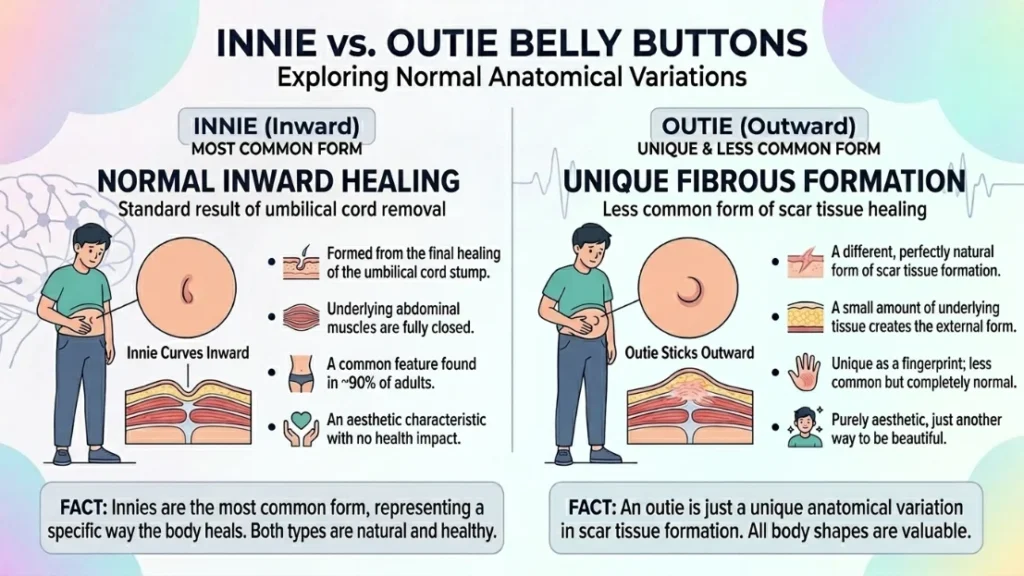

Innie and outie describe belly button types. An innie goes inward, while an outie sticks outward. Both are normal, harmless, and caused by natural healing after birth.
I once heard friends joking about having an “innie” or an “outie,” and I realized many people did not actually know the difference. Some thought an outie meant a medical problem, while others believed belly button type depends on how the umbilical cord is cut. Curious about the truth, I started researching anatomy articles and medical explanations.
That helped me understand that both innies and outies are completely normal body variations. Learning the facts also cleared up many myths I had believed for years. If you have ever wondered whether an innie or outie is better, more common, or medically different, this guide will explain everything clearly with examples, science, myths, and real world facts.
Innie or Outie Quick Answer
An innie is a belly button that curves inward.
An outie is a belly button that sticks outward.
Both are natural and harmless.
Examples
She has an innie belly button.
The baby was born with a small outie.
Innie or Outie Meaning
The words innie and outie describe the shape of a person’s belly button.
Innie
An innie curves inward into the stomach.
It is the most common belly button type.
Outie
An outie sticks outward from the stomach.
It is less common but completely normal in most cases.
Innie or Outie Difference
| Type | Appearance | Commonness | Medical Concern |
|---|---|---|---|
| Innie | Curves inward | Very common | Usually none |
| Outie | Sticks outward | Less common | Usually harmless |
Key Point
Neither type is better or healthier. Both are natural body variations.
What Causes an Innie or Outie
Many people believe doctors create innies or outies by cutting the umbilical cord differently. That is actually a myth.
The real cause is how the belly button heals after birth.
Umbilical Cord Healing
Before birth, a baby receives nutrients through the umbilical cord.
After birth, the cord is cut and the remaining stump dries and falls off.
As the area heals, the skin forms either:
- an inward shape
- or an outward shape
This healing process determines whether someone has an innie or outie.
Why Most People Have Innies
Around 90 percent of people have innies.
There are several reasons for this.
Natural Healing Pattern
Most belly buttons naturally heal inward.
Body Structure
The abdominal wall and skin tissue usually pull inward during healing.
Genetics
Genetics may also influence belly button shape.
Why Some People Have Outies
Outies are less common but still normal.
Extra Scar Tissue
Sometimes extra scar tissue causes the belly button to protrude outward.
Umbilical Hernia
In some cases, babies develop a small umbilical hernia.
This happens when tissue pushes through the abdominal wall.
Most umbilical hernias heal naturally during childhood.
Healing Differences
Every person heals differently, which can affect belly button shape.
The Origin of the Words Innie and Outie
The terms are informal English slang.
Innie
Comes from the word “in,” meaning inward.
Outie
Comes from the word “out,” meaning outward.
These words became popular in everyday conversation and pop culture because they are simple and descriptive.
Innie or Outie in Medical Terms
Doctors usually do not use the words innie and outie in formal medical language.
Instead, they describe:
- inward belly buttons
- protruding belly buttons
- umbilical hernias
However, the terms innie and outie are widely understood by patients and the public.
Are Innies or Outies Better
Neither is better medically.
Health
Both are healthy in most situations.
Appearance
People may prefer one style based on personal opinion.
Function
Belly button shape does not affect digestion, strength, or health.
Common Myths About Innie or Outie
There are many myths about belly buttons.
Myth 1 The Doctor Creates an Outie
False.
The way the cord is cut does not decide belly button type.
Myth 2 Outies Are Dangerous
False.
Most outies are harmless.
Myth 3 Innies Are Cleaner
Not always.
Both types need proper hygiene.
Myth 4 Belly Button Shape Can Be Changed Naturally
False.
Shape is usually permanent unless changed surgically.
Innie or Outie and Hygiene
Both types require cleaning.
Cleaning an Innie
Innies can trap dirt and sweat because they curve inward.
Use warm water and gentle soap.
Cleaning an Outie
Outies are easier to clean but can still collect sweat and bacteria.
Important Tip
Dry the area properly after washing.
Innie or Outie in Babies
Parents often wonder if a baby’s belly button will change over time.
Baby Innies
Most babies naturally develop innies.
Baby Outies
Some babies have temporary protrusions that flatten later.
Umbilical Hernias
Doctors may monitor larger outies to ensure normal healing.
Most heal without treatment.
Innie or Outie and Surgery
Some adults choose cosmetic surgery for belly button appearance.
Umbilicoplasty
This procedure changes the shape of the belly button.
Reasons for Surgery
- cosmetic preference
- hernia repair
- reconstruction after surgery
However, most people never need medical treatment.
Innie or Outie in Everyday Conversation
People commonly use these terms casually.
Social Media Example
I have always had an innie.
Family Conversation Example
The baby has a tiny outie.
Humor and Pop Culture
Movies and television often joke about belly button types.
Innie or Outie in Fashion and Fitness
Belly button appearance sometimes becomes noticeable in fashion and fitness culture.
Swimwear
Belly buttons are more visible in swimsuits.
Fitness Content
Fitness influencers sometimes discuss body confidence and appearance.
Body Positivity
Modern culture increasingly promotes acceptance of all body types.
Innie or Outie and Pregnancy
Pregnancy can temporarily change belly button shape.
Innie During Pregnancy
Some innies become flatter or pop outward.
Outie During Pregnancy
Existing outies may become more noticeable.
After Pregnancy
Most belly buttons return to their previous appearance.
Can an Innie Become an Outie
Sometimes temporary changes happen.
Pregnancy
Pressure can push the belly button outward.
Weight Gain
Body changes may affect appearance.
Hernias
A hernia can create an outie shape.
However, permanent changes are less common without surgery.
Psychological and Social Perception
People often attach social meaning to appearance.
Beauty Standards
Some cultures consider innies more attractive because they are more common.
Confidence
Others proudly embrace outies as unique features.
Important Reminder
Belly button shape does not define beauty or health.
Scientific Facts About Belly Buttons
The belly button is also called the umbilicus.
Purpose Before Birth
It connects the fetus to the umbilical cord.
Purpose After Birth
After healing, it has no major biological function.
Variation
Every belly button is slightly different in size and shape.
Real World Usage of Innie and Outie
In Daily Conversation
He has an outie belly button.
In Parenting Discussions
Parents often ask whether their baby’s outie is normal.
In Health Articles
Medical writers explain that both forms are harmless.
Common Mistakes with Innie or Outie
Mistake 1 Thinking Outies Are Abnormal
Most outies are completely normal.
Mistake 2 Believing Cord Cutting Causes Shape
Healing determines belly button type.
Mistake 3 Ignoring Hygiene
Both types need regular cleaning.
Innie or Outie in Pop Culture
Television and movies often reference belly buttons humorously.
Some celebrities openly discuss body positivity and uniqueness.
Social media trends also encourage acceptance of natural body differences.
Innie or Outie and Google Search Trends
Many people search questions like:
- innie vs outie meaning
- why do people have outies
- are outies normal
- can an outie become an innie
- which is more common innie or outie
This shows strong curiosity about body anatomy and myths.
Exercise 1 Choose the Correct Word
Fill in the blank with innie or outie.
Most people have an ______ belly button.
Answer: innie
The baby developed a small ______ after healing.
Answer: outie
An ______ curves inward.
Answer: innie
Exercise 2 Correct the Sentence
Rewrite the sentence correctly.
An outie always means a serious medical problem.
Answer: Most outies are harmless and normal.
Doctors decide whether a baby gets an innie or outie.
Answer: Healing after birth determines belly button shape.
FAQs
What is the difference between an innie and an outie?
An innie curves inward, while an outie sticks outward. Both are natural belly button shapes.
Are outies rare?
Yes. Most people have innies, while outies are less common.
Can an innie become an outie?
Temporary changes can happen during pregnancy or hernias, but permanent changes are uncommon.
Do doctors create outies when cutting the cord?
No. Belly button shape depends on healing, not cord cutting.
Are outies unhealthy?
Most outies are completely harmless and healthy.
Which is more common, innie or outie?
Innies are far more common than outies.
Can surgery change belly button shape?
Yes. Cosmetic procedures like umbilicoplasty can change appearance.
Do belly buttons have a purpose after birth?
No major biological purpose exists after the umbilical cord heals.
Conclusion
Understanding the difference between innie or outie helps clear up many common myths about belly buttons. An innie curves inward, while an outie sticks outward. Both shapes are natural results of healing after birth and are usually completely harmless.
Many people wrongly believe that doctors determine belly button shape by cutting the umbilical cord differently. In reality, healing patterns, body structure, and sometimes minor hernias affect the final appearance. Most people have innies, but outies are also normal and healthy.
Belly button type does not affect health, strength, or beauty. Modern discussions around body positivity encourage people to accept natural body differences confidently. Whether someone has an innie or an outie, proper hygiene and self confidence matter far more than appearance.
By understanding the facts, examples, and medical explanations in this guide, you can now confidently explain the difference between innies and outies and avoid common misconceptions