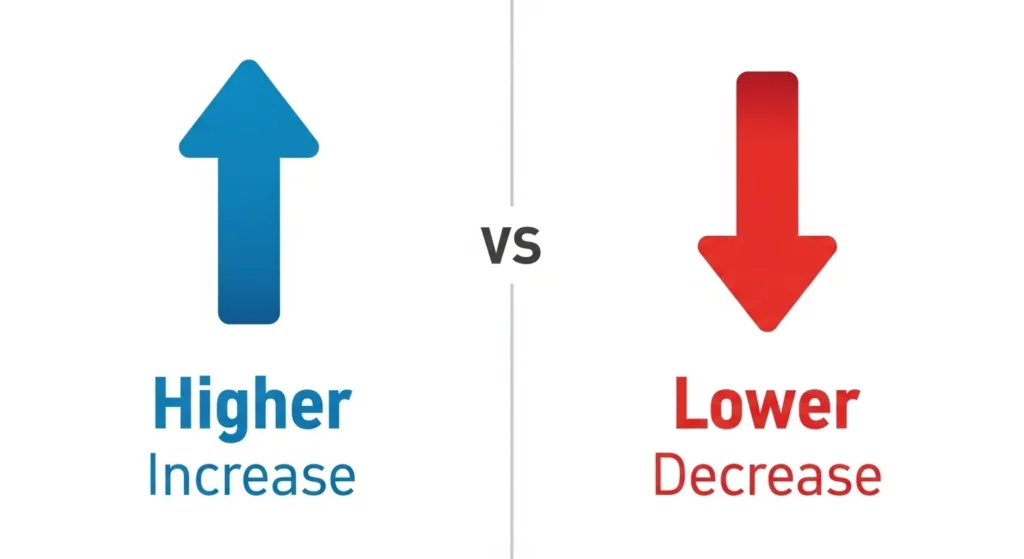

Higher means more in level, amount, or position. Lower means less or below. Use higher for increase and lower for decrease. Example: Prices are higher today. Temperatures are lower tonight.
I once mixed up higher and lower while writing a report about sales trends. I wrote that profits were “lower than last year,” but the data showed the opposite. That mistake taught me how important it is to clearly understand comparison words.
Since then, I’ve paid close attention to context, numbers, and direction before choosing between higher or lower. With practice, I learned that these words are simple but powerful in communication. If you’ve ever hesitated while choosing the right one, this guide will help you understand the difference clearly and use both words confidently in any situation.
Higher or Lower Quick Answer
Higher means more, above, or increased.
Lower means less, below, or decreased.
Examples
- The temperature is higher today.
- The price is lower this week.
Higher or Lower Meaning
Higher
Higher refers to something that is greater in level, value, amount, or position.
Examples
- The mountain is higher than the hill.
- Prices are higher this year.
- His score is higher than mine.
Lower
Lower refers to something that is less in level, value, amount, or position.
Examples
- The valley is lower than the mountain.
- Costs are lower this month.
- Her marks are lower than expected.
Higher or Lower Difference
| Word | Meaning | Direction | Example |
|---|---|---|---|
| Higher | More or above | Upward | Higher prices |
| Lower | Less or below | Downward | Lower costs |
Key Point
Higher = Increase
Lower = Decrease
Grammar Rule Depth
Both higher and lower are comparative adjectives.
They are used to compare two things.
Structure
Subject + verb + higher/lower + than + comparison
Examples
- This building is higher than that one.
- This price is lower than last week.
Without Comparison
They can also be used without “than” when comparison is understood.
Examples
- Prices are getting higher.
- Temperatures are getting lower.
Forms of High and Low
High
- Positive: high
- Comparative: higher
- Superlative: highest
Example
This is the highest building in the city.
Low
- Positive: low
- Comparative: lower
- Superlative: lowest
Example
This is the lowest price available.
Origin of Higher and Lower
Both words come from Old English roots.
High comes from a word meaning tall or elevated.
Low comes from a word meaning short or near the ground.
Over time, they developed comparative forms:
High → higher
Low → lower
These forms are now used in both physical and abstract comparisons.
Why People Confuse Higher and Lower
- Context Confusion
People may not know whether something is increasing or decreasing. - Data Misreading
Graphs and numbers can be misunderstood. - Abstract Use
Words like higher and lower apply to many areas such as price, emotion, and quality.
Real World Usage of Higher and Lower
In Daily Life
- The temperature is higher in summer.
- Water levels are lower during drought.
In Business
- Sales are higher this quarter.
- Expenses are lower this year.
In Education
- His grades are higher than before.
- Her score is lower than expected.
Higher or Lower in Different Contexts
Numbers and Data
- Higher income
- Lower costs
Physical Position
- Higher floor
- Lower ground
Quality and Level
- Higher quality
- Lower standard
Sound and Volume
- Higher pitch
- Lower volume
Higher or Lower in Everyday Examples
Emails
- Our revenue is higher this month.
- The cost is lower than expected.
News
- Oil prices are higher today.
- Inflation rates are lower this year.
Social Media
- My energy is higher today.
- Stress levels feel lower now.
Formal Writing
- The study shows higher productivity.
- Results indicate lower error rates.
Common Mistakes with Higher or Lower
Mistake 1 Using Wrong Direction
Incorrect
Prices are lower when they increased.
Correct
Prices are higher.
Mistake 2 Confusing Context
Incorrect
The mountain is lower than the hill.
Correct
The mountain is higher than the hill.
Mistake 3 Missing Comparison
Incorrect
This price is higher. (unclear)
Better
This price is higher than last week.
Higher or Lower in Data and Graphs
Understanding charts is important.
Upward Trend
Use higher
Example
The graph shows higher sales over time.
Downward Trend
Use lower
Example
The chart shows lower costs after 2023.
Higher or Lower in Business and Finance
Revenue
Higher revenue means growth.
Lower revenue means decline.
Costs
Higher costs reduce profit.
Lower costs increase profit.
Investment
Higher returns are preferred.
Lower risk is safer.
Higher or Lower in Health and Science
Health
Higher blood pressure can be risky.
Lower sugar levels may be healthy.
Science
Higher temperature increases reaction speed.
Lower pressure changes conditions.
Higher or Lower Idioms and Expressions
Higher Expressions
- Higher level
- Higher authority
- Higher standard
Lower Expressions
- Lower your voice
- Lower expectations
- Lower risk
Tips to Remember Higher or Lower
Think direction.
Up = Higher
Down = Lower
Ask yourself
Is it increasing or decreasing
This simple check prevents mistakes.
Usage Trends
Both words are extremely common in English.
They are used in
Business reports
Academic writing
Daily conversations
News articles
Clear usage improves communication accuracy.
Exercise 1 Choose the Correct Word
- The price is ______ this week.
Answer: higher - The temperature is ______ at night.
Answer: lower - His score is ______ than mine.
Answer: higher - The water level is ______ this year.
Answer: lower
Exercise 2 Correct the Sentence
- The mountain is lower than the hill.
Answer: The mountain is higher than the hill. - Prices are lower when they increased.
Answer: Prices are higher when they increased.
FAQs
What is the difference between higher and lower?
Higher means more or above, while lower means less or below.
When should I use higher?
Use higher when something increases in level, amount, or value.
When should I use lower?
Use lower when something decreases in level, amount, or value.
Are higher and lower comparative adjectives?
Yes, they compare two things.
Can they be used without “than”?
Yes, when the comparison is already clear.
Why do people confuse higher and lower?
Because they depend on context and direction.
Are these words used in business writing?
Yes, they are commonly used in reports and analysis.
Conclusion
Understanding higher or lower is essential for clear communication in English. These words may seem simple, but they carry strong meaning in comparisons, data analysis, and everyday conversation. Higher indicates an increase or upward movement, while lower shows a decrease or downward direction.
Many mistakes happen when context is unclear or data is misunderstood. By focusing on direction and comparison, you can avoid these errors easily. Practice using these words in sentences, emails, and reports to build confidence.
A simple rule to remember is: higher means more, lower means less. This guideline will help you choose the correct word every time and improve both your writing and speaking skills.