
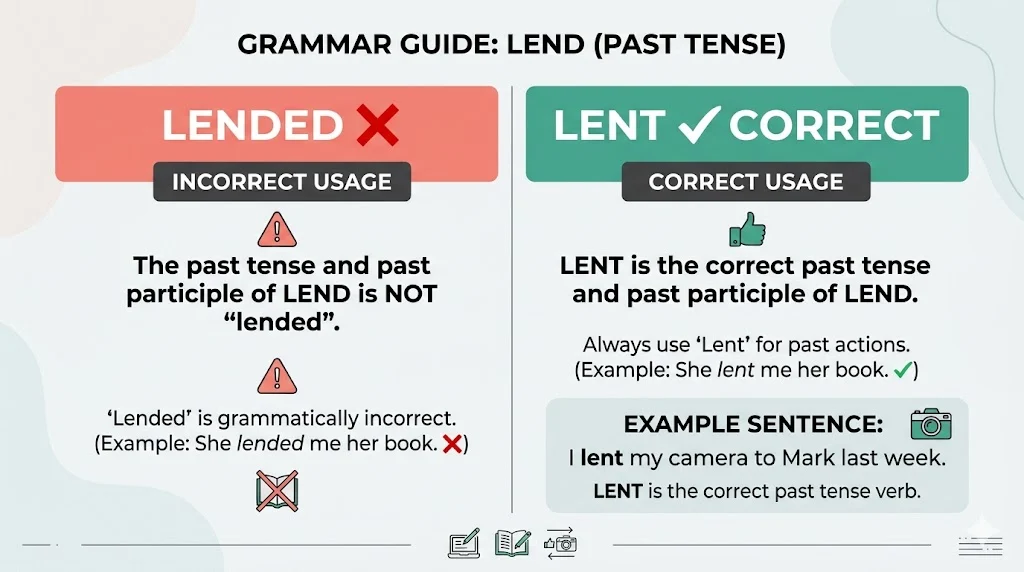
Lent is the correct past tense of lend, while lended is incorrect in standard English. Use lent in all formal and informal writing. Example: She lent me money yesterday.
I used to write lended in emails without thinking twice. It sounded natural, especially when speaking fast. One day, while reviewing a report, I noticed it looked wrong. I checked grammar rules and learned that lend is an irregular verb, and its correct past form is lent, not lended.
After practicing this rule and correcting my writing habits, the mistake disappeared. Now I always double check irregular verbs when writing professionally.
If you have ever been confused between lended vs lent, this guide will help you understand the correct usage clearly and avoid common mistakes.
Lended vs Lent Quick Answer
Lent is the correct past tense and past participle of lend.
Lended is incorrect in modern standard English.
Examples
Correct
She lent me her book.
Incorrect
She lended me her book.
Lended vs Lent Meaning
Lend
To give something to someone temporarily with the expectation that it will be returned.
Example
I will lend you my laptop.
Lent
Past form of lend.
Example
He lent me his car yesterday.
Lended
Not accepted in standard English grammar.
Lended vs Lent Difference
| Word | Meaning | Correct Usage | Example |
|---|---|---|---|
| Lent | Past of lend | Correct | She lent money |
| Lended | Incorrect form | Not used | ❌ She lended money |
Key Point: Always use lent, never use lended.
Grammar Rule Depth
Lend Is an Irregular Verb
Irregular verbs do not follow the regular “ed” pattern.
Verb Forms
| Base | Past | Past Participle |
|---|---|---|
| Lend | Lent | Lent |
Examples
- Present: I lend him money.
- Past: I lent him money.
- Perfect: I have lent him money.
Why Lended Is Wrong
Regular verbs use “ed”
Example: walk → walked
But irregular verbs change form
Example: lend → lent
So “lended” breaks the rule.
The Origin of Lend and Lent
The word lend comes from Old English lǣnan, meaning “to grant or give temporarily.”
Over time, its past form evolved into lent, following irregular verb patterns common in English.
Many similar verbs follow this pattern:
- send → sent
- spend → spent
- bend → bent
This pattern explains why lent is correct and natural.
Why People Say Lended Instead of Lent
1. Regular Verb Habit
Many learners apply the “ed” rule automatically.
2. Spoken Language Influence
In casual speech, “lended” may sound natural.
3. Lack of Irregular Verb Knowledge
Learners may not memorize irregular forms.
Real World Usage of Lent
Everyday Conversation
I lent him my charger.
Business Communication
The company lent funds to support the project.
Academic Writing
The research study lent credibility to the theory.
Financial Context
The bank lent money to the client.
Lent in Everyday Examples
Emails
I lent the documents to the manager yesterday.
News
The organization lent support to the campaign.
Social Media
I lent my friend my car for the weekend.
Formal Writing
The evidence lent strength to the argument.
Common Mistakes with Lended vs Lent
Mistake 1 Using Lended
Incorrect
She lended me money.
Correct
She lent me money.
Mistake 2 Mixing Verb Forms
Incorrect
I have lended him books.
Correct
I have lent him books.
Mistake 3 Confusing With Borrow
Incorrect
I lent money from him.
Correct
I borrowed money from him.
Lend vs Borrow Clarification
Lend
You give something.
Example
I lent him money.
Borrow
You receive something.
Example
I borrowed money from him.
Lended vs Lent in Different Contexts
Instructions
Lend your notes if needed.
Past Actions
She lent her phone to a friend.
Descriptions
The results lent support to the claim.
Related Words and Similar Patterns
Similar Irregular Verbs
| Base | Past |
|---|---|
| Send | Sent |
| Spend | Spent |
| Bend | Bent |
Key Insight
These patterns help remember that lend → lent is correct.
Usage Trends
Modern English strongly prefers lent.
The form lended is considered incorrect in:
Academic writing
Business communication
Professional documents
Exercise 1 Choose the Correct Word
- She ______ me her book yesterday.
Answer: lent - I have ______ him money before.
Answer: lent - The bank ______ funds to the company.
Answer: lent
Exercise 2 Correct the Sentence
- He lended me his phone.
Answer: He lent me his phone. - I have lended her money.
Answer: I have lent her money.
FAQs
Is lended correct in English?
No, lended is not correct in standard English. The correct past form is lent.
What is the past tense of lend?
The past tense of lend is lent.
Why do people say lended?
Because they apply regular verb rules incorrectly or follow spoken habits.
Is lent used in formal writing?
Yes, lent is used in both formal and informal writing.
What is the difference between lend and lent?
Lend is present tense, while lent is past tense and past participle.
Can I ever use lended?
No, it is not accepted in standard grammar.
What is the past participle of lend?
The past participle is also lent.
Conclusion
The difference between lended vs lent is simple but important. Lent is the correct past form of lend, while lended is incorrect in standard English. This confusion happens because many verbs use “ed” in the past tense, but lend is an irregular verb.
By remembering patterns like send → sent and spend → spent, you can easily recall that lend → lent follows the same rule. Using the correct form improves your writing clarity and professionalism.
Whether you are writing emails, academic papers, or daily messages, always choose lent. Avoiding this common mistake will make your English more accurate and polished.