
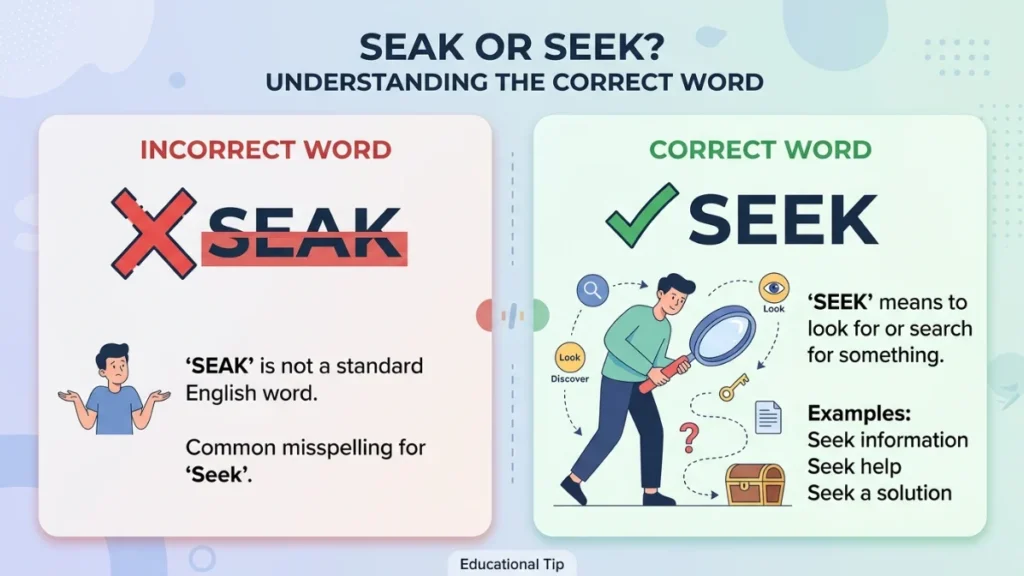

Seek is the correct English word. It means to look for, try to find, or ask for something. Seak is a spelling mistake and is not standard English.
I once wrote seak instead of seek in an email. I was writing quickly and did not notice the mistake until I read the sentence again. At first, I thought both spellings looked possible because they sound similar when spoken fast. That small mistake made me check dictionaries, usage examples, and grammar references. I quickly learned that seek is the only correct spelling, while seak is simply a common writing error.
After that, I started noticing how often the word appears in business emails, formal writing, and daily conversation. If you have ever paused while typing seak or seek, this guide will help you understand the correct spelling, meaning, grammar, and real-world usage with complete clarity.
Seak or Seek Quick Answer
The correct word is seek.
Seek means to look for something, try to get something, or ask for something.
Seak is not a correct English word. It is simply a spelling mistake.
Quick Examples
- Many students seek better learning opportunities.
- She decided to seek advice from her teacher.
- We seek answers when we feel confused.
Incorrect:
- He wants to seak help.
Correct:
- He wants to seek help.
Seak or Seek Meaning
The confusion usually begins because people hear the word and then guess the spelling.
What Does Seek Mean
Seek is a verb.
It means:
- to look for something
- to try to obtain something
- to ask for something
- to search for something carefully
Simple Meaning
When you seek something, you want to find it or get it.
Examples
- They seek peace.
- She seeks a new job.
- We seek truth.
- He sought help when he felt lost.
Is Seak a Real Word
No.
Seak is not accepted in standard English dictionaries.
People usually write seak because it sounds similar to speak, break, or sneak, but that spelling is incorrect.
Seak or Seek Difference
| Word | Meaning | Correct or Incorrect | Example |
|---|---|---|---|
| Seek | To look for or try to get | Correct | Seek help |
| Seak | No accepted meaning | Incorrect | Not standard English |
Key Point
If you are writing about searching, asking, or trying to find something, always use seek.
Why People Confuse Seak and Seek
Many spelling mistakes happen because English pronunciation does not always match spelling.
Similar Sound Patterns
English has words like:
- speak
- sneak
- break
- steak
Because of these familiar patterns, many people assume seak might also be correct.
Fast Typing
A lot of people make the mistake while typing quickly.
Memory Confusion
Writers often remember how the word sounds but forget the exact spelling.
Common Learner Error
English learners often rely on sound. Since English spelling is not always phonetic, mistakes like seak happen often.
Grammar Rule Depth
Understanding how seek works grammatically helps remove confusion.
Seek Is a Verb
It is an action word.
Base Form
seek
Third Person Singular
seeks
Past Tense
sought
Past Participle
sought
Present Participle
seeking
| Form | Example |
|---|---|
| seek | I seek advice |
| seeks | She seeks truth |
| sought | He sought help |
| sought | They have sought answers |
| seeking | We are seeking support |
Examples
- I seek better opportunities.
- She seeks honest feedback.
- He sought medical help.
- They are seeking solutions.
Why This Matters
Many learners know seek, but they also make mistakes with sought. Understanding the full verb family makes your writing stronger.
The Origin of Seek
The word seek is very old.
It comes from Old English sēcan, which meant:
- to search for
- to inquire
- to pursue
For hundreds of years, English speakers have used seek to describe searching, asking, and trying to obtain something.
That long history explains why the spelling stayed stable.
Seak, however, never became an accepted standard spelling.
Why Seek Is the Correct Spelling
English often preserves older spelling patterns.
Historical Consistency
The spelling seek has existed for centuries.
Dictionary Standard
All major dictionaries recognize seek.
Writing Conventions
Academic writing, professional writing, journalism, and books all use seek.
Important Note
Even though seak may look possible, it does not follow accepted usage.
What Does Seek Mean in Different Contexts
The word changes slightly depending on context.
Seek Information
To try to learn something.
Example:
- Journalists seek facts before publishing stories.
Seek Help
To ask for assistance.
Example:
- Students should seek help when they do not understand.
Seek Permission
To ask formally.
Example:
- Employees must seek approval before making major changes.
Seek Opportunity
To try to obtain something better.
Example:
- Many people seek better career opportunities.
Seek Peace
To pursue a goal.
Example:
- Nations often seek peace during conflict.
Real World Usage of Seek
In Business
The word appears often in professional writing.
Examples:
- We seek new partnerships.
- The company seeks talented employees.
- Investors seek long-term growth.
In Education
Examples:
- Students seek knowledge.
- Researchers seek evidence.
- Teachers seek better learning methods.
In Law
Examples:
- The lawyer seeks justice.
- The court may seek more evidence.
In Healthcare
Examples:
- Patients should seek medical advice.
- Doctors seek the cause of symptoms.
Seek in Everyday Conversation
People use seek in formal and informal situations.
Casual Use
- I need to seek better options.
- She wants to seek answers.
Formal Use
- We seek clarification regarding the proposal.
- They seek permission to proceed.
Seek in Emails
The word appears very often in professional emails.
Examples
- I am writing to seek your approval.
- We seek clarification on the project deadline.
- I would like to seek your guidance on this issue.
This is why knowing the correct spelling matters.
A small spelling mistake in an email can make writing look careless.
Seek in News Writing
Journalists use the word often.
Examples
- Officials seek new solutions.
- Police seek witnesses.
- Leaders seek peace talks.
- Authorities seek public cooperation.
Seek in Academic Writing
Academic writing often uses seek because it sounds precise.
Examples
- This study seeks to understand consumer behavior.
- Researchers seek new evidence.
- The report seeks to explain the results.
Common Mistakes with Seak or Seek
Mistake 1 Writing Seak
Incorrect:
- I seak advice.
Correct:
- I seek advice.
Mistake 2 Wrong Past Tense
Incorrect:
- He seeked help.
Correct:
- He sought help.
Mistake 3 Wrong Verb Form
Incorrect:
- She is seak answers.
Correct:
- She is seeking answers.
Why Seek Matters in Professional Writing
Words like seek, request, ask, and obtain appear often in professional communication.
Using the correct spelling matters because:
- it improves clarity
- it shows attention to detail
- it builds trust
- it avoids distraction
Example
Incorrect:
- We seak your approval.
Correct:
- We seek your approval.
The second sentence feels polished and credible.
Seek vs Search
People often ask about this too.
Seek
Usually more formal and often connected to goals, answers, or permission.
Search
Usually more physical or direct.
Examples
- I seek truth.
- I search the room.
Quick Difference
| Word | Typical Meaning |
|---|---|
| Seek | Try to obtain or find |
| Search | Look physically or carefully |
Related Words to Seek
Learning related words helps deepen understanding.
Seek Related Forms
- seeking
- seeker
- sought
Examples
- He is seeking a solution.
- She is a truth seeker.
- They sought help immediately.
Common Expressions with Seek
Seek Help
- Always seek help when needed.
Seek Advice
- She decided to seek advice from her mentor.
Seek Permission
- They must seek permission first.
Seek Justice
- Families often seek justice after tragedy.
Seek Answers
- Curious minds always seek answers.
Why Seak Looks Correct to Some Writers
This happens because of visual analogy.
People know words like:
- speak
- steak
- sneak
- break
So they unconsciously copy that pattern.
But English does not always follow a single spelling rule.
That is why seek stays correct.
Memory Trick to Remember Seek
A simple trick helps.
Think of EE in Seek
The double ee can remind you of eyes looking for something.
Seek = looking with your eyes
That makes the spelling easier to remember.
Seak or Seek in Everyday Examples
Social Media
- People often seek attention online.
- Many users seek honest reviews before buying.
Workplace
- Employees seek growth opportunities.
- Managers seek better solutions.
School
- Students seek understanding.
- Teachers seek better results.
Family
- Children often seek comfort from parents.
Usage Trends
The spelling seek appears widely in:
- books
- newspapers
- websites
- academic papers
- business communication
The spelling seak mostly appears as a typo.
That means professional writing always favors seek.
Advanced Usage of Seek
As your English improves, you will notice more formal uses.
Seek to
Means “try to.”
Examples:
- The company seeks to improve customer service.
- This article seeks to explain the difference.
Seek out
Means “actively look for.”
Examples:
- She sought out expert advice.
- Good leaders seek out feedback.
Seak or Seek in Formal Writing
Formal writing often uses seek because it sounds professional.
Examples
- We seek further clarification.
- The committee seeks public input.
- This research seeks to answer key questions.
Using seak in these contexts would look incorrect.
Exercises
Exercise 1 Choose the Correct Word
Fill in the blanks with seak or seek.
I want to ______ better opportunities.
Answer: seek
They ______ peace after conflict.
Answer: seek
Students often ______ help before exams.
Answer: seek
We ______ honest feedback from customers.
Answer: seek
She wants to ______ advice from her teacher.
Answer: seek
Exercise 2 Correct the Sentence
Rewrite the sentence correctly.
He wants to seak help.
Answer: He wants to seek help.
The company seaks new employees.
Answer: The company seeks new employees.
She seeked advice before deciding.
Answer: She sought advice before deciding.
They are seak answers online.
Answer: They are seeking answers online.
Exercise 3 Choose the Correct Verb Form
He ______ help yesterday.
Answer: sought
We are ______ a better solution.
Answer: seeking
She ______ peace in difficult times.
Answer: seeks
FAQs
Is it seak or seek?
The correct spelling is seek. Seak is a spelling mistake.
What does seek mean?
Seek means to look for something, try to get something, or ask for something.
Is seak a real English word?
No. It is not standard English.
Why do people write seak?
People often write seak because English has similar-looking words like speak, sneak, and steak.
What is the past tense of seek?
The past tense of seek is sought.
Can I say seek help?
Yes. Seek help is a very common and correct phrase.
What is the difference between seek and search?
Seek often means trying to obtain or find something abstract. Search usually means physically looking for something.
Is seek formal or informal?
Seek is often slightly more formal, but it is common in everyday English too.
Conclusion
The confusion between seak or seek is common, especially because English spelling can be tricky. Words that sound similar often look different, and this creates uncertainty for many writers.
The important rule is simple: seek is the correct spelling.
It means to look for something, try to obtain something, ask for help, or pursue a goal.
Seak is not standard English.
Understanding this difference helps improve everyday writing, professional emails, academic work, and formal communication.
A useful way to remember it is to think of the double ee in seek as eyes searching for something.
Once you connect the spelling with the meaning, the confusion becomes much easier to avoid.
Whether you seek advice, seek answers, seek help, or seek opportunity, using the correct spelling makes your writing clearer, stronger, and more professional.