
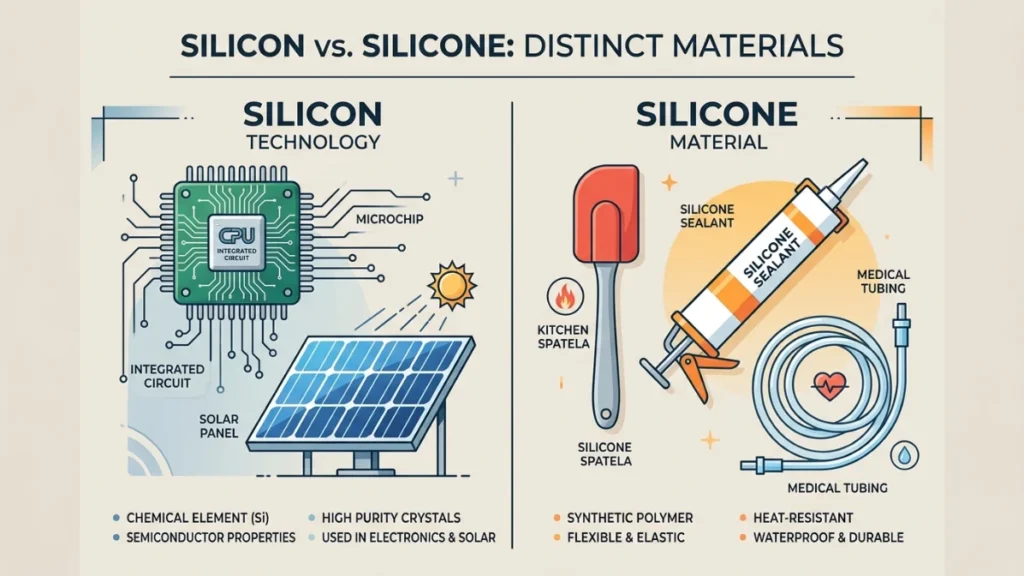

Silicon is a natural chemical element used in electronics and computer chips. Silicone is a synthetic material used in sealants, cookware, and medical products.
I once used silicone when writing about computer chips in a draft article. It looked fine until an engineer pointed it out. That small mistake mattered because silicon and silicone sound similar but mean very different things. To fix it, I checked technical sources, product labels, and real usage examples.
The rule became simple: silicon belongs to technology and chemistry, while silicone belongs to materials and everyday products. Since then, I always double-check the context first. If you have ever paused while writing these words, this guide will make the difference clear and easy to remember.
Silicone or Silicon Quick Answer
Silicon is a natural chemical element. It is used in semiconductors, computer chips, solar panels, and electronics.
Silicone is a man made polymer. It is used in sealants, bakeware, medical tubes, adhesives, and personal care products.
Quick Examples
The company designs silicon chips for smartphones.
This spatula is made from heat-resistant silicone.
Silicone or Silicon Meaning
Although the words look almost the same, they belong to very different fields.
Silicon
Silicon is a chemical element with the symbol Si and atomic number 14. It is found naturally in sand, rocks, and minerals. After oxygen, it is one of the most abundant elements in Earth’s crust.
In modern life, silicon matters because it is a semiconductor. That means it can conduct electricity under controlled conditions, which makes it essential in electronics.
Silicone
Silicone is a synthetic polymer made from silicon, oxygen, carbon, and hydrogen. It is flexible, heat-resistant, water-resistant, and durable.
Manufacturers use silicone when they need a material that can bend, seal, protect, or withstand high temperatures.
Silicone or Silicon Difference
| Word | Meaning | Type | Common Use |
|---|---|---|---|
| Silicon | Natural chemical element | Element | Chips, semiconductors, solar panels |
| Silicone | Synthetic polymer material | Material | Sealants, bakeware, medical devices |
Simple Rule
If you are talking about technology, the word is usually silicon.
If you are talking about materials or flexible products, the word is usually silicone.
The Origin of Silicone and Silicon
Understanding the history makes the difference easier to remember.
Origin of Silicon
The word silicon comes from the Latin word silex, meaning flint or hard stone. Scientists in the nineteenth century named the element after its connection to mineral compounds found in rocks and sand.
Origin of Silicone
The word silicone appeared later. Chemists used it to describe a class of synthetic compounds based partly on silicon.
Even though silicone comes from silicon, they are not the same thing.
That relationship causes much of the confusion.
Why People Confuse Silicone and Silicon
Many people mix these words up for simple reasons.
Similar Spelling
The only visible difference is the extra e at the end of silicone.
Similar Pronunciation
In everyday speech, many people pronounce them very similarly.
Related Chemistry
Silicone is partly made from silicon, so people assume the words are interchangeable.
Media Influence
People often hear phrases like Silicon Valley, but then see products labeled silicone sealant. The brain links the two words even though the meanings are different.
Grammar Rule and Usage Pattern
These words are both nouns, but they belong to different semantic categories.
Silicon Is Usually Used in Scientific and Technical Contexts
Example
Silicon is widely used in microprocessors.
Silicone Is Usually Used in Material and Product Contexts
Example
The mold is made of food-grade silicone.
Important Rule
You cannot normally replace one with the other.
Incorrect
The engineer developed a new silicone chip.
Correct
The engineer developed a new silicon chip.
Incorrect
The baker used silicon molds.
Correct
The baker used silicone molds.
What Is Silicon in Detail
Silicon has transformed modern civilization.
In Nature
Silicon is not usually found in pure form in nature. It exists mainly in compounds such as silica, which is common in sand and quartz.
Silicon in Electronics
The biggest reason silicon matters is its use in semiconductors.
Semiconductors help control electrical current. This property makes silicon useful in:
Computer processors
Memory chips
Transistors
Integrated circuits
Solar cells
Why Silicon Works So Well
Silicon is stable, widely available, and can be purified relatively efficiently. That combination made it the backbone of modern electronics.
What Is Silicone in Detail
Silicone is not a single product. It is a family of synthetic polymers.
Properties of Silicone
Silicone is known for being:
Flexible
Heat resistant
Water resistant
Durable
Chemically stable
Common Silicone Products
Silicone appears in many everyday objects.
Kitchen spatulas
Bakeware
Sealants
Caulking materials
Phone cases
Medical tubing
Baby bottle nipples
Cosmetics
Why Silicone Is Popular
Manufacturers like silicone because it handles heat and moisture without breaking down easily.
Silicone or Silicon in Real World Usage
Technology
A smartphone contains silicon chips that process data.
Construction
Builders often use silicone sealants around windows.
Medical Industry
Doctors may use silicone tubes or implants.
Renewable Energy
Solar panels use silicon cells to convert sunlight into electricity.
Cooking
Heat-resistant baking molds are usually made of silicone.
Silicon in Technology and the Meaning of Silicon Valley
One of the most famous examples of the word is Silicon Valley.
Silicon Valley is a region in California known for technology companies and semiconductor innovation.
The area got its name because many early firms produced silicon-based chips.
That means the name refers to silicon, not silicone.
A common mistake is writing Silicone Valley, which is incorrect.
Correct
Many startups began in Silicon Valley.
Incorrect
Many startups began in Silicone Valley.
Silicone in Everyday Products
Silicone appears in many places people rarely notice.
Kitchen Products
Silicone baking mats
Silicone spatulas
Silicone muffin trays
Bathroom and Home
Silicone sealants
Silicone waterproof coatings
Personal Care
Silicone appears in shampoos, skin products, and cosmetics because it helps create a smooth texture.
Medical Use
Silicone is widely used in medical-grade products because it is flexible and chemically stable.
Silicone or Silicon in Business Writing
Writers often confuse these terms in business articles.
Correct Business Examples
The startup develops silicon chips for electric vehicles.
The company manufactures silicone adhesives for industrial use.
Why Accuracy Matters
In technical writing, mixing these terms can hurt credibility.
If a product report says silicone microprocessor, experts notice the mistake immediately.
Silicone or Silicon in News and Media
Journalists use both words often, but context decides which one fits.
Technology News
The company announced a new silicon processor.
Consumer Product News
The brand launched a new line of silicone kitchen tools.
Industry Reports
Solar energy demand increased the need for silicon wafers.
Common Mistakes with Silicone or Silicon
Mistake 1 Using Silicone for Electronics
Incorrect
The laptop uses advanced silicone chips.
Correct
The laptop uses advanced silicon chips.
Mistake 2 Using Silicon for Flexible Products
Incorrect
The baby bottle nipple is made from silicon.
Correct
The baby bottle nipple is made from silicone.
Mistake 3 Confusing Silicon Valley
Incorrect
Silicone Valley is home to major tech firms.
Correct
Silicon Valley is home to major tech firms.
How to Remember the Difference
A simple memory trick helps.
Silicon Ends with “on”
Think of electronics turned on.
That connects silicon with technology.
Silicone Ends with “one”
Think of soft material in one piece.
That connects silicone with flexible products.
Another easy rule:
Chips use silicon. Spatulas use silicone.
Related Words That Cause Similar Confusion
Learning similar word pairs can strengthen your language accuracy.
Commonly Confused Scientific Words
affect and effect
adapt and adopt
metal and mettle
minerals and materials
These pairs cause confusion because spelling is close but meaning changes completely.
Silicone or Silicon Usage Trends
In modern English, both words are widely used but in very different contexts.
Where Silicon Appears Most
Technology journalism
Engineering
Semiconductor manufacturing
Academic science writing
Where Silicone Appears Most
Home improvement
Consumer products
Medical products
Beauty and cosmetics
When you search online, product listings usually show silicone, while technology reports usually show silicon.
Silicone or Silicon in Everyday Examples
Please order more silicone sealant for the repair.
Office Report
The company plans to expand silicon chip production.
Social Media
I bought new silicone baking molds today.
News
Global demand for silicon wafers increased this year.
Formal Writing
Silicon remains essential in semiconductor manufacturing.
Exercise 1 Choose the Correct Word
Fill in the blanks with silicon or silicone.
The smartphone uses a powerful ______ processor.
Answer: silicon
The chef used a heat-resistant ______ spatula.
Answer: silicone
Solar panels contain purified ______ cells.
Answer: silicon
The plumber applied ______ sealant around the sink.
Answer: silicone
Exercise 2 Correct the Sentence
Rewrite the sentence using the correct word.
The company develops advanced silicone chips.
Answer: The company develops advanced silicon chips.
The baker bought new silicon molds.
Answer: The baker bought new silicone molds.
Silicone Valley attracts tech investors.
Answer: Silicon Valley attracts tech investors.
Frequently Asked Questions
What is the difference between silicone and silicon?
Silicon is a natural chemical element used in electronics. Silicone is a synthetic polymer used in sealants, cookware, medical products, and flexible materials.
Is silicone made from silicon?
Yes. Silicone is partly made using silicon, but the final material is very different in structure and use.
Is Silicon Valley spelled with silicon or silicone?
It is spelled Silicon Valley, because the name refers to semiconductor technology.
Which word is used for computer chips?
The correct word is silicon.
Which word is used for kitchen tools?
The correct word is silicone.
Can silicone conduct electricity like silicon?
No. Silicon is used in semiconductors. Silicone is generally used as an insulating material.
Why do people confuse silicone and silicon?
Because the words look and sound similar, and silicone is chemically related to silicon.
Conclusion
The difference between silicone and silicon is small in spelling but huge in meaning.
Silicon is a natural chemical element. It plays a central role in electronics, semiconductors, solar panels, and modern computing. Without silicon, today’s digital world would look very different.
Silicone is a synthetic polymer. It appears in kitchens, homes, medical equipment, cosmetics, and industrial products because it is flexible, durable, and heat resistant.
Many writers confuse the two words because they sound alike and share a chemical connection. But the practical rule is simple:
Technology uses silicon. Everyday flexible products use silicone.
Once you connect silicon with chips and silicone with sealants, the difference becomes much easier to remember.
Using the correct term matters, especially in technical writing, product descriptions, journalism, and professional communication. A small spelling difference can completely change the meaning of a sentence.