
Human or not refers to identifying whether a response, behavior, or interaction comes from a real person or artificial intelligence. It is commonly used in online chats, games, and AI detection contexts.
I first faced the human or not problem while chatting online. The replies felt fast and perfect, but something seemed off. I wondered if I was talking to a real person or an AI. That moment made me realize how difficult it has become to tell the difference.
I started testing responses, asking unexpected questions, and observing patterns. Over time, I learned key signs that help identify whether something is human or not. If you have ever doubted a message, review, or chat response, this guide will help you understand the difference clearly and confidently.
Human or Not Quick Answer
Human means a real person with emotions, imperfections, and natural responses.
Not human usually refers to AI, bots, or automated systems that generate responses based on data and algorithms.
Examples
- A real person shares personal experiences and emotions.
- An AI provides fast, structured, and often neutral responses.
Human or Not Meaning
Human
A human is a real individual capable of thinking, feeling, and reacting based on personal experience.
Example
A human might say, “I felt nervous during the interview because I really wanted the job.”
Not Human
“Not human” typically refers to artificial systems like AI, bots, or automated programs.
Example
An AI might say, “Interviews can be stressful. Preparation helps improve performance.”
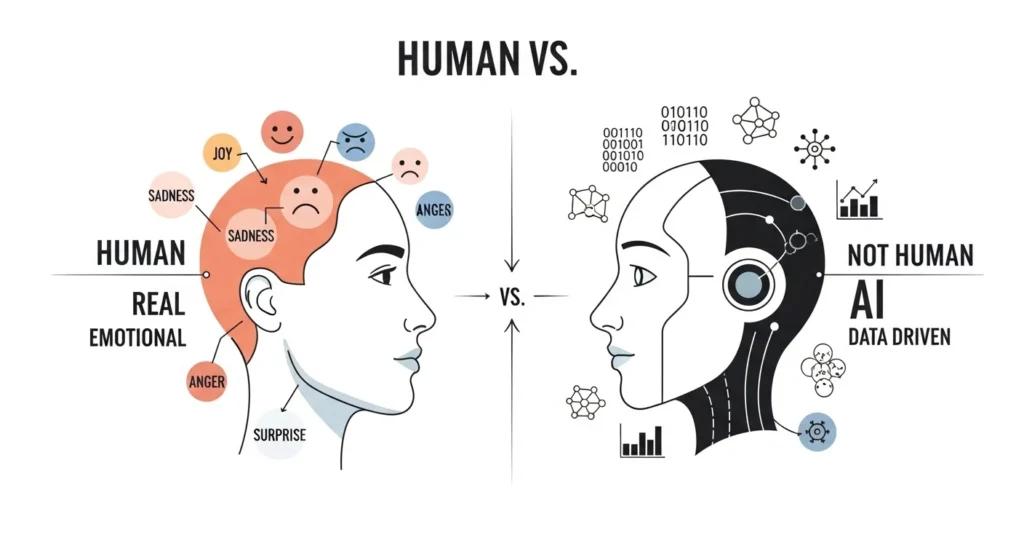
Human vs Not Human Difference
| Aspect | Human | Not Human |
|---|---|---|
| Emotion | Real and personal | Simulated or neutral |
| Speed | Slower, natural | Very fast |
| Mistakes | Common | Rare or patterned |
| Creativity | Personal and unique | Pattern-based |
| Context | Based on experience | Based on data |
Key Point
Humans rely on experience and emotion. AI relies on patterns and data.
Grammar Rule Depth
The phrase human or not is often used as a question or comparison rather than a strict grammar structure.
As a Question
“Is this human or not?”
As a Concept
It is commonly used in AI discussions, online safety, and content verification.
Usage Forms
- Human or not
- Is it human or not
- Human vs AI
- Real or bot
The Origin of Human or Not
The phrase became popular with the rise of artificial intelligence, chatbots, and online interactions.
Early Context
Before AI, people rarely questioned whether something was human.
Modern Context
With AI tools, bots, and automated systems, users now frequently ask whether content or responses are human or generated.
The phrase gained popularity in:
Online chat platforms
Customer support systems
AI detection tools
Social media discussions
Why People Ask Human or Not
Rise of AI
AI systems can now write, chat, and respond like humans.
Online Safety
Users want to know if they are interacting with a real person or a bot.
Trust and Authenticity
People trust human experiences more than automated responses.
Content Quality
Some users want original human content rather than AI generated text.
Real World Usage of Human or Not
Online Chat
Users question if they are talking to a real person.
Example
I cannot tell if this support agent is human or not.
Customer Support
Companies use bots for quick responses.
Example
The replies were instant, so I wondered if it was human or not.
Social Media
People question comments, reviews, or messages.
Example
This review feels fake. Is it human or not?
Gaming
Some games challenge players to identify AI.
Example
The game asks you to guess if the player is human or not.
Human or Not in Everyday Examples
Emails
The response was so fast that I wondered if it was human or not.
News
Experts discuss how AI makes it harder to know if content is human or not.
Social Media
This account posts nonstop. Is it human or not?
Formal Writing
The study examines whether users can distinguish between human and AI generated responses.
Signs to Identify Human or Not
Human Signs
- Personal stories
- Emotional language
- Small mistakes
- Unique opinions
- Slower responses
Not Human Signs
- Very fast replies
- Perfect grammar every time
- Repetitive patterns
- Neutral tone
- Lack of personal experience
Advanced Analysis of Human vs AI Behavior
Language Patterns
Humans often use incomplete sentences, slang, or emotional expressions.
AI tends to use structured and balanced sentences.
Context Understanding
Humans may misunderstand context or ask follow-up questions.
AI often gives complete answers quickly.
Emotional Depth
Humans express real emotions.
AI simulates emotions but may lack depth.
Common Mistakes with Human or Not
Mistake 1 Assuming Speed Means AI
Fast responses can be human.
Mistake 2 Assuming Perfect Grammar Means AI
Some humans write perfectly.
Mistake 3 Ignoring Context
You must analyze multiple signals, not just one.
Human or Not in Digital Marketing
Content Creation
Businesses want human sounding content.
AI Tools
AI generates blogs, emails, and ads.
User Trust
Audiences prefer authentic human tone.
Human or Not in Security and Technology
Bot Detection
Websites detect bots to prevent spam.
AI Moderation
Platforms analyze content to identify automated behavior.
Verification Systems
CAPTCHA tests are used to confirm human users.
Related Concepts
Artificial Intelligence
Systems that simulate human intelligence.
Chatbots
Programs designed to interact with users.
Automation
Processes that run without human input.
Usage Trends
The phrase human or not is increasing in popularity due to:
AI growth
Online communication
Content automation
Digital trust concerns
Exercise 1 Choose the Correct Meaning
Identify if the example is human or not.
The response shares a personal story about childhood.
Answer: human
The reply is instant and structured with no emotion.
Answer: not human
The message includes spelling mistakes and emotions.
Answer: human
Exercise 2 Analyze the Sentence
Decide if the response sounds human or not.
The system provides a detailed but neutral explanation.
Answer: not human
The person shares feelings and personal opinions.
Answer: human
FAQs
What does human or not mean?
It refers to identifying whether something is created or done by a real person or an AI system.
Why is it hard to tell human or not?
AI has become advanced and can mimic human language and behavior very closely.
Can AI sound like a human?
Yes, modern AI can generate responses that feel very natural and human like.
How can I identify a human response?
Look for emotions, personal experiences, and natural imperfections.
Are fast responses always AI?
No, humans can also respond quickly.
Why is this topic important?
It helps with trust, authenticity, and understanding online interactions.
Is AI content always obvious?
No, advanced AI content can be difficult to distinguish from human writing.
Conclusion
The concept of human or not has become increasingly important in today’s digital world. As artificial intelligence continues to evolve, the line between human and machine generated content is becoming harder to distinguish. Understanding the key differences between human behavior and AI responses helps users make better decisions, especially in online communication, content evaluation, and digital trust.
Humans bring emotion, experience, and unpredictability, while AI relies on patterns, speed, and structured responses. By observing tone, context, and behavior, you can improve your ability to identify whether something is human or not.
This knowledge is valuable for everyday interactions, professional work, and online safety. With practice, you will become more confident in recognizing authentic human communication.