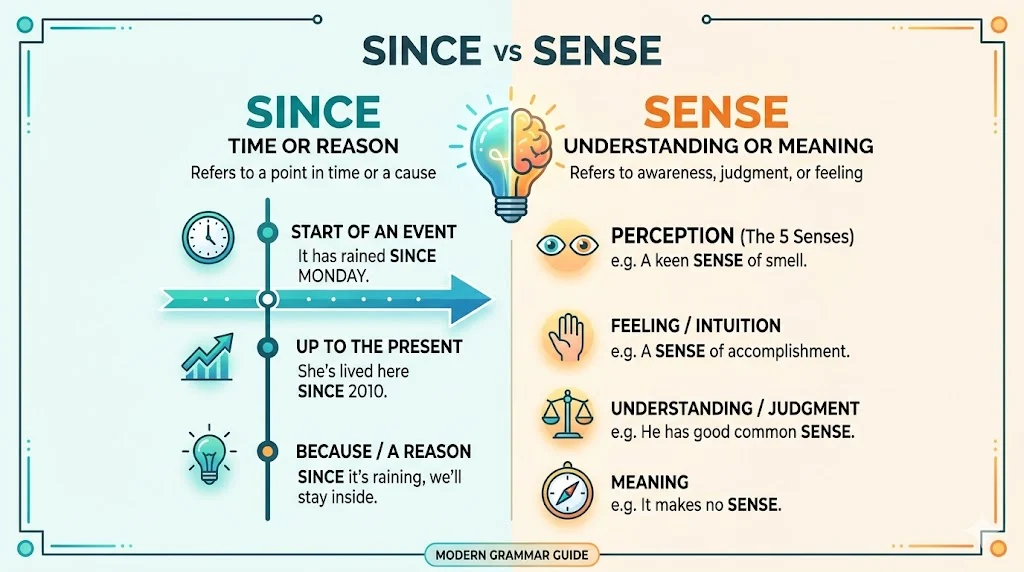
Since shows time or reason, while sense relates to understanding or feeling. Since is a conjunction or preposition; sense is a noun or verb. Example: I lived here since 2020. This makes sense.
I used to mix up since and sense in my writing, especially in emails and quick messages. I once wrote “it doesn’t since” instead of “it doesn’t make sense,” and it completely changed the meaning. That moment made me realize how small spelling differences can create big confusion.
I started focusing on how each word is used in context. Since is about time or reason, while sense is about meaning or understanding. After practicing with real examples, the confusion disappeared.
If you’ve faced the same issue, this guide will help you clearly understand and confidently use since vs sense in every situation.
Quick Answer
Since is used for time or reason.
Sense refers to understanding, feeling, or perception.
Examples
- I have lived here since 2020.
- That explanation makes sense.
Since vs Sense Meaning
Since
Since has two main meanings.
- Time → from a specific point in the past until now
- Reason → because
Examples:
- She has worked here since Monday.
- Since you are here, let’s start the meeting.
Sense
Sense refers to understanding, awareness, or feeling. It can also describe human perception like sight or touch.
Examples:
- This idea makes sense.
- He has a strong sense of responsibility.
- Humans have five basic senses.
Since vs Sense Difference
| Word | Meaning | Grammar Type | Example |
|---|---|---|---|
| Since | Time or reason | Conjunction, preposition | I lived here since 2010 |
| Sense | Understanding or feeling | Noun, verb | That makes sense |
Key Point
Since = time or reason
Sense = understanding or feeling
Grammar Rule Depth
Since as a Time Expression
Used to show something started in the past and continues now.
Structure:
Present Perfect + since + past time
Examples:
- I have studied English since childhood.
- She has lived here since 2015.
Since as a Reason
Used instead of “because.”
Examples:
- Since it is raining, we will stay inside.
- Since you finished early, you can leave.
Sense as a Noun
Represents understanding or perception.
Examples:
- This plan makes no sense.
- She has a good sense of humor.
Sense as a Verb
Means to feel or detect something.
Examples:
- I sense danger here.
- He could sense the tension in the room.
Verb Forms and Usage
Since
Does not change form.
Used as:
- Preposition → since Monday
- Conjunction → since you arrived
Sense
| Form | Example |
|---|---|
| Base | sense |
| Past | sensed |
| Past participle | sensed |
Examples:
- She sensed something was wrong.
- He has sensed this issue before.
The Origin of Since and Sense
Since
Comes from Old English meaning “after that time.” It developed into both time and reason usage.
Sense
Comes from Latin sensus, meaning feeling or perception.
These different origins explain why the words have completely different meanings.
Why People Confuse Since and Sense
- Same Pronunciation
Both sound identical in speech. - Spelling Similarity
Only one letter difference creates confusion. - Fast Typing Errors
People often type quickly and choose the wrong word. - Lack of Grammar Awareness
Not understanding their functions leads to mistakes.
Real World Usage of Since and Sense
At Work
- I have worked here since 2022.
- Your explanation makes sense.
In School
- Students have studied this topic since last week.
- This concept makes sense after practice.
In Daily Life
- I have known him since childhood.
- That decision makes no sense.
Since vs Sense in Everyday Examples
Emails
- I have been waiting since morning.
- Your suggestion makes sense.
News
- The policy has changed since last year.
- Experts say the decision makes sense.
Social Media
- I haven’t seen you since last week.
- That post makes no sense.
Formal Writing
- The company has grown rapidly since 2010.
- The results make logical sense.
Since vs Sense in Different Contexts
Time Context
- I have lived here since 2015.
Reason Context
- Since you are late, we will start without you.
Understanding Context
- This explanation makes sense.
Emotional Context
- She has a strong sense of pride.
Common Mistakes with Since vs Sense
Mistake 1 Wrong Word for Meaning
Incorrect: This doesn’t since.
Correct: This doesn’t make sense.
Mistake 2 Wrong Use of Since
Incorrect: I live here since 2010.
Correct: I have lived here since 2010.
Mistake 3 Mixing Both Words
Incorrect: Since this idea is good, it makes since.
Correct: Since this idea is good, it makes sense.
Advanced Usage of Since
Since in Perfect Tense
- She has been studying since morning.
Since in Formal Writing
- Since the results improved, the project continued.
Since in Spoken English
Often used instead of “because.”
Advanced Usage of Sense
Sense in Abstract Meaning
- A sense of purpose
- A sense of direction
Sense in Physical Perception
- Sense of smell
- Sense of touch
Sense in Logic
- It makes sense
- It makes no sense
Related Words and Expressions
Since Related
- ever since
- long since
- since then
Sense Related
- common sense
- sense of humor
- sense of direction
Usage Trends
Since is extremely common in both spoken and written English because it is used in time expressions and reasoning.
Sense is widely used in communication to express logic, understanding, and emotions.
Mistakes usually occur in informal writing and among learners.
Exercise 1 Choose the Correct Word
- I have lived here ______ 2010.
Answer: since - This idea makes no ______.
Answer: sense - She has worked here ______ Monday.
Answer: since - I can ______ something is wrong.
Answer: sense
Exercise 2 Correct the Sentence
- This doesn’t since.
Answer: This doesn’t make sense. - I am here since two years.
Answer: I have been here since two years. - Since this plan works, it makes since.
Answer: Since this plan works, it makes sense.
FAQs
What is the difference between since and sense?
Since is used for time or reason, while sense refers to understanding, feeling, or perception.
When should I use since?
Use since for time starting in the past or to give a reason.
When should I use sense?
Use sense when talking about meaning, logic, or feelings.
Is since used in present perfect tense?
Yes, since is commonly used with present perfect to show time from past to present.
Can sense be used as a verb?
Yes, sense can mean to feel or detect something.
Why do people confuse since and sense?
Because they sound the same but have different meanings and grammar uses.
What is a common phrase with sense?
The most common phrase is “make sense.”
Conclusion
Understanding since vs sense is essential for clear communication in English. Although both words sound identical, they serve completely different purposes. Since is used to show time or reason, while sense relates to understanding, feeling, or perception. This difference becomes especially important in writing, where a small mistake can completely change the meaning of a sentence.
By learning their meanings, grammar rules, and real-world usage, you can avoid common errors and improve your writing quality. Practicing examples and remembering key patterns will help you use both words confidently in emails, conversations, and formal writing.
A simple way to remember is:
Since = time or reason
Sense = meaning or feeling
Mastering this distinction will make your English more accurate, clear, and professional.