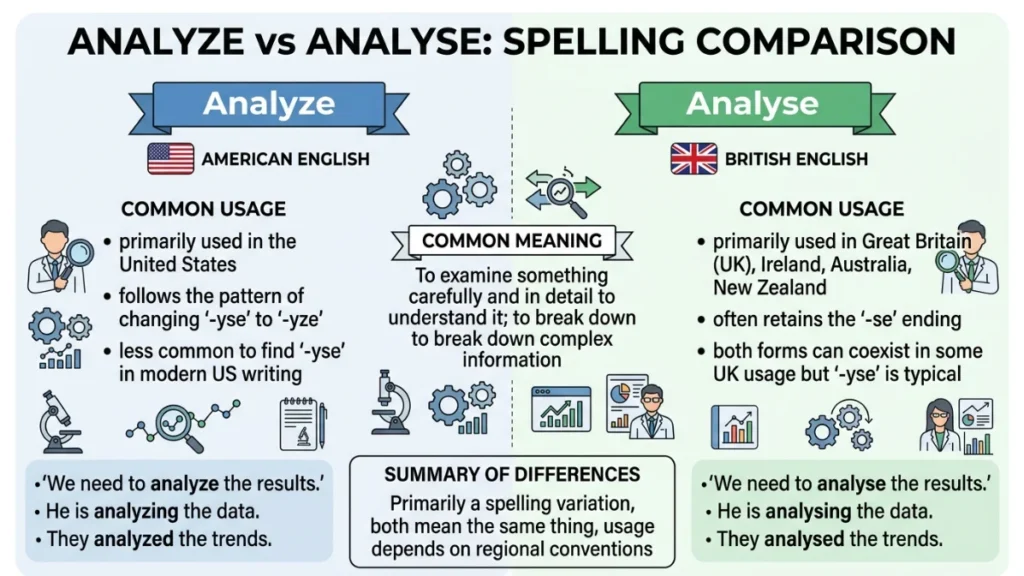

Analyze and analyse are both correct spellings. Analyze is used in American English, while analyse is used in British English and Commonwealth countries.
I used to switch between analyze and analyse without realizing it, especially when writing for different audiences. Sometimes I would write analyze in one document and analyse in another without noticing.
The confusion became obvious when editing content for international readers because spelling consistency started becoming a problem. After understanding that both spellings are correct but depend on location and audience, the confusion disappeared.
If you also wonder whether to use analyze or analyse, this guide explains the differences, spelling rules, usage patterns, examples, and exactly which version you should use.
Quick Answer
Both spellings are correct.
Analyze is used in American English.
Analyse is used in British English.
Quick Examples
American English:
We need to analyze the data.
British English:
We need to analyse the data.
Both sentences are correct.
Analyze or Analyse Difference
| Feature | Analyze | Analyse |
|---|---|---|
| Correct spelling | Yes | Yes |
| American English | Yes | No |
| British English | No | Yes |
| Used in US companies | Common | Rare |
| Used in UK writing | Rare | Common |
Key Rule
Use analyze for American audiences.
Use analyse for British and Commonwealth audiences.
Analyze and Analyse Meaning Explained
Both words have exactly the same meaning.
They mean:
- To examine something carefully.
- To study information closely.
- To investigate data or details.
Examples
Scientists analyze data.
Researchers analyse findings.
Businesses analyze customer behavior.
Students analyse literature.
The meaning never changes.
Only the spelling changes.
How to Pronounce Analyze and Analyse
Pronunciation:
/ˈænəlaɪz/
Simple pronunciation:
an uh lize
Both spellings have identical pronunciation.
This is one reason people often confuse them.
Whether you write:
analyze
analyse
They sound the same.
Why People Confuse Analyze and Analyse
Several reasons create confusion.
Same Pronunciation
Both words sound identical.
International Content
People read articles written in different English styles.
Software Autocorrect
Some programs automatically change spellings.
Mixed Audience Writing
Writers producing global content often switch between styles accidentally.
Grammar Rule Depth
The difference comes from spelling conventions.
American English Rule
American English usually prefers:
yze
Examples:
analyze
paralyze
catalyze
British English Rule
British English usually prefers:
yse
Examples:
analyse
paralyse
catalyse
Understanding this pattern makes spelling easier.
Why Are There Two Spellings
English evolved differently in different regions.
American English simplified many spellings.
British English preserved older spelling traditions.
Because of this:
analyze became standard in America
analyse remained standard elsewhere
Neither version is incorrect.
The Origin of Analyze and Analyse
The word comes from Greek roots.
The original root:
analysis
Meaning:
breaking something into parts for examination
The word later entered Latin and French before becoming English vocabulary.
Over time regional spelling differences developed.
This produced:
analyze
analyse
Both remained acceptable.
Which Spelling Should You Use
The answer depends on audience.
Use Analyze If You Write For
United States readers
American businesses
US universities
American publications
Use Analyse If You Write For
United Kingdom readers
Australia
Pakistan
India
Canada in some contexts
International organizations using British English
For Global Audiences
Choose one style.
Remain consistent.
Analyze vs Analyse Comparison Table
| Situation | Preferred Spelling |
|---|---|
| American university paper | Analyze |
| British newspaper article | Analyse |
| US business report | Analyze |
| UK academic writing | Analyse |
| International audience | Either but stay consistent |
Real World Usage of Analyze and Analyse
Analyze in Business Writing
We analyze customer behavior.
The company analyzes market trends.
Analyse in Academic Writing
Researchers analyse data carefully.
Students analyse literary themes.
Analyze in Technology
Software analyzes performance metrics.
Artificial intelligence analyzes patterns.
Analyse in Research Papers
Scientists analyse results before publishing.
Analyze in Emails
American Example:
Please analyze the report before tomorrow.
British Example:
Please analyse the report before tomorrow.
Analyze in News Writing
Economists analyze inflation trends.
Experts analyse economic performance.
Journalists analyze survey results.
Researchers analyse public opinion.
Analyze in Social Media
Analyze your mistakes and improve.
Always analyse your progress.
Businesses analyze customer feedback daily.
Common Mistakes With Analyze or Analyse
Mistake 1 Mixing Spellings
Incorrect:
We analyze data and analyse reports.
Correct:
Choose one style.
Mistake 2 Assuming One Is Wrong
Both are correct.
Mistake 3 Ignoring Audience
Using analyse in US business writing may appear inconsistent.
Using analyze in British publications may look unusual.
Related Words of Analyze and Analyse
| Word | Type |
|---|---|
| Analyze | Verb |
| Analyse | Verb |
| Analysis | Noun |
| Analytical | Adjective |
| Analyst | Noun |
| Analyzing | Present participle |
| Analyzed | Past tense |
Examples
The analysis was detailed.
She works as an analyst.
The analytical report was useful.
Words Similar to Analyze and Analyse
Many words follow similar spelling patterns.
| American English | British English |
|---|---|
| Analyze | Analyse |
| Paralyze | Paralyse |
| Catalyze | Catalyse |
| Organization | Organisation |
| Color | Colour |
Learning these together improves consistency.
Usage Trends and Popularity
Analyze appears more often globally because American English content dominates online.
However:
Analyse remains standard in many countries.
Neither spelling is disappearing.
Both remain widely accepted.
Memory Tricks to Remember Analyze or Analyse
Trick 1
Think:
America uses Z
Analyze → Z
Trick 2
Remember:
British English often prefers:
S instead of Z
Analyse → S
Trick 3
Match your audience.
US audience → analyze
UK audience → analyse
Analyze or Analyse Summary
Analyze:
American English
Analyse:
British English
Meaning:
Same meaning
Pronunciation:
Same pronunciation
Rule:
Choose based on audience
Exercise 1 Choose the Correct Spelling
The scientist will ______ the results.
Answer:
analyze or analyse depending on audience
We need to ______ customer behavior.
Answer:
analyze or analyse depending on audience
Students must ______ the text.
Answer:
analyze or analyse depending on audience
Exercise 2 Correct the Sentence
We analyze data and analyse reports.
Answer:
Use one style consistently.
Example:
We analyze data and analyze reports.
OR
We analyse data and analyse reports.
FAQs
Is analyze or analyse correct?
Both are correct.
What is the difference between analyze and analyse?
The difference is regional spelling.
Which spelling does America use?
America uses analyze.
Which spelling does Britain use?
Britain uses analyse.
Do analyze and analyse mean different things?
No. They have identical meanings.
Can I use both spellings together?
You should avoid mixing styles.
Which spelling should international writers use?
Use the spelling that matches your target audience and remain consistent.
Conclusion
Understanding analyze or analyse becomes easy once you know that both spellings are correct. The difference is not meaning, pronunciation, or grammar. The difference is simply regional spelling preference.
Analyze is preferred in American English, while analyse is standard in British English and many Commonwealth countries. Both words mean examining information carefully or studying something in detail.
The most important rule is consistency. Choose the spelling that matches your audience and use it throughout your writing.
Once you remember that America prefers Z and British English often prefers S, deciding between analyze and analyse becomes much simpler.