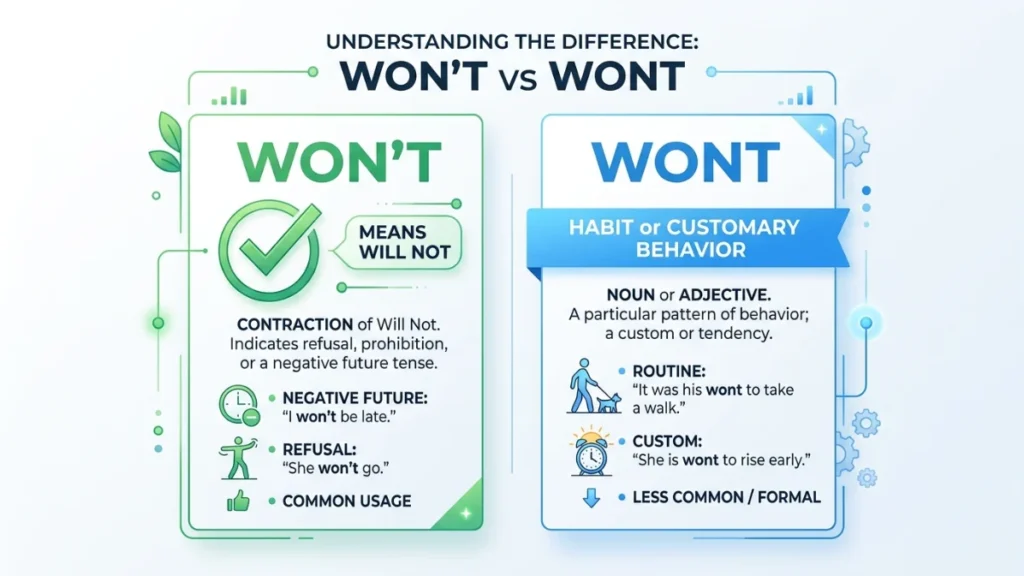

Won’t is correct when meaning “will not.” Wont is a real word but has a different meaning. Won’t is a contraction, while wont means habit or accustomed behavior.
I used to think wont and won’t were simply spelling variations of the same word. While proofreading emails and messages, I occasionally typed wont without the apostrophe, assuming autocorrect would fix it. Later, I realized something surprising: wont is actually a real English word with a completely different meaning.
That mistake made me understand how important punctuation can be in English. After learning the difference and practicing examples, the confusion disappeared. If you also wonder whether to use wont or won’t, this guide explains the meanings, grammar rules, examples, and simple tricks that make the difference easy to remember.
Quick Answer
Won’t means:
Will not
Wont means:
Habitual behavior or being accustomed to something
Examples
Correct:
I won’t go today.
She won’t agree.
Correct:
He is wont to arrive early.
Incorrect:
I wont go today.
Wont or Won’t Difference
| Word | Meaning | Correct Usage |
|---|---|---|
| Won’t | Contraction of will not | Very common |
| Wont | Habit or accustomed behavior | Less common |
Key Point
If you mean will not, use:
Won’t
If you mean:
habitual behavior
Use:
wont
Won’t Meaning Explained
Won’t is a contraction.
It combines:
will + not
This contraction is extremely common in modern English.
Examples
I won’t attend.
She won’t answer.
They won’t arrive today.
We won’t forget.
Why People Use Won’t
Shorter writing
Natural conversation
Informal communication
Everyday speech
Wont Meaning Explained
Wont is a real English word.
However, many people rarely use it.
It usually means:
customary behavior
habit
accustomed to something
Examples
He was wont to wake early.
She is wont to complain.
They were wont to travel often.
Important Note
Most people encounter won’t much more often than wont.
How to Pronounce Wont and Won’t
Won’t Pronunciation
/wəʊnt/
Sounds like:
wohnt
Wont Pronunciation
Usually pronounced similarly:
/wəʊnt/
Because pronunciation is almost identical, confusion happens easily.
Why People Confuse Wont and Won’t
Several reasons create confusion.
Missing Apostrophes
People type quickly.
They forget punctuation.
Similar Pronunciation
Both sound almost identical.
Autocorrect Dependence
Many writers expect devices to correct mistakes automatically.
Rare Usage of Wont
Because wont is uncommon, many people assume it is always incorrect.
Grammar Rule Depth
Understanding contractions solves most confusion.
Won’t Is a Contraction
Contractions combine words.
Examples:
cannot → can’t
do not → don’t
will not → won’t
Why Won’t Looks Strange
Most contractions keep letters.
Examples:
did not → didn’t
should not → shouldn’t
But:
will not → won’t
This irregular form developed historically.
Why Doesn’t Won’t Become Willn’t
Many learners ask this question.
Historically:
will not
became
wonnot
then evolved into
won’t
English contractions changed over centuries.
That created today’s unusual spelling.
The Origin of Won’t
Won’t developed hundreds of years ago.
Older English used forms similar to:
wonnot
Over time, speakers shortened the word.
Eventually:
won’t
became standard.
Today, it is among the most common contractions in English.
The Origin of Wont
Wont comes from Old English roots meaning:
habit
custom
usual behavior
The word existed long before modern contractions appeared.
Although still correct, modern English uses it less frequently.
Real World Usage of Won’t
Won’t in Everyday Conversation
I won’t do that.
She won’t listen.
We won’t stay long.
Won’t in Emails
I won’t be available tomorrow.
We won’t change the schedule.
Won’t in Business Writing
The company won’t release results today.
Management won’t approve the proposal.
Won’t in Social Media
I won’t give up.
You won’t believe this.
Real World Usage of Wont
Literature
Writers sometimes use wont.
Example:
He was wont to wander alone.
Formal Writing
Example:
The professor was wont to begin lectures early.
Historical Texts
Older texts use wont more frequently.
Common Mistakes With Wont or Won’t
Mistake 1 Missing Apostrophe
Incorrect:
I wont go.
Correct:
I won’t go.
Mistake 2 Assuming Wont Is Wrong
Incorrect Thinking:
Wont is not a real word.
Correct:
Wont is a real word with different meaning.
Mistake 3 Using Wont for Negatives
Incorrect:
She wont attend.
Correct:
She won’t attend.
Wont or Won’t Comparison Table
| Feature | Won’t | Wont |
|---|---|---|
| Means will not | Yes | No |
| Uses apostrophe | Yes | No |
| Common in speech | Yes | Rare |
| Formal usage | Yes | Sometimes |
| Means habit | No | Yes |
Related Contractions People Confuse
People often confuse similar contractions.
| Correct | Incorrect |
|---|---|
| Don’t | Dont |
| Can’t | Cant |
| Isn’t | Isnt |
| Won’t | Wont |
Learning apostrophes helps avoid mistakes.
Common Phrases Using Won’t
- won’t give up
- won’t stop
- won’t happen
- won’t forget
Examples
I won’t give up.
She won’t forget.
This won’t work.
Common Phrases Using Wont
wont to do something
accustomed behavior
habitual practice
Examples
He was wont to arrive early.
She is wont to complain.
How Common Is the Mistake Wont Instead of Won’t
This mistake is extremely common.
Reasons include:
typing speed
missing punctuation
mobile keyboards
autocorrect failures
Many users search this topic because they accidentally remove apostrophes.
Memory Tricks to Remember Won’t
Trick 1
Think:
Won’t contains an apostrophe because something is missing
Trick 2
If you mean:
will not
use:
won’t
Trick 3
If there is no apostrophe:
ask yourself:
Am I talking about habits?
Wont or Won’t Summary
Won’t:
means will not
uses apostrophe
Wont:
means habit
no apostrophe
less common
Exercise 1 Choose the Correct Word
I ______ attend tomorrow.
Answer:
won’t
She is ______ to wake early.
Answer:
wont
We ______ forget this.
Answer:
won’t
Exercise 2 Correct the Sentence
I wont go today.
Answer:
I won’t go today.
She won’t to complain.
Answer:
She is wont to complain.
They wont arrive tomorrow.
Answer:
They won’t arrive tomorrow.
FAQs
Is wont or won’t correct?
Both are correct, but they have different meanings.
What does won’t mean?
Won’t means will not.
What does wont mean?
Wont means habitual behavior or being accustomed to something.
Why is won’t spelled strangely?
Won’t developed historically from older forms and evolved differently from other contractions.
Is wont commonly used today?
Not very often. Most people use won’t much more frequently.
Can I write wont instead of won’t?
Only if you mean habit or customary behavior.
Why do people forget the apostrophe?
Typing quickly and mobile keyboards often cause missing punctuation.
Conclusion
Understanding wont or won’t becomes easy once you know that these words are not spelling variations of each other. Won’t is a contraction meaning will not, while wont is a separate word connected to habits and customary behavior.
Most confusion happens because both words sound almost identical and many people forget apostrophes while typing quickly. Since won’t appears much more frequently in modern English, many writers assume wont must always be incorrect. That assumption creates mistakes.
The easiest way to remember the difference is simple: if you mean will not, use won’t. If you are talking about habits or customary actions, use wont.
Remembering this small distinction helps improve writing accuracy and prevents one of the most common punctuation mistakes in English.