
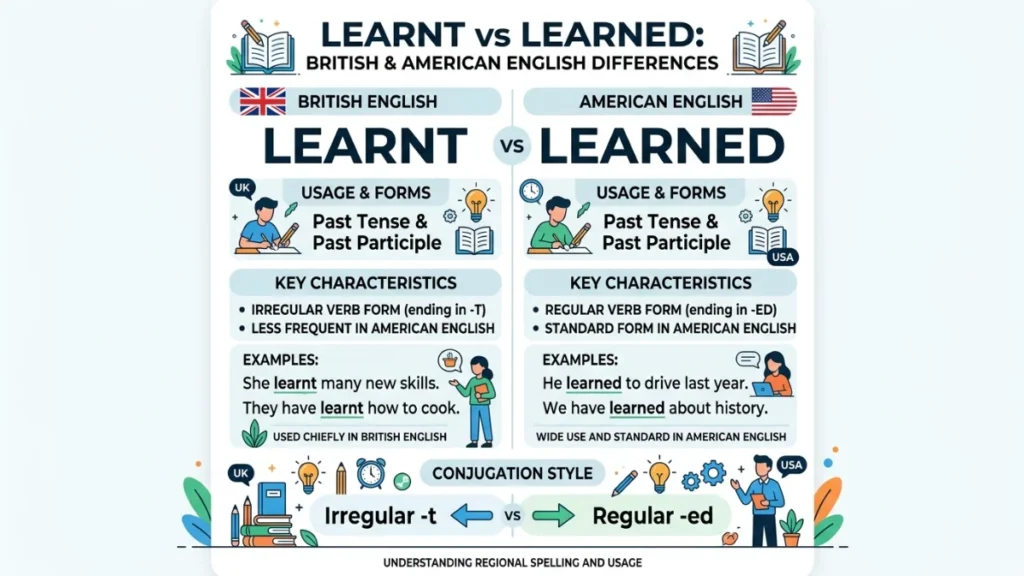

Learnt and learned are both correct. Learned is more common in American English, while learnt is more common in British English and other Commonwealth countries.
I used to stop while writing every time I reached the past tense of learn. Sometimes I wrote learned, and other times I typed learnt without knowing which version was actually correct. The confusion became more obvious when reading articles from different countries because both spellings appeared everywhere.
After researching grammar rules and language patterns, I discovered something interesting: both forms are correct, but usage depends mostly on region and writing style.
If you also get confused between learnt or learned, this guide explains the difference clearly so you can choose the right version confidently.
Quick Answer
Both words are correct.
Learned is more common in American English.
Learnt is more common in British English.
Quick Examples
American English:
I learned something new today.
British English:
I learnt something new today.
Both sentences are correct.
Learnt or Learned Difference
| Feature | Learnt | Learned |
|---|---|---|
| Correct spelling | Yes | Yes |
| American English | Less common | More common |
| British English | More common | Also used |
| Meaning | Same | Same |
| Professional writing | Acceptable | Acceptable |
Key Rule
The difference is usually regional preference rather than grammar correctness.
What Do Learnt and Learned Mean
Both words are past forms of learn.
They mean:
- to gain knowledge
- to acquire skills
- to discover information
Examples
I learned Spanish last year.
She learnt piano as a child.
We learned valuable lessons.
They learnt from mistakes.
The meaning remains identical.
Grammar Rule Depth
The verb learn has multiple forms.
| Form | Word |
|---|---|
| Base Verb | Learn |
| Present Participle | Learning |
| Past Tense | Learned / Learnt |
| Past Participle | Learned / Learnt |
Example Using Learned
I learned French.
I have learned many skills.
Example Using Learnt
I learnt French.
I have learnt many skills.
Both structures are grammatically correct.
Why Do Two Versions Exist
English developed from multiple language influences.
Many verbs historically had:
regular forms
irregular forms
Over time, certain regions preferred different endings.
British English often kept t endings.
American English preferred ed endings.
This created pairs like:
learned / learnt
dreamed / dreamt
burned / burnt
spelled / spelt
The Origin of Learnt and Learned
The verb learn comes from Old English.
Earlier forms gradually evolved into:
learned
learnt
For centuries both existed together.
Language changes and regional preferences later influenced which version became dominant.
Today both remain accepted.
Why People Get Confused Between Learnt and Learned
Several reasons create confusion.
Different Countries Use Different Forms
People see different spellings online.
Both Are Correct
Having two correct answers creates uncertainty.
School Systems Teach Different Rules
Some educational systems teach one form more heavily.
Global Content Creates Mixed Exposure
Internet content combines American and British English constantly.
Which Spelling Should You Use
Use Learned If
You write for:
American audiences
US companies
US schools
International audiences
Use Learnt If
You write for:
British audiences
Australian audiences
Commonwealth countries
UK education systems
Simple Rule
If unsure:
Use learned
It works almost everywhere.
British English vs American English Usage
| Region | Preferred Form |
|---|---|
| United States | Learned |
| Canada | Mostly Learned |
| United Kingdom | Learnt Common |
| Australia | Learnt Common |
| New Zealand | Learnt Common |
| International Business | Learned Common |
Key Observation
Learned dominates globally because American content is widespread.
How to Pronounce Learnt and Learned
Learned Pronunciation
/ˈlɜːrnd/
Sounds like:
lurnd
Learnt Pronunciation
/lɜːnt/
Sounds like:
lernt
The pronunciation difference is small.
This is why people often use both forms interchangeably.
Real World Usage Examples
Everyday Conversation
I learned something new.
I learnt something useful.
Business Writing
We learned valuable lessons from the project.
Academic Writing
Students learnt important concepts.
Emails
I learned that the meeting moved.
I learnt about the schedule yesterday.
Learnt and Learned in Professional Writing
Professional writing accepts both forms.
However consistency matters.
Incorrect:
I learnt coding and later learned design.
Better:
I learnt coding and later learnt design.
Or:
I learned coding and later learned design.
Choose one style.
Stay consistent.
Common Phrases Using Learned and Learnt
Lessons learned
Learned behavior
Hard learned lesson
Learned skills
Recently learnt information
Examples
Experience taught valuable lessons learned.
She has learned patience.
I learnt this from practice.
Common Mistakes With Learnt or Learned
Mistake 1 Thinking One Is Wrong
Incorrect belief:
Learnt is wrong.
Reality:
Both are correct.
Mistake 2 Mixing Styles
Incorrect:
I learnt English and learned grammar.
Correct:
Use one style consistently.
Mistake 3 Using Wrong Verb Form
Incorrect:
I have learn many things.
Correct:
I have learned many things.
Similar Words With Two Correct Forms
English has many pairs like this.
| American | British |
|---|---|
| Learned | Learnt |
| Burned | Burnt |
| Dreamed | Dreamt |
| Spoiled | Spoilt |
| Spelled | Spelt |
Learning these patterns helps reduce confusion.
Usage Trends and Popularity
Learned appears more frequently worldwide.
Reasons include:
American media influence
International business writing
Online content dominance
Learnt remains common in:
UK publications
Australian writing
Educational materials in Commonwealth countries
Memory Tricks to Remember Learnt vs Learned
Trick 1
Think:
US prefers ED
UK often prefers T
Trick 2
Remember:
Learned works almost everywhere.
Trick 3
Think of similar pairs:
burned burnt
dreamed dreamt
spelled spelt
Learnt or Learned Summary
Both are correct.
American English:
learned
British English:
learnt
Meaning:
exactly the same
Safest option globally:
learned
Exercise 1 Choose the Correct Form
I ______ something important yesterday.
Answer:
learned or learnt
She has ______ many skills.
Answer:
learned or learnt
We ______ valuable lessons.
Answer:
learned or learnt
Exercise 2 Correct the Sentence
I have learn many things.
Answer:
I have learned many things.
OR
I have learnt many things.
She learn a new language.
Answer:
She learned a new language.
OR
She learnt a new language.
FAQs
Is learnt or learned correct?
Both are correct. Learned is more common in American English, while learnt is more common in British English.
Why are there two versions?
English developed different regional preferences, which created multiple acceptable forms.
Do Americans use learnt?
Rarely. Most American writing uses learned.
Do British people use learned?
Yes. Although learnt is common, learned also appears.
Which version should I use internationally?
Learned is usually safer for global audiences.
Are learnt and learned pronounced differently?
Yes, slightly. Learned usually has a stronger ending sound.
Can I use both in the same document?
You should avoid mixing styles. Choose one and stay consistent.
Conclusion
Understanding learnt or learned becomes much easier once you know that both forms are correct. The difference is mostly regional rather than grammatical. American English generally prefers learned, while British English and many Commonwealth countries commonly use learnt.
This means your audience matters more than strict grammar rules. If you write for international readers or global businesses, learned is often the safer choice. If you follow British conventions, learnt fits naturally.
The most important rule is consistency. Choose one style and keep using it throughout your writing. Once you understand this simple principle, deciding between learnt and learned becomes much easier.