
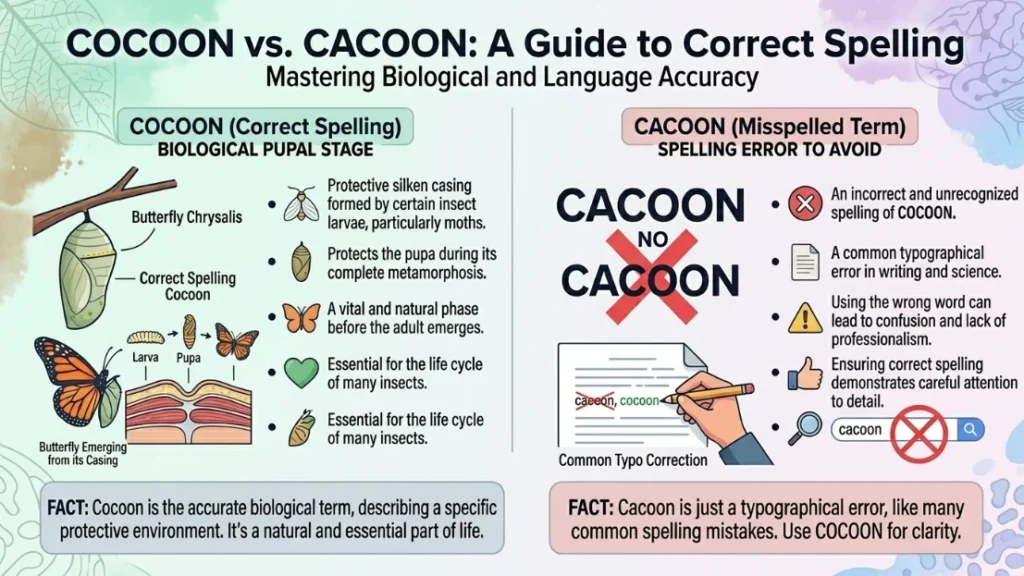

Cocoon is the correct spelling in English. Cacoon is a common misspelling. A cocoon is a protective covering made by insects during transformation.
I once wrote cacoon in a blog draft while explaining butterfly life cycles. At first, I did not notice the mistake because both spellings sounded similar in my head. Later, while editing the article, I realized the correct word is cocoon. That small error made me research the spelling, origin, and real meaning of the word more deeply.
Since then, I have seen many people make the same mistake in emails, social media posts, and school assignments. If you also feel confused between cacoon or cocoon, this guide will help you understand the correct spelling, why people make the error, and how to use the word confidently in writing and conversation.
Cocoon or Cacoon Quick Answer
Cocoon is the correct spelling.
Cacoon is incorrect and considered a spelling mistake in standard English.
A cocoon is a protective covering made by insects such as moths during transformation into adults.
Examples
Correct: The caterpillar formed a cocoon.
Incorrect: The caterpillar formed a cacoon.
Cocoon or Cacoon Meaning
The word cocoon refers to a soft protective case made by insects during a stage of development.
It is most commonly connected with:
Moths
Butterflies
Silkworms
Other insects undergoing transformation
A cocoon protects the insect while it changes form.
Example Sentences
The caterpillar stayed inside the cocoon for weeks.
Scientists studied the cocoon carefully.
The moth emerged from the cocoon in spring.
Cocoon vs Cacoon Difference
| Word | Correct Spelling | Meaning | Usage |
|---|---|---|---|
| Cocoon | Yes | Protective insect covering | Correct |
| Cacoon | No | No accepted meaning | Incorrect |
Key Point
Only cocoon is recognized in dictionaries and standard English writing.
The Origin of Cocoon
The word cocoon comes from the French word cocon.
The term entered English several centuries ago and became associated with insect transformation and protection.
Originally, the word mainly described the silky protective case made by silkworms.
Over time, it gained broader meanings and is now used in science, literature, psychology, and everyday speech.
Why People Write Cacoon Instead of Cocoon
Many people accidentally write cacoon because of pronunciation confusion.
Similar Sound
When spoken quickly, cocoon may sound like “cacoon” to some listeners.
Spelling Assumption
English spelling patterns can confuse learners. Some people assume the first vowel should be “a” instead of “o”.
Typing Mistakes
Fast typing often causes spelling errors, especially with double vowels.
Lack of Reading Exposure
People who hear the word more than they read it are more likely to spell it incorrectly.
Grammar Rule Depth
Cocoon Is a Noun
The word cocoon functions mainly as a noun.
Example:
The insect built a cocoon.
Cocoon as a Verb
Sometimes cocoon is also used as a verb.
Meaning: to wrap or protect someone or something.
Example:
Parents tried to cocoon their child from stress.
This figurative use is common in modern English.
Cocoon in Science
The word cocoon is important in biology and environmental science.
Insect Transformation
A cocoon protects insects during metamorphosis.
Inside the cocoon, major physical changes happen.
Silk Production
Silkworm cocoons are used to produce silk.
The silk industry has depended on cocoons for centuries.
Research and Education
Scientists study cocoons to understand insect growth and adaptation.
Cocoon in Everyday Language
The word cocoon is also used metaphorically.
Emotional Protection
People may “cocoon” themselves emotionally.
Example:
After the stressful week, she cocooned herself at home.
Comfort and Safety
The word often describes warmth and security.
Example:
The blanket cocooned him during winter.
Parenting
Parents sometimes protect children too much.
Example:
Some experts warn against cocooning children excessively.
Cocoon in Literature and Media
Writers often use cocoon symbolically.
Symbol of Change
A cocoon represents transformation and growth.
Symbol of Isolation
Sometimes it represents hiding from the world.
Symbol of Protection
It can also symbolize emotional safety.
Example from storytelling:
The hero enters a cocoon-like phase before personal growth.
Cocoon in Real World Examples
School Writing
The butterfly emerged from its cocoon.
News Articles
Scientists discovered rare insect cocoons in the forest.
Social Media
I just want to cocoon myself in blankets today.
Professional Writing
The protective cocoon shields the developing organism.
Cocoon in Different Contexts
Biology
The moth remained inside the cocoon.
Fashion
The designer introduced a cocoon coat style.
Psychology
People sometimes cocoon themselves during stressful times.
Home and Lifestyle
Soft blankets can create a cocoon feeling.
Common Mistakes with Cocoon or Cacoon
Mistake 1 Using Cacoon
Incorrect: The insect stayed inside the cacoon.
Correct: The insect stayed inside the cocoon.
Mistake 2 Wrong Pronunciation
Some people pronounce cocoon incorrectly because of spelling confusion.
Mistake 3 Overusing Figurative Meaning
Not every protective situation needs the word cocoon.
Why Cocoon Is Important in English Vocabulary
The word appears in:
Science books
Children’s education
Nature documentaries
Fashion writing
Psychology discussions
Lifestyle blogs
Learning the correct spelling improves writing accuracy and professionalism.
British English vs American English Usage
Both British and American English use the same spelling:
Cocoon
There is no spelling difference between regions.
| Region | Preferred Spelling |
|---|---|
| American English | Cocoon |
| British English | Cocoon |
| Australian English | Cocoon |
| Canadian English | Cocoon |
Cocoon in Figurative Expressions
English speakers often use cocoon metaphorically.
Emotional Cocoon
Feeling emotionally protected.
Cocoon of Comfort
A safe and relaxing environment.
Cocoon Yourself
To isolate yourself for comfort or recovery.
Example:
He cocooned himself indoors during the storm.
Related Words and Similar Terms
Understanding related words helps vocabulary growth.
Chrysalis
A butterfly’s transformation stage.
Metamorphosis
The process of transformation.
Pupa
An immature insect stage.
Shelter
A place of protection.
Cocoon vs Chrysalis
Many people confuse cocoon and chrysalis.
| Word | Meaning |
|---|---|
| Cocoon | Protective covering made by moths |
| Chrysalis | Hard outer stage of butterflies |
Key Difference
A chrysalis is not technically a cocoon.
Real World Usage Trends
The word cocoon appears widely in:
Biology education
Lifestyle writing
Mental health discussions
Fashion magazines
Home decor content
Search trends show that many users mistakenly search for “cacoon,” especially students and learners.
Why Correct Spelling Matters
Correct spelling improves:
Professional writing
Search visibility
Academic accuracy
Reader trust
Using “cacoon” may make writing appear careless or unprofessional.
Tips to Remember Cocoon
Memory Trick
Think of the double “o” shape like a wrapped cocoon.
Visual Learning
Picture a butterfly inside a cocoon.
Practice
Use the correct spelling regularly in sentences.
Cocoon in Professional Writing
Academic Writing
The cocoon stage protects the insect during development.
Scientific Research
Researchers analyzed the cocoon structure carefully.
Journalism
The article described the butterfly emerging from its cocoon.
Marketing
The hotel offers a cocoon-like atmosphere of comfort.
Cocoon in Social Media and Pop Culture
People often use cocoon in lifestyle content.
Examples:
Weekend cocoon mode activated.
I want to cocoon myself in blankets today.
This room feels like a warm cocoon.
The word now commonly represents comfort and emotional security online.
Exercise 1 Choose the Correct Word
Fill in the blanks with cocoon or cacoon.
The insect remained inside the ______ for two weeks.
Answer: cocoon
The moth emerged from its ______ in spring.
Answer: cocoon
Scientists examined the silky ______ carefully.
Answer: cocoon
Exercise 2 Correct the Sentence
Rewrite the sentence using the correct spelling.
The butterfly came out of the cacoon.
Answer: The butterfly came out of the cocoon.
The scientist studied the cacoon carefully.
Answer: The scientist studied the cocoon carefully.
FAQs
Is cocoon or cacoon correct?
Cocoon is the correct spelling. Cacoon is a spelling mistake and is not accepted in standard English.
What does cocoon mean?
A cocoon is a protective covering made by insects such as moths during transformation into adults.
Why do people spell cocoon as cacoon?
People confuse the spelling because of pronunciation, typing mistakes, and unfamiliarity with the word.
Is cacoon a real English word?
No. Standard English dictionaries do not recognize cacoon as a correct word.
What is the difference between cocoon and chrysalis?
A cocoon is a protective case made by moths, while a chrysalis is the hard outer stage of a butterfly.
Can cocoon be used as a verb?
Yes. Cocoon can mean to wrap, protect, or isolate someone in comfort.
Is cocoon used metaphorically?
Yes. People often use cocoon to describe emotional comfort, safety, or isolation.
Conclusion
Understanding the difference between cocoon or cacoon is simple once you know the correct spelling. The standard and accepted word in English is cocoon, while cacoon is only a common spelling mistake. The word cocoon originally referred to the protective covering made by insects during transformation, but today it also carries symbolic meanings connected to comfort, safety, and emotional protection.
This word appears in science, education, psychology, literature, fashion, and everyday conversation. Because it is widely used across many fields, learning the correct spelling is important for both professional and casual writing.
Remember that cocoon contains two “o” letters, just like the rounded shape of a protective shell. This simple memory trick can help prevent mistakes. With practice and exposure, using the correct spelling becomes natural and easy in all forms of communication.