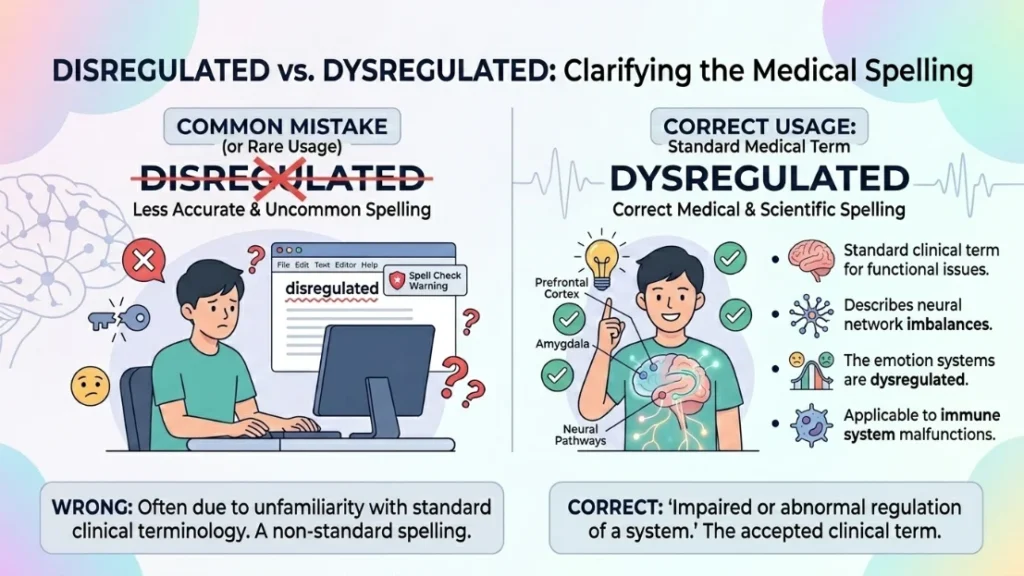

Dysregulated is the correct and commonly used term for emotional, mental, or biological imbalance. Disregulated is rare and usually considered incorrect or nonstandard in modern English usage.
I once used the word disregulated while writing about emotional health, thinking it was correct because many English words begin with “dis.” Later, while reviewing medical and psychology sources, I noticed experts consistently used dysregulated instead. That small mistake taught me how important word accuracy is, especially in professional and health related writing.
After researching the difference, I learned that dysregulated refers to something functioning abnormally or out of balance, especially emotions, behavior, or body systems. If you also feel confused between disregulated or dysregulated, this guide will help you clearly understand the meanings, differences, grammar, origins, examples, and correct usage in modern English.
Quick Answer
Dysregulated is the correct and widely accepted term in psychology, medicine, and biology.
Disregulated is uncommon and usually considered incorrect or nonstandard in modern English.
Examples
Correct
The child became emotionally dysregulated after the stressful event.
Uncommon
The patient appeared disregulated during the interview.
Disregulated vs Dysregulated Meaning
Both words attempt to describe something that is not functioning normally or properly controlled.
However, only one term is standard in modern English.
Dysregulated Meaning
Dysregulated means functioning abnormally, being emotionally unbalanced, or failing to regulate properly.
It is commonly used in:
Psychology
Mental health
Medicine
Neuroscience
Biology
Example Sentences
The patient showed dysregulated emotions.
Stress can lead to dysregulated sleep patterns.
The nervous system became dysregulated after trauma.
Disregulated Meaning
Disregulated is rarely used and is generally considered a nonstandard or mistaken form of dysregulated.
Some writers use it informally to mean “not regulated,” but it is not preferred in professional English.
Example
The system became disregulated after the update.
Most editors and professionals would replace this with dysregulated.
Disregulated vs Dysregulated Difference
| Word | Meaning | Standard Usage | Common Fields |
|---|---|---|---|
| Dysregulated | Abnormally controlled or unbalanced | Correct | Psychology, medicine |
| Disregulated | Rare nonstandard form | Usually incorrect | Informal or mistaken usage |
Key Point
If you are writing professionally, academically, or medically, always use dysregulated.
The Origin of Dysregulated
The word dysregulated comes from two parts:
Dys
The prefix dys comes from Greek and means:
abnormal
difficult
impaired
bad
This prefix appears in many medical and psychological terms.
Examples
dysfunction
dyslexia
dysphoria
dyspepsia
Regulated
Regulated means controlled, balanced, or functioning properly.
Combined Meaning
Dysregulated literally means:
not functioning properly
abnormally controlled
out of balance
This is why the word fits perfectly in emotional and biological contexts.
Why People Write Disregulated Instead of Dysregulated
Many people assume the prefix should be dis because it appears in common English words.
Common Dis Prefix Examples
disconnect
disagree
disappear
disorganized
Because “dis” often means “not,” people naturally think disregulated should be correct.
However, in medical and psychological language, the prefix dys is more accurate because it refers to abnormal function rather than simple absence.
Grammar Rule Depth
Understanding prefixes helps explain the difference clearly.
The Prefix Dis
Dis usually means:
not
opposite of
removal
Examples
dislike
disconnect
disapprove
The Prefix Dys
Dys means:
abnormal
impaired
difficult
Examples
dysfunctional
dysregulated
dyslexia
Important Difference
Dis often suggests complete separation or reversal.
Dys suggests abnormal operation or impaired functioning.
That is why emotional imbalance is called dysregulation, not disregulation.
Dysregulated in Psychology
The word appears most often in psychology and mental health.
Emotional Dysregulation
This describes difficulty managing emotions.
A person may experience:
intense anger
panic
sudden sadness
emotional instability
Example
Children with trauma may become emotionally dysregulated.
Behavioral Dysregulation
This refers to difficulty controlling actions or reactions.
Example
Stress can cause dysregulated behavior in some individuals.
Dysregulated in Medicine
Medical professionals also use the term frequently.
Nervous System Dysregulation
The nervous system may stop functioning normally after trauma or illness.
Hormonal Dysregulation
Hormones can become imbalanced.
Immune System Dysregulation
The immune system may overreact or underreact.
Examples
The patient showed dysregulated cortisol levels.
Sleep deprivation can cause dysregulated hormones.
Dysregulated in Everyday Language
Although the term is technical, it also appears in everyday conversations about mental health.
Social Media
I felt emotionally dysregulated after a stressful day.
Blogs and Self Help Content
Trauma can lead to dysregulated emotional responses.
Parenting Discussions
Children sometimes become dysregulated when overwhelmed.
Real World Usage Examples
In Therapy
The therapist helped the client manage dysregulated emotions.
In Healthcare
Doctors monitored the patient’s dysregulated heart rhythm.
In Education
Teachers often support dysregulated students during stressful situations.
In Workplace Discussions
Burnout may cause dysregulated sleep and anxiety.
British English vs American English Usage
Both British and American English strongly prefer dysregulated.
There is no major regional difference in spelling preference.
| Region | Preferred Word |
|---|---|
| United States | Dysregulated |
| United Kingdom | Dysregulated |
| Canada | Dysregulated |
| Australia | Dysregulated |
Key Point
Dysregulated is the accepted international spelling.
Which Spelling Should You Use
Use Dysregulated When
Writing professionally
Discussing psychology
Talking about mental health
Describing abnormal biological function
Creating academic content
Avoid Disregulated When
Writing medical content
Preparing academic papers
Creating professional communication
Common Mistakes with Disregulated or Dysregulated
Mistake 1 Using Disregulated in Professional Writing
Incorrect
The patient became disregulated.
Correct
The patient became dysregulated.
Mistake 2 Assuming Both Words Are Equal
Some people believe both spellings are interchangeable.
In reality, professional English strongly prefers dysregulated.
Mistake 3 Misunderstanding the Prefix
Many learners think dys and dis mean the same thing.
They do not.
Dys means abnormal functioning.
Dis means separation or opposite.
Dysregulated in Emotional Health
The term is especially important in emotional and mental health discussions.
Emotional Dysregulation Symptoms
anger outbursts
panic reactions
rapid mood changes
difficulty calming down
Example
People with anxiety disorders may feel emotionally dysregulated during stress.
Dysregulated in Child Development
Children often experience dysregulation before learning emotional control skills.
Common Signs
crying intensely
difficulty calming down
impulsive behavior
overreaction to stress
Example
Young children may become dysregulated when tired or overstimulated.
Dysregulated in Trauma Discussions
Trauma specialists frequently use the term.
Trauma affects the nervous system and emotional regulation.
Example
Traumatic experiences may leave the nervous system dysregulated for years.
Dysregulated in Neuroscience
Neuroscience research also uses this word extensively.
Brain Function
Some conditions affect the brain’s ability to regulate emotions and responses.
Example
Researchers studied dysregulated dopamine activity in patients.
Related Words and Similar Terms
Understanding related vocabulary improves comprehension.
Related Terms
dysfunction
dysregulation
imbalance
instability
emotional overload
Similar Concepts
poor emotional control
abnormal regulation
mental imbalance
Why Dysregulated Became Popular
Mental health awareness increased significantly in recent years.
As discussions about trauma, anxiety, and emotional regulation grew, the word dysregulated became more common online and in healthcare.
Today, therapists, educators, parents, and healthcare workers regularly use the term.
Dysregulated in Formal Writing
Professional writers use the term carefully because it has specific clinical meaning.
Academic Example
The study examined dysregulated emotional responses in adolescents.
Healthcare Example
Patients with chronic stress often show dysregulated cortisol production.
Therapy Example
The counselor discussed strategies for managing dysregulated behavior.
Dysregulated in Social Media and Online Discussions
Mental health creators often use the term when discussing stress and emotional overwhelm.
Example Posts
I feel emotionally dysregulated today.
Stress can make the nervous system dysregulated.
Sleep problems may be linked to dysregulated hormones.
Usage Trends and Language Data
Search trends show growing interest in the word dysregulated, especially in mental health topics.
The word appears frequently in:
therapy content
medical research
psychology articles
healthcare discussions
educational materials
The term disregulated appears much less often and is usually considered an error.
Exercise 1 Choose the Correct Word
Fill in the blank using dysregulated or disregulated.
The child became emotionally ______ after the stressful event.
Answer: dysregulated
The patient showed ______ sleep patterns.
Answer: dysregulated
The nervous system appeared ______ after trauma.
Answer: dysregulated
Exercise 2 Correct the Sentence
Rewrite the sentence using the correct word.
The client felt disregulated during therapy.
Answer: The client felt dysregulated during therapy.
The doctor noticed disregulated hormone levels.
Answer: The doctor noticed dysregulated hormone levels.
FAQs
What is the difference between disregulated and dysregulated?
Dysregulated is the correct and widely accepted term used in psychology and medicine. Disregulated is uncommon and generally considered incorrect in modern English.
Is disregulated a real word?
Some people use disregulated informally, but it is not the preferred standard spelling in professional or academic writing.
What does dysregulated mean?
Dysregulated means functioning abnormally or being emotionally, mentally, or physically out of balance.
Why is dysregulated used in psychology?
Psychologists use dysregulated to describe emotional or behavioral states that are difficult to control or regulate properly.
Should I use dysregulated in professional writing?
Yes. Dysregulated is the correct term for academic, medical, therapeutic, and professional communication.
Why do people confuse dysregulated and disregulated?
People often confuse them because the prefix dis is more familiar in everyday English vocabulary.
Is dysregulated used in medicine?
Yes. Doctors and researchers use the term when discussing nervous system function, hormones, emotional regulation, and biological balance.
Conclusion
The confusion between disregulated or dysregulated mainly comes from the similarity between the prefixes dis and dys. Although both may seem logical at first glance, only one form is widely accepted in professional English.
The correct word is dysregulated. It describes abnormal emotional, mental, or biological functioning and appears frequently in psychology, medicine, neuroscience, and mental health discussions. The prefix dys means impaired or abnormal, which accurately reflects the meaning of the term.
The word disregulated is rare and usually considered nonstandard or mistaken in modern English writing. While some people use it informally, professional editors and experts strongly prefer dysregulated.
Understanding this distinction improves clarity, professionalism, and accuracy in writing. Whether you are discussing emotional health, trauma, hormones, or nervous system function, using the correct term helps communicate ideas more effectively and confidently.