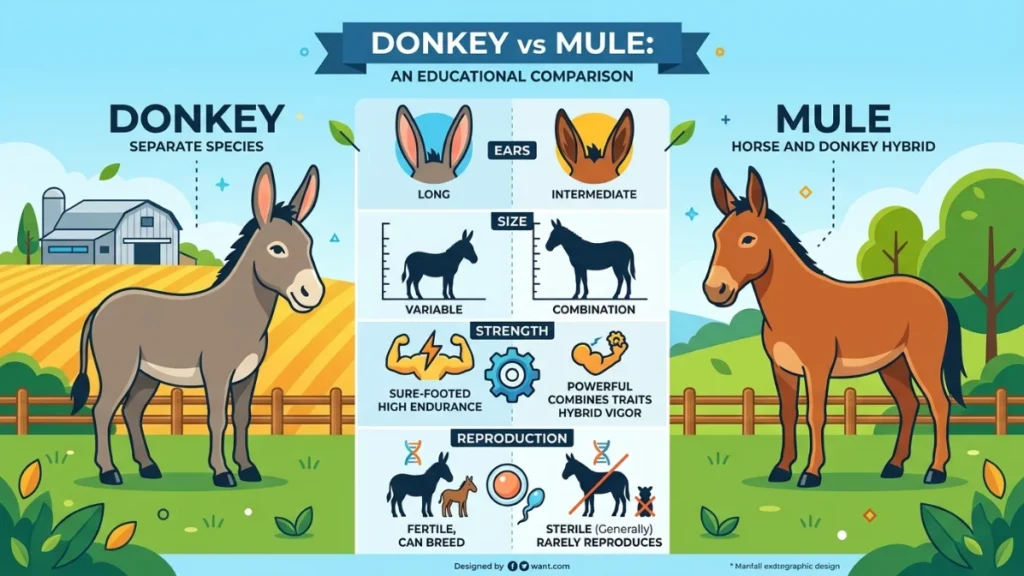

A donkey is a separate animal species, while a mule is a hybrid created by breeding a male donkey with a female horse. Donkeys can reproduce naturally, but most mules cannot.
I once confused a mule with a donkey during a visit to a rural farm. At first glance, both animals looked very similar because they had long ears, strong bodies, and calm behavior. I later asked the farmer about the difference, and that conversation completely changed my understanding.
He explained that a donkey is a natural animal species, while a mule is actually a hybrid animal created by crossing a donkey and a horse. After learning about their body structure, behavior, strength, and breeding differences, identifying them became much easier.
If you also struggle to understand donkey or mule, this guide will clearly explain their meanings, differences, origins, uses, and real world examples in simple language.
Donkey or Mule Quick Answer
A donkey is a fully separate animal species related to horses.
A mule is a hybrid animal created by breeding a male donkey with a female horse.
Quick Examples
- Donkeys can reproduce naturally.
- Most mules are sterile and cannot reproduce.
- Mules are usually larger and stronger than donkeys.
Donkey vs Mule Meaning
Understanding the meaning of each animal is the first step.
Donkey
A donkey is a hoofed mammal belonging to the horse family. It has been domesticated for thousands of years and is widely used for carrying loads, farming, and transportation.
Mule
A mule is the offspring of a male donkey and a female horse. Because it is a hybrid animal, it combines traits from both parents.
Donkey vs Mule Difference
| Feature | Donkey | Mule |
|---|---|---|
| Animal Type | Separate species | Hybrid animal |
| Parents | Donkey parents | Male donkey + female horse |
| Size | Smaller | Larger |
| Strength | Strong | Very strong |
| Reproduction | Can reproduce | Usually sterile |
| Ears | Long | Medium to long |
| Voice | Bray | Mix of bray and neigh |
| Intelligence | Intelligent | Very intelligent |
Key Difference
A donkey is a natural species.
A mule is a crossbreed between a donkey and a horse.
The Origin of Donkeys
Donkeys have existed for thousands of years and were first domesticated in Africa.
Ancient civilizations used donkeys for:
Transportation
Agriculture
Carrying goods
Travel across deserts
Because donkeys are hardy animals, they became important in trade and farming societies around the world.
Historical Importance
Donkeys played a major role in:
Ancient Egypt
Mesopotamia
Roman trade routes
Asian farming systems
Even today, donkeys remain valuable working animals in many countries.
The Origin of Mules
Mules were developed by humans through selective breeding.
A mule is created when:
Male donkey + female horse = mule
Humans bred mules because they wanted animals with:
The endurance of donkeys
The size and speed of horses
This combination created an animal that was stronger and more durable for difficult work.
Why People Confuse Donkeys and Mules
Many people confuse donkeys and mules because they look alike.
Similar Physical Features
Both animals have:
Long ears
Hooves
Short hair
Strong bodies
Similar Uses
Both are commonly used for:
Farm work
Transportation
Carrying loads
Limited Awareness
Many people do not know that mules are hybrid animals.
Physical Differences Between Donkeys and Mules
Although they look similar, there are clear physical differences.
Size
Mules are generally larger because they inherit size from horses.
Donkeys are usually smaller and more compact.
Ears
Donkeys typically have longer ears.
Mules have ears slightly shorter than donkeys but longer than horses.
Tail
Donkeys have tails with hair mostly at the end.
Mules have tails more similar to horses.
Body Shape
Donkeys often have shorter, sturdier bodies.
Mules usually appear taller and more athletic.
Behavioral Differences
Donkey Personality
Donkeys are cautious and thoughtful animals.
They often stop and assess danger before moving.
This behavior is sometimes misunderstood as stubbornness.
Mule Personality
Mules are intelligent, energetic, and hardworking.
They inherit intelligence from donkeys and athletic ability from horses.
Mules are often easier to train for difficult work.
Strength and Work Ability
Donkeys
Donkeys are strong for their size.
They can carry heavy loads over long distances.
Mules
Mules are extremely powerful and durable.
They are widely used for:
Mountain transport
Military supply routes
Agriculture
Ranch work
Because of hybrid vigor, mules often outperform both horses and donkeys in endurance.
Reproduction Differences
This is one of the biggest differences.
Donkeys
Donkeys reproduce naturally and produce offspring.
Mules
Most mules are sterile.
This happens because horses and donkeys have different chromosome numbers.
As a result, mules usually cannot produce babies.
Donkey vs Mule Intelligence
Both animals are intelligent, but mules are often considered exceptionally smart.
Donkeys
Donkeys think carefully before reacting.
They rarely panic.
Mules
Mules combine donkey caution with horse responsiveness.
This makes them highly adaptable working animals.
Donkeys and Mules in Farming
Donkeys in Farming
Donkeys are used for:
Pulling carts
Carrying water
Transporting supplies
Guarding livestock
Mules in Farming
Mules are used for:
Heavy hauling
Plowing fields
Mountain transportation
Long distance carrying
Mules are preferred when strength and endurance are needed.
Donkeys and Mules in History
Both animals played important historical roles.
Military Use
Mules transported supplies during wars because they could travel through rough terrain.
Trade Routes
Donkeys helped transport goods across deserts and villages.
Agriculture
Farmers relied on both animals before modern machinery became common.
Common Myths About Donkeys and Mules
Myth 1 Donkeys Are Stubborn
Donkeys are actually cautious and intelligent.
They stop to evaluate danger instead of reacting quickly.
Myth 2 Mules Cannot Work Hard
Mules are among the hardest working domestic animals.
Myth 3 Donkeys and Mules Are the Same
They are completely different animals.
One is a species, and the other is a hybrid.
Donkey vs Mule in Everyday Examples
Farming
The farmer used a donkey to carry supplies.
The mule pulled the heavy wagon uphill.
Travel
Donkeys are often used in villages and deserts.
Mules are commonly used on mountain trails.
Tourism
Many tourist locations use donkeys and mules for transportation.
Donkey vs Mule in Popular Culture
Both animals appear frequently in stories, movies, and idioms.
Donkeys in Culture
Donkeys are often shown as humble and hardworking animals.
Mules in Culture
Mules are known for endurance and toughness.
Donkey and Mule Sounds
Donkey Sound
Donkeys produce a loud braying sound.
Mule Sound
Mules make sounds that combine horse neighing and donkey braying.
Lifespan Differences
Donkeys
Donkeys often live 25 to 35 years.
Mules
Mules may live 30 to 40 years with proper care.
Which Animal Is Better for Work
The answer depends on the task.
Choose a Donkey If
You need:
Smaller size
Simple transport
Lower maintenance
Choose a Mule If
You need:
More strength
Long distance travel
Heavy hauling
Mountain work
Donkey vs Mule Around the World
Different regions prefer different animals.
Africa and Asia
Donkeys are widely used for transportation and farming.
Mountain Regions
Mules are preferred because of their strength and balance.
Rural Communities
Both animals remain important in agriculture.
Google Trends and Usage Data
Search interest for donkey or mule often increases because of:
Animal education
Farming topics
Travel experiences
Children’s learning content
Many people search the topic to understand physical differences and identify the animals correctly.
Related Hybrid Animals
Mules are not the only hybrid animals.
Hinny
A hinny is produced by:
Male horse + female donkey
Hinnies are less common than mules.
Zebra Hybrids
Some breeders cross zebras with horses or donkeys.
Common Mistakes with Donkey and Mule
Mistake 1 Thinking They Are the Same Animal
A donkey is a species.
A mule is a hybrid.
Mistake 2 Assuming Mules Can Reproduce
Most mules are sterile.
Mistake 3 Calling Every Long Eared Animal a Donkey
Some are actually mules.
Tips to Identify a Donkey or Mule
Look at the Size
Mules are usually larger.
Check the Tail
Mule tails look more horse like.
Observe Behavior
Mules are often more energetic.
Consider the Face Shape
Donkeys often have shorter, wider heads.
Exercise 1 Choose the Correct Animal
Fill in the blank with donkey or mule.
The hybrid animal created from a horse and donkey is a ______.
Answer: mule
A naturally reproducing species in the horse family is a ______.
Answer: donkey
Farmers often use a ______ for heavy mountain transport.
Answer: mule
Exercise 2 Correct the Sentence
Rewrite the sentence correctly.
A mule is a separate animal species.
Answer: A mule is a hybrid animal.
Donkeys are usually sterile animals.
Answer: Donkeys can reproduce naturally.
FAQs
What is the difference between a donkey and a mule?
A donkey is a separate animal species, while a mule is a hybrid created by breeding a male donkey with a female horse.
Can mules reproduce?
Most mules are sterile because horses and donkeys have different chromosome numbers.
Are mules stronger than donkeys?
Yes. Mules are generally stronger and have greater endurance.
Why do mules look like donkeys?
Mules inherit physical traits from donkeys, especially long ears and facial features.
What sound does a mule make?
A mule makes sounds that combine horse neighing and donkey braying.
Which is smarter, a donkey or a mule?
Both are intelligent, but mules are often considered highly adaptable because they inherit traits from both horses and donkeys.
Why are donkeys called stubborn?
Donkeys are cautious animals that think before reacting, which people sometimes misunderstand as stubborn behavior.
Conclusion
Understanding the difference between donkey or mule becomes much easier once you know their origins and characteristics. A donkey is a natural species that has existed for thousands of years and has helped humans with farming, transportation, and trade. A mule, on the other hand, is a hybrid animal created by breeding a male donkey with a female horse.
Although both animals share similar features like long ears and strong bodies, they differ in size, behavior, reproduction, and physical structure. Donkeys are smaller and cautious, while mules are larger, stronger, and known for exceptional endurance.
These animals continue to play important roles in agriculture, travel, and rural communities worldwide. Learning the differences helps people identify them correctly and better understand their value in history and modern life.