
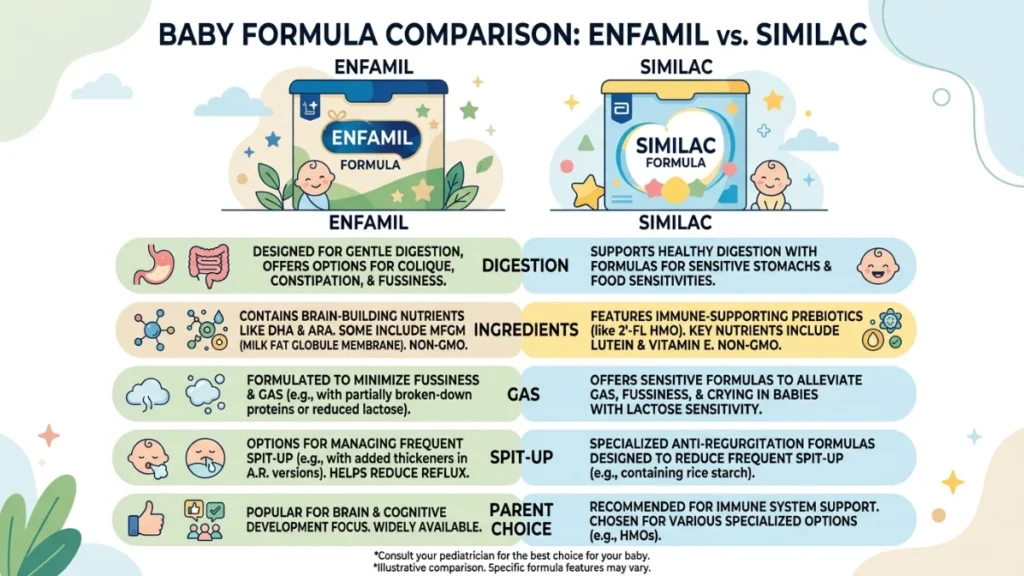

Enfamil and Similac are both trusted infant formulas. Enfamil is often chosen for gentler digestion, while Similac is often preferred for lower palm oil content and broad availability.
When I first had to compare Enfamil and Similac, I thought the answer would be simple. It was not. I stood in front of a store shelf reading labels, checking ingredients, and trying to understand why parents strongly preferred one over the other. The real challenge was not choosing the “best” brand. It was understanding which formula matched the baby’s needs.
I started comparing digestion, ingredients, stool changes, and how babies reacted after feeding. That experience taught me something important: the right formula depends more on the baby than the brand name. If you are confused between Enfamil or Similac, this guide will help you understand the real differences clearly.
Enfamil or Similac Quick Answer
Both Enfamil and Similac are well-known infant formula brands.
Neither is universally better.
Enfamil is often chosen for babies who need gentler digestion.
Similac is often preferred by parents who want formulas that commonly avoid palm olein oil in many popular varieties.
The best choice depends on your baby’s digestion, tolerance, feeding pattern, and pediatrician’s advice.
What Is Enfamil
Enfamil is a major infant formula brand used by many families from birth through the first year.
It offers formulas for:
- standard infant feeding
- sensitive stomachs
- spit-up concerns
- premature babies
- plant-based feeding needs
Parents often mention Enfamil when babies need easier digestion or when they are switching from breast milk to formula.
Common Enfamil Lines
- Enfamil Infant
- Enfamil NeuroPro
- Enfamil Gentlease
- Enfamil AR
- Enfamil ProSobee
What Is Similac
Similac is another leading infant formula brand widely used for newborns and infants.
It also offers formulas for many feeding needs.
Similac is often chosen for:
- standard daily feeding
- tummy sensitivity
- immune support formulas
- lactose-sensitive feeding
- organic feeding choices
Common Similac Lines
- Similac Advance
- Similac 360 Total Care
- Similac Sensitive
- Similac Alimentum
- Similac Soy Isomil
Enfamil or Similac Meaning for Parents
For many parents, this question is not simply about ingredients.
It usually means:
- Which formula is easier on the baby’s stomach?
- Which formula causes less gas?
- Which one helps with constipation?
- Which formula causes less spit-up?
- Which brand is easier to continue long term?
That is why parents search Enfamil or Similac. They want practical answers, not just labels.
Enfamil or Similac Difference
| Feature | Enfamil | Similac |
|---|---|---|
| Digestion reputation | Often chosen for gentler digestion | Often chosen for broad tolerance |
| Popular parent reason | Gas and fussiness support | Ingredient preference |
| Common ingredient focus | DHA and brain support | HMO blends and nutrition support |
| Stool changes | Can vary by baby | Can vary by baby |
| Formula variety | Wide range | Wide range |
Key Point
The biggest difference is often how your baby reacts, not just what the label says.
The Origin of Enfamil and Similac
Understanding the background helps parents trust what they are choosing.
Enfamil History
Enfamil has been used for decades and has long focused on infant nutrition, brain development support, and specialized formulas for sensitive babies.
Similac History
Similac also has a long history in infant feeding and is widely used in hospitals and pediatric feeding programs.
Why This Matters
Parents often trust these brands because they are established and widely recognized.
That does not mean one is perfect for every baby.
Why Parents Compare Enfamil and Similac
Parents usually compare these two brands because babies react differently to formula.
Digestion Concerns
A baby may do well on one formula and become gassy on another.
Stool Changes
Formula can change stool color, texture, and frequency.
Fussiness
Some babies seem calmer on one brand.
Spit-Up
A baby may spit up less with a different formula.
Pediatric Recommendations
Hospitals and pediatricians often introduce one of these brands early.
Ingredient Comparison Between Enfamil and Similac
Parents often compare ingredients first.
Protein
Both formulas use milk-based proteins in many standard versions.
Protein digestion can affect:
- gas
- fussiness
- comfort after feeding
DHA and Brain Support
Both brands include DHA in many formulas.
Prebiotics and HMOs
Many modern formulas from both brands include ingredients designed to support gut health.
Fat Sources
Parents often compare palm oil content because some babies seem to tolerate certain fat blends differently.
Important Note
Ingredient differences matter, but baby response matters more.
Enfamil or Similac for Digestion
This is one of the most searched concerns.
When Parents Prefer Enfamil
Some parents feel Enfamil works better for babies with:
- mild gas
- fussiness
- sensitive digestion
When Parents Prefer Similac
Some parents choose Similac because their baby seems more comfortable with its ingredient profile.
Reality
No formula works the same for every baby.
Two babies can drink the same formula and react completely differently.
Enfamil or Similac for Gas and Fussiness
Gas is one of the biggest reasons parents switch formulas.
Enfamil
Many parents try Enfamil Gentlease when babies seem gassy or uncomfortable.
Similac
Some parents use sensitive Similac formulas when gas or fussiness appears.
Important Truth
Gas does not always mean the formula is wrong.
Newborn digestion changes rapidly in the first months.
Enfamil or Similac for Constipation
Constipation worries many parents.
Formula changes can affect stool.
What Parents Often Notice
A baby may have:
- firmer stools
- fewer bowel movements
- harder stool texture
Important Reminder
Constipation can depend on:
- formula type
- hydration
- age
- feeding frequency
One brand is not automatically better for every baby.
Enfamil or Similac for Spit-Up
Spit-up is common.
Parents often change formula too quickly because of spit-up.
Normal Spit-Up
Many babies spit up and still grow normally.
When Formula May Matter
If spit-up is frequent, uncomfortable, or affects feeding, pediatricians may suggest trying another formula type.
Both brands offer formulas made for spit-up concerns.
Enfamil or Similac in Everyday Situations
Newborn Feeding
Parents often start with the formula introduced in hospital.
Transition From Breastfeeding
Some babies adjust easily. Others need a slower transition.
Sensitive Tummy
Parents often test one formula for a few days before deciding.
Budget Planning
Long-term formula cost also matters for many families.
Real Parent Situations
Example 1
A baby becomes fussy after every bottle.
Parents may ask whether the issue is hunger, burping, feeding speed, or formula tolerance.
Example 2
A baby drinks well but has hard stools.
Parents often start comparing Enfamil or Similac immediately.
Example 3
A baby spits up often.
Parents may switch formulas before checking whether spit-up is simply normal.
Which Formula Should You Choose
This depends on the baby.
Choose Based on Baby Response
Ask these questions:
- Does the baby finish feeds comfortably?
- Is the baby unusually fussy after feeding?
- Is there excessive gas?
- Is stool normal for that baby?
- Is weight gain healthy?
A Practical Rule
The formula that your baby tolerates well is often the better choice.
When Switching From Enfamil to Similac or Similac to Enfamil
Parents switch formulas often.
Reasons for Switching
- gas
- fussiness
- constipation
- spit-up
- availability
- pediatric advice
A Better Approach
Give a formula a little time unless there is a medical concern.
Babies sometimes need a short adjustment period.
Common Mistakes Parents Make
Switching Too Quickly
Many parents switch after one difficult feeding.
Comparing Babies
What works for one baby may not work for another.
Following Social Media Alone
Online opinions can be helpful but should not replace medical guidance.
Expecting Instant Results
Digestion changes can take time.
Enfamil or Similac in Everyday Examples
At the Store
We started with Similac because it was available, then moved to Enfamil when gas became a problem.
At Home
The baby seemed calmer after switching to Enfamil.
Pediatric Discussion
Our doctor suggested staying with Similac because weight gain looked healthy.
Parent Conversation
We tried both, but only one worked well for our baby.
Why Babies React Differently
Babies are not identical.
Differences may come from:
- digestive maturity
- feeding speed
- swallowing air
- sensitivity to ingredients
- feeding amount
- natural development changes
That is why there is no universal winner.
Enfamil or Similac for First-Time Parents
First-time parents often feel pressure to choose perfectly.
That pressure can make formula decisions stressful.
A better approach is simple.
Watch the baby.
Look for:
- comfort after feeding
- normal diaper changes
- steady feeding
- healthy growth
Those signs usually matter more than brand popularity.
Usage Trends and Parent Preference
In many families, the decision depends on practical factors.
What Parents Usually Compare
- digestion
- availability
- price
- baby tolerance
- pediatrician familiarity
Most parents do not stay loyal to a brand.
They stay loyal to what works.
Enfamil or Similac Quick Comparison Table
| Question | Enfamil | Similac |
|---|---|---|
| Good for standard feeding | Yes | Yes |
| Good for sensitive feeding options | Yes | Yes |
| Common hospital familiarity | Yes | Yes |
| Widely available | Yes | Yes |
| Better for every baby | No | No |
Exercise 1 Choose the Better Statement
A formula is better because everyone online recommends it.
Answer: Incorrect. Baby tolerance matters more.
A formula may work differently for each baby.
Answer: Correct.
Gas after one bottle always means the formula is wrong.
Answer: Incorrect.
Exercise 2 Complete the Sentence
The best formula is usually the one that your baby ______ well.
Answer: tolerates
Parents often compare Enfamil and Similac because babies react ______.
Answer: differently
A formula change should often be based on baby comfort and ______ advice.
Answer: pediatrician
FAQs
Is Enfamil better than Similac?
Not always. Enfamil may work better for some babies, while Similac may work better for others. Baby response matters most.
Is Similac easier to digest than Enfamil?
For some babies yes, for others no. Digestion depends on the individual baby.
Which formula is better for gas?
Some parents try gentler formulas first, but there is no universal answer.
Can I switch from Enfamil to Similac?
Yes, many parents switch formulas. It is best to monitor baby comfort and ask a pediatrician if concerns continue.
Which formula do hospitals use?
Hospitals may use different brands depending on location and supply.
Why does my baby react differently to formulas?
Babies differ in digestion, feeding habits, and sensitivity to ingredients.
Should I change formula after one bad feeding?
Usually not. One feeding alone may not show how well a formula truly works.
Conclusion
The question Enfamil or Similac sounds simple, but for parents it often feels emotional and stressful. I learned this myself when I tried to compare labels and ingredients, only to realize that the real answer was not on the can. It was in the baby’s response.
Both brands are widely used and trusted. Both offer many formula options. Both can work very well. The difference often appears in how your baby digests the formula, how comfortable feeding feels, and how the baby behaves after a bottle.
That is why there is no universal winner.
If your baby feeds comfortably, grows well, has manageable digestion, and seems content after feeding, that formula is probably doing its job.
For most parents, the best formula is not the most popular one.
It is the one that works best for their baby.