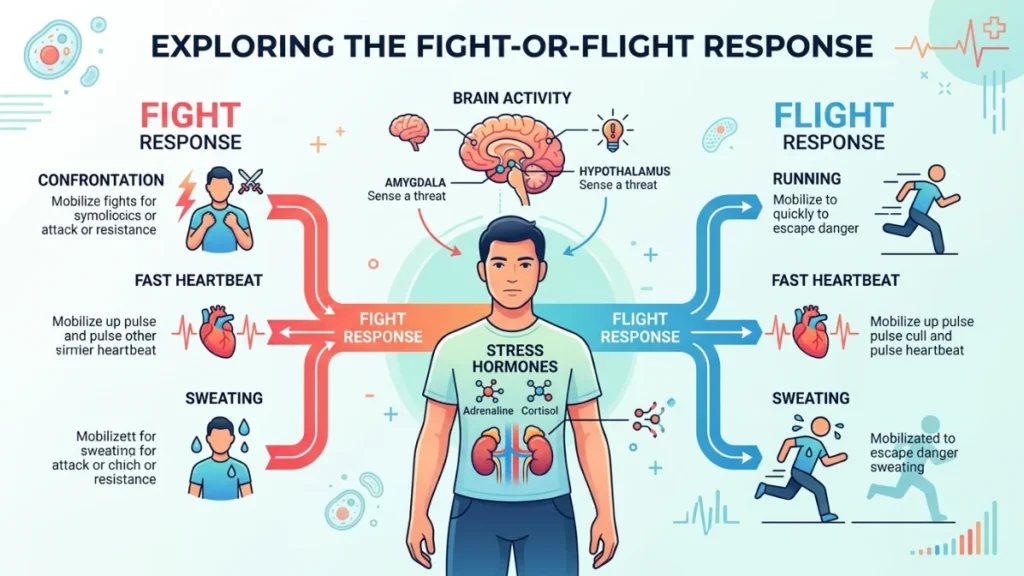

Fight or flight is the body’s automatic stress response. It prepares you to face danger by fighting the threat or escaping from it quickly.
I first understood the meaning of fight or flight during a stressful situation where my heart suddenly started racing before an important presentation. My hands became sweaty, breathing changed, and my mind felt like it had only two options: stay and deal with the pressure or escape completely. At first, I thought something was wrong. Later, I learned this reaction is actually normal.
That experience pushed me to understand how the body reacts under stress and why humans experience these powerful responses. Once I understood the science behind it, stressful situations became easier to manage.
If you have ever frozen during pressure, panicked before an exam, or suddenly felt intense fear, understanding fight or flight can help explain what is happening inside your body.
Quick Answer
Fight or flight is a biological response that happens when the brain detects danger.
The body automatically prepares itself to:
Fight the threat
Escape from danger
React quickly for survival
Simple Examples
Seeing a dangerous animal
Hearing sudden loud noises
Experiencing extreme stress
Facing physical danger
What Does Fight or Flight Mean
Fight or flight refers to the body’s natural survival mechanism.
When humans sense danger, the brain immediately activates physical and mental changes.
The purpose is simple:
Increase survival chances.
The body begins preparing for action before you consciously decide what to do.
Fight Response
Fight means confronting danger.
Examples:
Defending yourself
Arguing during conflict
Taking action under pressure
Flight Response
Flight means escaping danger.
Examples:
Running away
Avoiding threatening situations
Leaving dangerous environments
Fight or Flight Difference
| Response | Meaning | Typical Behavior |
|---|---|---|
| Fight | Face danger directly | Confrontation |
| Flight | Escape danger | Avoidance |
| Both | Survival response | Fast reactions |
The Origin of Fight or Flight
The term fight or flight was introduced by physiologist Walter Cannon in the early twentieth century.
He studied how humans and animals respond to stress.
His research discovered that danger activates automatic body reactions designed for survival.
Long before modern civilization, this response helped humans survive predators and environmental threats.
Although life has changed, the biological system remains largely the same.
Today, the same response activates during:
Work stress
Exams
Public speaking
Relationship conflicts
Financial pressure
How Fight or Flight Works
The process happens extremely quickly.
Step 1: Brain Detects Danger
The brain identifies possible threats.
This could be real danger or perceived danger.
Step 2: Brain Sends Emergency Signals
The brain activates the nervous system.
Hormones are released.
Step 3: Body Changes Begin
Heart rate increases.
Breathing speeds up.
Muscles tighten.
Focus becomes stronger.
Step 4: Action Preparation
The body prepares to:
Fight
Run
Protect itself
The Science Behind Fight or Flight
Several body systems work together.
Nervous System
The nervous system sends emergency signals throughout the body.
Hormones
Stress hormones increase energy and alertness.
Important hormones include:
Adrenaline
Cortisol
Noradrenaline
Brain Activity
The brain temporarily prioritizes survival instead of long term thinking.
This explains why people sometimes make fast emotional decisions during stress.
Physical Symptoms of Fight or Flight
Many people experience symptoms without realizing the cause.
Common Physical Signs
Fast heartbeat
Sweating
Rapid breathing
Shaking
Dry mouth
Muscle tension
Dilated pupils
Upset stomach
Why These Symptoms Happen
The body redirects energy toward survival.
Systems not immediately necessary temporarily receive less attention.
Emotional Symptoms of Fight or Flight
The response also affects emotions.
Common emotional reactions include:
Fear
Panic
Anxiety
Anger
Irritability
Restlessness
Feeling overwhelmed
Fight or Flight in Everyday Life
Many situations trigger this response.
Public Speaking
Many people experience:
Sweaty hands
Fast heartbeat
Shaking
Exams
Students often feel:
Pressure
Panic
Difficulty concentrating
Workplace Stress
Deadlines can trigger survival responses.
Driving Situations
Unexpected road events may activate instant reactions.
Fight or Flight vs Freeze Response
Many people think there are only two responses.
Actually, another common response exists.
Freeze Response
Instead of fighting or escaping, some people temporarily become unable to react.
Examples:
Suddenly becoming silent
Feeling stuck
Not knowing what to do
Comparison Table
| Response | Action |
|---|---|
| Fight | Confront danger |
| Flight | Escape danger |
| Freeze | Become temporarily inactive |
Why People Experience Fight or Flight Differently
Not everyone reacts the same way.
Several factors influence responses.
Previous Experiences
Past experiences shape reactions.
Personality
Some people naturally react faster.
Environment
Current surroundings matter.
Stress Levels
Higher stress may increase response intensity.
Common Triggers of Fight or Flight
Physical Threats
Dangerous situations
Accidents
Injuries
Social Threats
Embarrassment
Public speaking
Arguments
Psychological Stress
Work pressure
Exams
Financial problems
Fight or Flight and Anxiety
People often confuse anxiety with fight or flight.
Fight or flight is temporary.
Anxiety may keep the body in a prolonged state of alertness.
Repeated activation can make symptoms feel stronger.
Fight or Flight in Children
Children experience the response too.
Common signs include:
Crying
Hiding
Running away
Aggressive behavior
Difficulty concentrating
Understanding these reactions helps adults respond appropriately.
Fight or Flight in Animals
Animals rely heavily on survival responses.
Examples:
Birds flying away
Cats defending themselves
Deer running from predators
Humans still carry similar biological systems.
Benefits of Fight or Flight
Although uncomfortable, the response has advantages.
Faster Reactions
Danger detection improves speed.
More Energy
Extra energy helps survival.
Improved Focus
Attention temporarily increases.
Problems When Fight or Flight Activates Too Often
Frequent activation can create difficulties.
Examples:
Exhaustion
Poor sleep
Stress
Difficulty concentrating
Emotional fatigue
Long periods of stress may affect overall wellbeing.
How People Manage Fight or Flight Responses
Many strategies can help.
Controlled Breathing
Slowing breathing may reduce intensity.
Physical Activity
Movement helps use extra energy.
Sleep
Good sleep supports recovery.
Understanding Triggers
Identifying triggers may improve responses.
Fight or Flight in Everyday Examples
Email Example
I felt my fight or flight response activate before the presentation.
Social Media Example
My heart races every time I speak publicly.
Workplace Example
The stressful meeting triggered immediate anxiety.
Academic Example
Students often experience fight or flight during exams.
Exercise 1 Choose the Correct Response
Someone sees a dangerous dog and runs away.
Answer: Flight
A person defends themselves during danger.
Answer: Fight
Someone suddenly cannot react during stress.
Answer: Freeze
Exercise 2 Identify the Trigger
Public speaking causes sweating.
Answer: Stress trigger
Seeing an accident increases heartbeat.
Answer: Danger trigger
Work deadlines create anxiety.
Answer: Psychological trigger
FAQs
What is fight or flight?
Fight or flight is an automatic survival response that prepares the body to confront danger or escape from it.
Why does fight or flight happen?
It happens because the brain detects threats and activates survival systems.
Is fight or flight normal?
Yes. It is a natural biological response.
What hormones cause fight or flight?
Stress hormones increase energy and alertness during dangerous situations.
Can stress trigger fight or flight?
Yes. Modern stress frequently activates this response.
What is the difference between fight and flight?
Fight means confronting danger while flight means escaping it.
Can children experience fight or flight?
Yes. Children experience similar survival responses.
Conclusion
Fight or flight is one of the body’s most powerful survival mechanisms. It exists to protect humans during danger by preparing the body for quick action. Although modern life rarely involves predators or physical threats, the same biological system still responds to stress, fear, pressure, and uncertainty.
Understanding how this response works makes stressful situations easier to recognize and manage. Symptoms like rapid heartbeat, sweating, or panic often feel alarming, but they are usually signs that the body is trying to protect itself.
The key is not eliminating fight or flight completely. Instead, learning how it works allows people to respond more effectively when stress appears.
Once you understand the system, it becomes easier to work with your body’s natural reactions instead of fighting against them.