
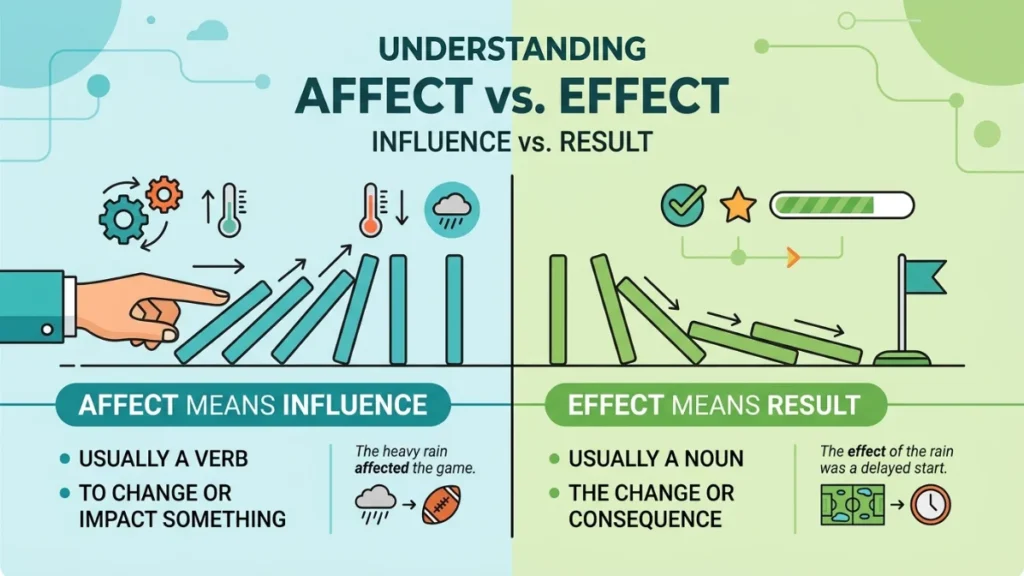

Affect is usually a verb that means to influence something. Effect is usually a noun that means a result or outcome. Example: The weather affected traffic. The effect was delays.
I used to confuse effect and affect more than almost any other English words. During professional writing, I often paused before typing them because both sounded similar and looked almost identical. One day, I sent an email using the wrong word and later realized the mistake while rereading it. That small error pushed me to learn the actual grammar rule behind these words.
What I discovered made things much easier. The confusion exists because these words have related meanings, similar pronunciation, and unusual grammar patterns. After learning a few simple rules and practicing real examples, I stopped second guessing myself.
If you also hesitate every time you write effect or affect, this guide will help you understand the difference clearly and use both words confidently.
Quick Answer
Affect is usually a verb.
It means to influence or change something.
Effect is usually a noun.
It means a result or consequence.
Quick Examples
The rain affected traffic.
The effect was longer travel time.
Effect or Affect Meaning
Understanding each word separately makes the difference easier.
What Does Affect Mean
Affect usually means to influence, change, or impact something.
Examples:
Stress can affect sleep.
Weather affects travel plans.
Poor communication affects teamwork.
What Does Effect Mean
Effect usually means the result or outcome of something.
Examples:
The effect of stress can be serious.
The new policy had positive effects.
The medicine produced immediate effects.
Effect vs Affect Difference
| Word | Usually Functions As | Meaning | Example |
|---|---|---|---|
| Affect | Verb | To influence | The weather affected us |
| Effect | Noun | Result or outcome | The effect was noticeable |
Easy Rule
Affect equals Action.
Effect equals End result.
This rule solves most situations.
Grammar Rule Depth
Understanding grammar is the easiest way to master these words.
Affect Is Usually a Verb
A verb describes an action.
Because affect means influencing something, it usually acts as a verb.
Examples:
The economy affects prices.
Stress affects health.
Exercise affects mood.
Notice something receives the action.
Effect Is Usually a Noun
A noun names a person, thing, idea, or result.
Effect describes outcomes.
Examples:
The effect was immediate.
Side effects are common.
The effect surprised everyone.
The Rare Exceptions
This is where many learners become confused.
Effect Can Sometimes Be a Verb
As a verb, effect means to bring about or create something.
Examples:
The manager effected major changes.
The government effected reforms.
This usage is formal and less common.
Affect Can Sometimes Be a Noun
In psychology, affect can describe emotional expression.
Example:
The patient displayed flat affect.
Most everyday writing does not use affect this way.
The Origin of Effect and Affect
Both words come from Latin.
Affect Origin
Affect comes from Latin words meaning to influence or act upon.
Over time, English adopted this meaning.
Effect Origin
Effect comes from Latin words meaning to accomplish or produce.
This connection explains why effect became associated with results.
Because both words share similar roots, confusion naturally developed.
Why People Confuse Effect and Affect
There are several reasons.
Similar Pronunciation
Both words sound nearly identical.
Similar Spelling
Only one letter changes.
Related Meanings
Influence and results are closely connected.
Grammar Complexity
One word usually acts as a verb while the other acts as a noun.
These factors combine to create confusion.
Real World Usage of Affect and Effect
Business Writing
Economic conditions affect sales.
The effect was reduced revenue.
Education
Attendance affects performance.
The effect appeared in test scores.
Healthcare
Diet affects health.
The effect may take time.
Technology
Software updates affect performance.
The effect can improve speed.
Affect vs Effect in Emails
Professional communication frequently uses these words.
Examples:
This issue may affect delivery schedules.
The effect of delays could impact customers.
The new policy affected employee productivity.
Its effects were noticeable immediately.
Affect vs Effect in News Writing
Journalists use these words regularly.
Examples:
The storm affected thousands of residents.
The effect of flooding remains severe.
Economic uncertainty affected investors.
The effect spread globally.
Affect vs Effect in Social Media
Examples:
Lack of sleep affects everything.
Coffee has an immediate effect.
Travel affects perspective.
Music has a calming effect.
Common Mistakes with Effect and Affect
Mistake 1 Using Effect as a Verb Incorrectly
Incorrect:
The weather effected my plans.
Correct:
The weather affected my plans.
Mistake 2 Using Affect as a Noun
Incorrect:
The affect was surprising.
Correct:
The effect was surprising.
Mistake 3 Guessing Based on Sound
Because pronunciation is similar, many people simply guess.
Rely on grammar instead.
Simple Memory Tricks
Trick One
Affect = Action
Effect = End Result
Trick Two
Ask yourself:
Am I describing influence?
Use affect.
Am I describing a result?
Use effect.
Trick Three
Replace the word.
If influence fits, choose affect.
If result fits, choose effect.
Affect vs Effect in Different Contexts
Workplace
Changes affect productivity.
The effect was improved efficiency.
School
Study habits affect grades.
The effect appeared quickly.
Health
Diet affects energy.
The effect may be significant.
Personal Life
Relationships affect emotions.
The effect can last years.
Related Words
Affect Related Words
influence
impact
alter
change
modify
Effect Related Words
result
consequence
outcome
reaction
impact
Usage Trends
Effect appears more frequently because nouns are extremely common in writing.
Affect appears heavily in academic, scientific, and business contexts.
Many language learners search this topic because both words remain among the most commonly confused English terms.
Exercise 1 Choose the Correct Word
The weather ______ travel plans.
Answer: affects
The medicine had an immediate ______.
Answer: effect
Stress can ______ sleep quality.
Answer: affect
The new law produced positive ______.
Answer: effects
Exercise 2 Correct the Sentence
The effect of stress can affect your health.
Answer:
The sentence is already correct.
The rain effected traffic.
Answer:
The rain affected traffic.
The affect was significant.
Answer:
The effect was significant.
FAQs
What is the difference between affect and effect?
Affect usually means influence and works as a verb. Effect usually means result and works as a noun.
Is affect always a verb?
Usually yes, but psychology sometimes uses affect as a noun.
Is effect always a noun?
Usually yes, but formal writing sometimes uses effect as a verb meaning create or accomplish.
How can I remember affect vs effect?
Remember Affect equals Action and Effect equals End result.
Which word is more common?
Both are common, but effect appears slightly more frequently.
Why do people confuse effect and affect?
They sound similar, look similar, and have related meanings.
Can affect and effect be interchangeable?
Usually no because they perform different grammar functions.
Conclusion
Understanding effect or affect becomes much easier once you focus on grammar instead of pronunciation. Although these words look similar and sound almost identical, their functions are different.
Affect usually acts as a verb and means to influence something. Effect usually acts as a noun and means the result of something. This simple distinction solves most situations.
The confusion is common because both words are closely related in meaning. Causes create results, which naturally connects influence and outcomes. However, remembering small rules like Affect equals Action and Effect equals End result makes choosing the correct word much easier.
Practice using these words in everyday writing, emails, conversations, and professional documents. With repetition, the difference becomes automatic and you will stop second guessing yourself.