
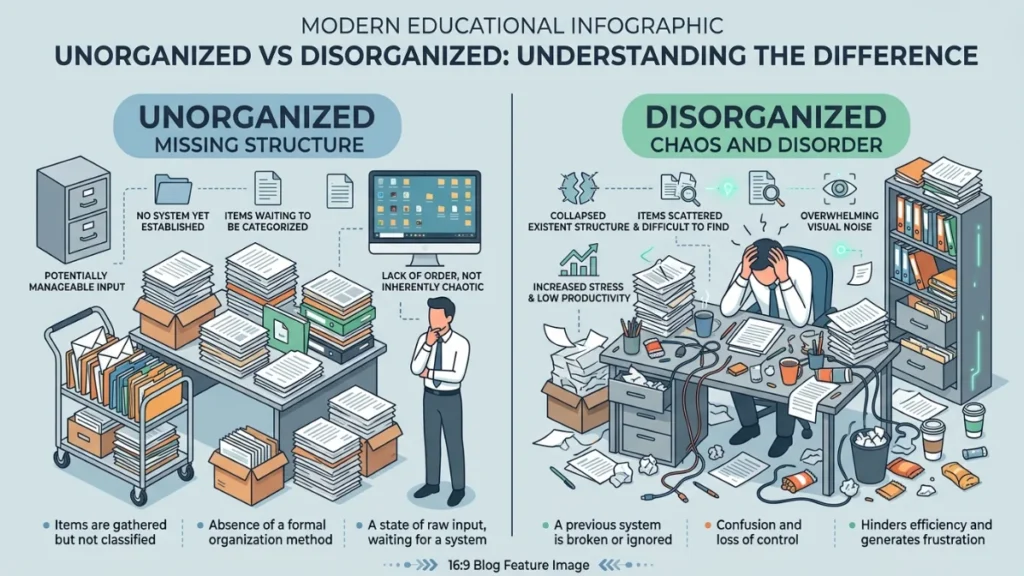

Unorganized means not arranged or planned properly. Disorganized means lacking order or becoming messy. Both are similar, but disorganized usually suggests more confusion or disorder.
I used to think unorganized and disorganized meant exactly the same thing. While writing reports and editing content, I often switched between these words without thinking. Then someone pointed out that although both describe disorder, they are not always used in the same way.
After checking grammar guides, dictionaries, and real examples, I realized the difference is mostly about how the disorder happens and how strong it feels. Once I started paying attention to context, choosing between the two became much easier.
If you also struggle with unorganized vs disorganized, this guide will help you understand the difference clearly with examples, grammar rules, real world usage, exercises, and practical tips.
Unorganized vs Disorganized Quick Answer
Unorganized means something has not been arranged, planned, or structured properly.
Disorganized means something lacks order or has become messy or confused.
Quick Examples
My desk is unorganized because I never arranged it.
The office became disorganized after the renovation.
Unorganized vs Disorganized Meaning
Although these words are similar, they create slightly different meanings.
What Does Unorganized Mean
Unorganized describes something that is not arranged or not properly planned.
It often suggests something was never organized in the first place.
Examples:
The files are unorganized.
Her notes look unorganized.
The project remains unorganized.
What Does Disorganized Mean
Disorganized describes something that is messy, confused, chaotic, or lacking order.
It often suggests something lost organization or failed to maintain it.
Examples:
The department became disorganized.
His schedule is completely disorganized.
The meeting felt disorganized.
Unorganized vs Disorganized Difference
| Word | Main Meaning | Common Use | Suggests |
|---|---|---|---|
| Unorganized | Not organized | Structure and planning | Missing organization |
| Disorganized | Lacking order | Confusion and mess | Disorder or chaos |
Simple Rule
If something was never organized, use unorganized.
If something became messy or chaotic, use disorganized.
Grammar Rule Depth
Both words are adjectives.
Both describe nouns.
Examples:
The room is unorganized.
The team is disorganized.
However, their word formation is slightly different.
Unorganized
Prefix: un
Root word: organized
The prefix un simply means not.
Therefore:
organized → unorganized
Disorganized
Prefix: dis
Root word: organized
The prefix dis often suggests:
reversal
removal
breakdown
loss
Therefore:
organized → disorganized
This is why disorganized usually feels stronger.
The Origin of Unorganized and Disorganized
Understanding history makes the difference easier.
Origin of Organize
The word organize comes from Greek and Latin roots related to arrangement and structure.
Origin of Unorganized
Unorganized developed by adding un, meaning not organized.
Origin of Disorganized
Disorganized developed by adding dis, meaning to break apart or reverse organization.
Because of these prefixes, both words evolved with slightly different meanings.
Why People Confuse Unorganized and Disorganized
Several reasons create confusion.
Similar Meaning
Both describe lack of order.
Same Root Word
Both come from organize.
Dictionary Overlap
Many dictionaries use similar definitions.
Everyday Usage
People often use them interchangeably.
Real World Usage of Unorganized and Disorganized
Workplace
An unorganized worker may forget planning.
A disorganized worker may create chaos.
Example:
The new employee was unorganized.
The entire department became disorganized.
Education
Students often use both words.
Example:
My study notes are unorganized.
My backpack is completely disorganized.
Business
Businesses prefer structured systems.
Example:
The company suffered because management was disorganized.
Daily Life
Many everyday situations use these words.
Example:
My closet is unorganized.
My room became disorganized after moving.
Unorganized vs Disorganized in Professional Writing
Professional writing sometimes prefers one word over another.
Use Unorganized When Talking About Structure
Examples:
An unorganized database
An unorganized report
An unorganized plan
Use Disorganized When Talking About Performance or Behavior
Examples:
A disorganized team
A disorganized process
A disorganized meeting
Unorganized vs Disorganized in Emails
Unorganized Example
Your files appear unorganized.
Disorganized Example
The project became disorganized after deadlines changed.
Unorganized vs Disorganized in Social Media
Examples:
My desk looks so unorganized today.
My entire week has been disorganized.
Unorganized vs Disorganized in Formal Writing
Examples:
The information was presented in an unorganized manner.
The response system became disorganized during the emergency.
Which Word Should You Use
Use Unorganized When
Something lacks planning
Structure does not exist
Organization never happened
Use Disorganized When
Something becomes chaotic
Order breaks down
Confusion exists
General Rule
Unorganized focuses more on missing structure
Disorganized focuses more on confusion or disorder
Common Mistakes with Unorganized vs Disorganized
Mistake 1 Using Them as Exact Synonyms
They overlap but are not identical.
Mistake 2 Using Disorganized for Simple Missing Structure
Incorrect:
The blank folder is disorganized.
Better:
The folder is unorganized.
Mistake 3 Using Unorganized for Chaos
Incorrect:
The emergency response became unorganized.
Better:
The emergency response became disorganized.
Related Words and Similar Expressions
Similar Words for Unorganized
unordered
unplanned
unsorted
messy
Similar Words for Disorganized
chaotic
confused
disordered
cluttered
Usage Trends and Language Patterns
In modern English:
Disorganized appears more frequently.
This is because it describes:
behavior
systems
business
productivity
mental processes
Unorganized appears more in:
storage
planning
arrangement
documents
Everyday Examples
Home
My drawers are unorganized.
My room became disorganized after guests visited.
Office
The files remain unorganized.
The workflow became disorganized.
School
My notes are unorganized.
The group project became disorganized.
Exercise 1 Choose the Correct Word
My desk is completely ______ because I never sorted anything.
Answer: unorganized
The meeting became ______ after the speaker left.
Answer: disorganized
The folder structure remains ______.
Answer: unorganized
The department feels extremely ______.
Answer: disorganized
Exercise 2 Correct the Sentence
The emergency team became unorganized during the crisis.
Answer:
The emergency team became disorganized during the crisis.
My unsorted notes are disorganized.
Answer:
My unsorted notes are unorganized.
FAQs
What is the difference between unorganized and disorganized?
Unorganized means lacking organization or structure. Disorganized means lacking order or becoming chaotic.
Is unorganized correct English?
Yes. Unorganized is a correct English word and commonly used.
Which word is stronger?
Disorganized is usually stronger because it suggests confusion or disorder.
Can unorganized and disorganized be used interchangeably?
Sometimes yes, but context matters because their meanings are slightly different.
Is disorganized more common?
Yes. Disorganized appears more frequently in modern English.
Should I use unorganized in professional writing?
Yes, especially when discussing structure, planning, or arrangement.
Which word should I use for messy rooms?
Usually disorganized because it suggests disorder and chaos.
Conclusion
Understanding unorganized vs disorganized becomes easier when you focus on how the disorder exists.
Unorganized usually means something lacks structure or was never properly arranged. It focuses more on missing planning or missing order.
Disorganized usually means something became messy, chaotic, or difficult to manage. It often suggests stronger disorder.
Although these words overlap, choosing the right one makes your writing clearer and more precise. Professional writing, business communication, academic work, and daily conversations all benefit from understanding this small difference.
A simple way to remember is:
Unorganized means not organized.
Disorganized means organization broke down.
Once you remember this rule, choosing the correct word becomes much easier.