
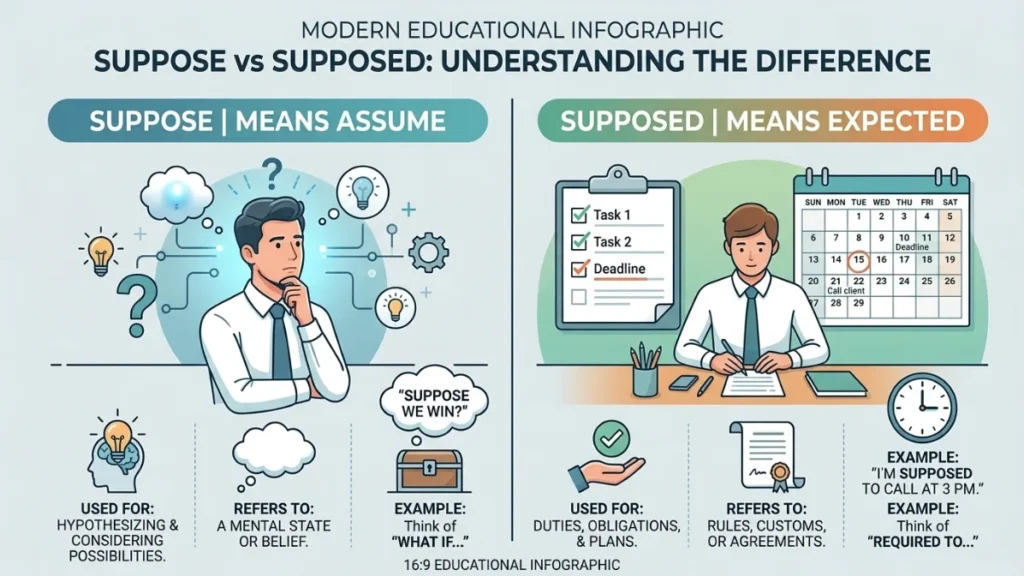

Suppose is a verb meaning to assume or imagine something. Supposed is usually the past form or an adjective meaning expected or required.
I used to confuse suppose and supposed more often than I expected. While writing emails and messages, I would sometimes write things like “I am suppose to attend” without realizing something sounded wrong. After seeing this mistake repeatedly in professional communication, I decided to understand the grammar behind both words. What I learned was simple.
Suppose is usually an action word, while supposed often describes expectation or requirement. Once I understood this rule and practiced real examples, the confusion disappeared. If you also struggle with suppose or supposed, this guide will explain everything clearly with examples, grammar rules, mistakes, and exercises.
Suppose or Supposed Quick Answer
Suppose is a verb.
Supposed is usually the past tense or an adjective.
Examples
I suppose he is busy.
You are supposed to finish the report today.
Suppose or Supposed Meaning
Understanding the meanings first makes everything easier.
What Does Suppose Mean
Suppose means:
To assume something
Imagine something
To believe something may be true
Examples:
I suppose she already knows.
Suppose you won the lottery.
We suppose the meeting starts at noon.
What Does Supposed Mean
Supposed usually means:
Expected
Required
Believed
Intended
Examples:
You are supposed to call first.
The package was supposed to arrive yesterday.
He is supposed to be the manager.
Suppose vs Supposed Difference
| Word | Part of Speech | Meaning | Example |
|---|---|---|---|
| Suppose | Verb | Assume or imagine | Suppose you win |
| Supposed | Adjective or past form | Expected or required | You are supposed to study |
Simple Rule
Use suppose for actions.
Use supposed for expectations.
Grammar Rule Depth
Grammar is where most confusion happens.
Suppose Is Usually a Verb
A verb shows action.
Examples:
I suppose he knows.
They suppose everything will work.
We suppose this is correct.
Supposed Works as an Adjective
Examples:
You are supposed to be here.
This machine is supposed to work.
The train was supposed to arrive earlier.
Past Tense Usage
Present:
suppose
Past:
supposed
Examples:
Yesterday I supposed they would agree.
Although grammatically correct, this usage is less common today.
The Origin of Suppose and Supposed
Both words come from Latin.
The root means:
“To place under”
Over time English developed the word suppose meaning:
assume
believe
imagine
Later supposed developed additional meanings involving expectation.
That is why modern English uses them differently.
Why People Confuse Suppose and Supposed
There are several reasons.
Similar Spelling
The words differ by only two letters.
Similar Pronunciation
When spoken quickly they sound similar.
Missing D Problem
Many people forget adding d.
Example:
Incorrect:
I am suppose to go.
Correct:
I am supposed to go.
Grammar Confusion
People often do not know whether they need a verb or adjective.
Common Grammar Patterns
Suppose That
Examples:
I suppose that he is correct.
They suppose that prices will rise.
Be Supposed To
Examples:
You are supposed to study.
She is supposed to arrive soon.
We were supposed to meet yesterday.
This pattern is extremely common.
Real World Usage of Suppose and Supposed
In Daily Conversation
I suppose we can leave now.
You are supposed to wear shoes here.
In School
Students are supposed to complete homework.
Suppose you could travel anywhere.
In Workplace Communication
Employees are supposed to follow rules.
I suppose the meeting starts at 10.
In Professional Writing
The report is supposed to include all findings.
We suppose demand will increase.
Suppose or Supposed in Everyday Examples
Emails
I suppose we can schedule another meeting.
You are supposed to submit the form today.
News
Experts suppose inflation may decrease.
The project was supposed to finish earlier.
Social Media
I suppose this movie is worth watching.
You were supposed to text me.
Formal Writing
Researchers suppose certain variables affect results.
Participants were supposed to follow instructions.
Suppose vs Supposed in Questions
Questions create additional confusion.
Suppose Questions
Suppose you had unlimited money?
What would happen?
Supposed Questions
Are you supposed to attend?
Was he supposed to call?
Common Mistakes with Suppose or Supposed
Mistake 1
Incorrect:
I am suppose to leave.
Correct:
I am supposed to leave.
Mistake 2
Incorrect:
Supposed you won.
Correct:
Suppose you won.
Mistake 3
Incorrect:
I suppose to go.
Correct:
I am supposed to go.
Mistake 4
Incorrect:
You suppose to wear uniform.
Correct:
You are supposed to wear uniform.
Why Native Speakers Also Make This Mistake
Even native speakers confuse these words.
Reasons include:
Fast typing
Informal communication
Auto correction mistakes
Speech habits
That is why this error appears frequently online.
Related Words and Expressions
Related words help understand usage.
Supposition
Supposedly
Assume
Imagine
Expectation
Theory
These words share similar meanings.
Memory Tricks to Remember the Difference
Simple trick:
Suppose = Think
Supposed = Expected
Another trick:
If you can replace it with expected, use supposed.
Example:
You are expected to arrive.
You are supposed to arrive.
Usage Trends and Language Patterns
Modern English uses supposed much more frequently.
Why?
Because expressions like:
supposed to
was supposed to
are supposed to
appear constantly in speech.
Suppose remains common but is used differently.
Exercise 1 Choose the Correct Word
Fill the blanks.
I ______ he knows.
Answer:
suppose
You are ______ to finish today.
Answer:
supposed
The train was ______ to arrive earlier.
Answer:
supposed
Exercise 2 Correct the Sentence
I am suppose to call.
Answer:
I am supposed to call.
Supposed you became rich.
Answer:
Suppose you became rich.
You suppose to attend class.
Answer:
You are supposed to attend class.
FAQs
What is the difference between suppose and supposed?
Suppose is usually a verb meaning assume or imagine. Supposed usually means expected or required.
Is it suppose to or supposed to?
The correct phrase is supposed to.
Why do people write suppose instead of supposed?
Because both words sound similar and people often forget the final d.
Can supposed be a verb?
Yes. It can be the past tense form of suppose, although this usage is less common.
Is I am suppose correct?
No. The correct phrase is I am supposed.
What does supposed to mean?
It means expected, required, or intended.
Can suppose mean imagine?
Yes. Suppose is often used when asking people to imagine situations.
Conclusion
Understanding suppose or supposed becomes easier when you focus on one simple idea. Suppose is mainly used as a verb that means assume or imagine. Supposed usually describes expectations, requirements, or intentions.
Many mistakes happen because the words sound almost identical. This causes people to forget the letter d or choose the wrong grammar structure. Fortunately, the solution is simple. If the sentence talks about expectation, requirement, or obligation, you usually need supposed. If the sentence talks about imagining or assuming something, suppose is normally correct.
The best way to master these words is practice. Read examples, notice common patterns like “supposed to,” and test yourself regularly. Over time, choosing between suppose and supposed becomes automatic.