
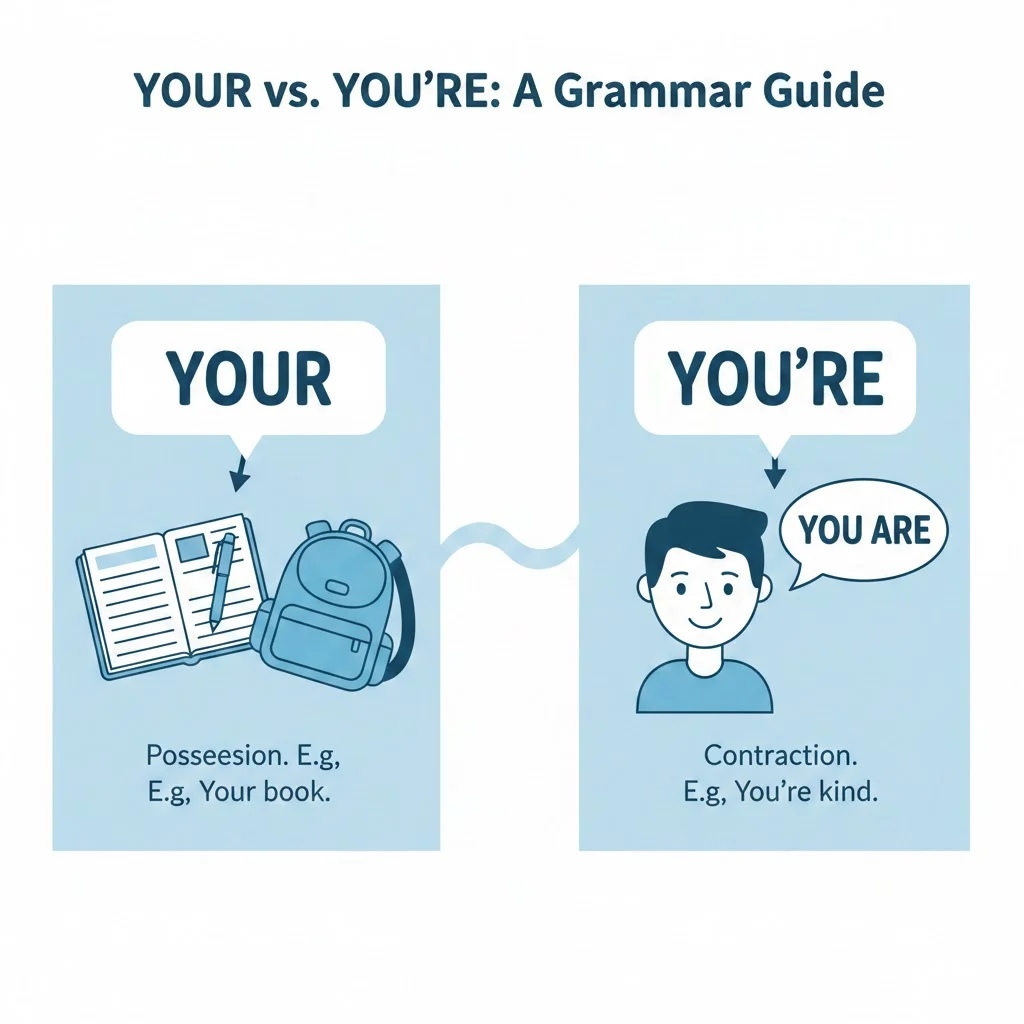
Your shows ownership or possession. You’re is short for you are. Use your before a noun, and use you’re when you mean you are. Replacing you’re with you are is the easiest way to choose the correct word.
Many people feel confused when writing your or you’re because both words sound exactly the same. This confusion is extremely common in messages, emails, school writing, and even professional communication. A missing apostrophe can completely change the meaning of a sentence.
People search for “your or you’re” because they want to avoid embarrassing grammar mistakes. Using the wrong word can make writing look careless or unclear. Even native English speakers make this mistake frequently.
This article explains the difference between your and you’re in a simple and practical way. You will learn clear grammar rules, real life examples, common mistakes, exercises with answers, and tips to remember the correct usage every time.
Quick Answer
Your shows possession.
You’re is a contraction of you are.
Examples
- This is your book.
- You’re late today.
- Is that your phone?
- You’re doing a great job.
Quick Tip
If you can replace the word with you are, then you’re is correct.
Grammar Rules Explained
Your Meaning and Rule
Your is a possessive adjective.
It shows that something belongs to you.
It always comes before a noun.
Examples
- Your house is beautiful.
- Your idea makes sense.
- I like your shoes.
You’re Meaning and Rule
You’re is a contraction of you are.
It always includes an apostrophe.
It describes a state, action, or condition.
Examples
- You’re very kind.
- You’re my best friend.
- You’re learning fast.
Key Difference
- Your = ownership
- You’re = you are
Why People Confuse Your or You’re
Same Pronunciation
Both words sound identical when spoken, which causes confusion in writing.
Apostrophe Ignored
Many writers forget apostrophes or do not understand contractions.
Fast Typing
Quick typing in texts and chats leads to careless errors.
Informal Writing Habits
Social media and texting reduce attention to grammar rules.
Weak Grammar Basics
Some writers are unfamiliar with possessive adjectives and contractions.
Your or You’re in Real Life Usage
Daily Conversation
- This is your bag.
- You’re welcome anytime.
- Your friend is waiting.
- You’re invited to the party.
Emails
- Please submit your report today.
- You’re scheduled for the meeting.
- Your feedback is important.
Social Media
- You’re amazing.
- Don’t forget your goals.
- Your support means a lot.
Formal Writing
- Your application has been approved.
- You’re eligible for the program.
- Your response was appreciated.
British and American English Usage
There is no difference between British and American English.
Both use:
- Your for possession
- You’re for you are
Examples
- UK: Your opinion matters.
- US: Your opinion matters.
- UK: You’re doing well.
- US: You’re doing well.
Which One Should You Use
Ask yourself one simple question.
Can I replace the word with you are?
- If yes, use you’re.
- If no, use your.
Quick Check
- You are late → You’re late
- Your car → ownership
This test works every time.
Common Mistakes and Corrections
Wrong: Your going to love this.
Correct: You’re going to love this.
Wrong: You’re book is on the table.
Correct: Your book is on the table.
Wrong: Your welcome.
Correct: You’re welcome.
Wrong: You’re phone is ringing.
Correct: Your phone is ringing.
Your or You’re in More Sentences
Simple Sentences
- Your answer is correct.
- You’re very helpful.
Medium Sentences
- Your performance has improved.
- You’re making great progress.
Formal Sentences
- Your request has been reviewed.
- You’re eligible for consideration.
Related Confusing Words
Learning similar word pairs helps improve accuracy.
- its or it’s
- lets or let’s
- their or there
- then or than
- whose or who’s
Practice Exercises
Fill in the Blanks
- ______ doing a great job.
Answer: You’re - Is this ______ pen?
Answer: your - ______ invited to the meeting.
Answer: You’re - I like ______ idea.
Answer: your - ______ going to succeed.
Answer: You’re
Choose the Correct Word
- (Your / You’re) late today.
Answer: You’re - This is (your / you’re) responsibility.
Answer: your - (Your / You’re) welcome anytime.
Answer: You’re - I like (your / you’re) style.
Answer: your
FAQs
What is the difference between your and you’re?
Your shows possession, while you’re means you are.
When should I use you’re in a sentence?
Use you’re when you can replace it with you are.
When should I use your in a sentence?
Use your before a noun to show ownership.
Is your or you’re used more often?
Your is used more often because it shows possession.
Why is this mistake so common?
Because both words sound the same and apostrophes are often ignored.
Does you’re always need an apostrophe?
Yes, because it is a contraction of you are.
Conclusion
The confusion between your and you’re is very common, but it is easy to fix. Your shows ownership, while you’re means you are. A simple replacement test helps you choose the correct word every time.
Clear grammar improves writing confidence and communication. By understanding the difference, practicing examples, and checking your sentences, you can avoid this mistake completely. With time and awareness, using your or you’re correctly will become natural and effortless.