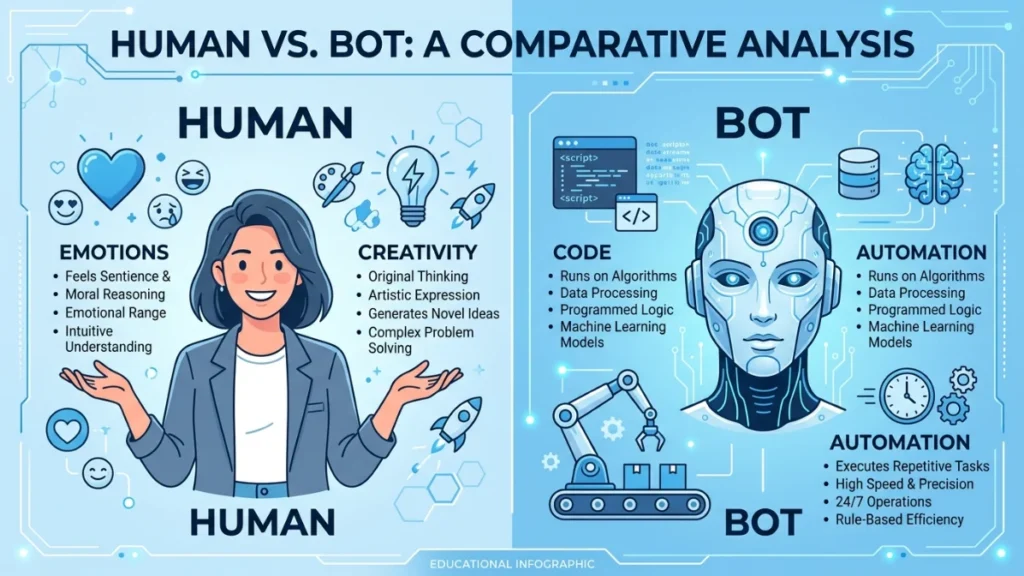

A human is a real person, while a bot is software designed to perform automated tasks. Bots can mimic human behavior online, but humans show natural emotions, creativity, and unpredictable responses.
I once received a message online that seemed completely real. The replies were fast, polite, and natural. After a few minutes, I realized I was not talking to a person at all. It was a bot designed to imitate human conversation. That experience made me curious about how difficult it has become to distinguish between humans and bots online.
Today, bots appear everywhere on social media, websites, games, and customer support systems. Some are helpful, while others spread spam, scams, or fake engagement. Learning the difference between a human and a bot is now an important digital skill. This guide explains what humans and bots are, how they differ, common signs of automated behavior, and practical ways to identify them online.
Human or Bot Quick Answer
A human is a real person with emotions, creativity, and independent thinking.
A bot is an automated software program designed to perform tasks, answer questions, or imitate human behavior online.
Quick Examples
A real customer service employee is human.
An automatic website chat responder is a bot.
A real gamer controls actions naturally.
An automated game farming account is a bot.
Human or Bot Meaning
Understanding the meaning of both terms helps remove confusion.
Human Meaning
A human is a living person capable of thinking, feeling emotions, making decisions, and communicating naturally.
Humans can:
Think creatively
Show empathy
Learn from experiences
Make unpredictable choices
Understand emotional context
Bot Meaning
A bot is a software program created to automate tasks.
Bots can:
Reply automatically
Collect information
Perform repetitive tasks
Generate content
Simulate conversations
Some bots are simple, while advanced AI bots can imitate human communication very closely.
Human vs Bot Difference
| Feature | Human | Bot |
|---|---|---|
| Nature | Real person | Software program |
| Emotions | Real emotions | Simulated responses |
| Creativity | Natural creativity | Programmed patterns |
| Speed | Variable | Extremely fast |
| Decision Making | Independent | Rule based or AI based |
| Mistakes | Natural human mistakes | Repetitive or patterned errors |
| Availability | Limited | Can operate 24/7 |
Key Point
Humans think naturally and emotionally. Bots follow instructions, algorithms, or AI systems.
The Origin of the Word Human
The word human comes from the Latin word humanus, meaning people.
For centuries, the term referred only to real living people with intelligence and emotions.
Today, the word still represents real individuals in contrast to machines or automated systems.
The Origin of the Word Bot
The word bot comes from robot.
The term became popular with the rise of the internet and computer automation.
Early bots performed simple automated actions like sending messages or scanning websites.
Modern AI bots can now:
Write text
Answer questions
Generate images
Play games
Imitate conversation
Why People Search Human or Bot
Many people search this topic because online interaction has changed dramatically.
People want to know:
Is this account real?
Am I chatting with a person?
Can bots copy human behavior?
How can I detect fake accounts?
Are AI chat systems human?
As AI technology improves, distinguishing humans from bots becomes more difficult.
Human or Bot in Social Media
Bots are extremely common on social platforms.
Human Accounts
Human users post naturally and emotionally.
Examples:
Personal photos
Real conversations
Unique opinions
Irregular activity patterns
Bot Accounts
Bots often show repetitive behavior.
Examples:
Posting identical comments
Replying instantly every time
Following thousands of accounts
Sharing spam links repeatedly
Example
A human might post personal experiences and respond emotionally.
A bot may repeatedly post promotional messages with similar wording.
Human or Bot in Customer Support
Many companies now use bots for customer service.
Human Support Agents
Humans understand complex emotional situations.
Example:
A human agent can calm an angry customer and adapt naturally during conversation.
Chatbots
Bots answer common questions automatically.
Example:
A chatbot can instantly provide shipping details or password reset instructions.
Human or Bot in Online Gaming
Bots are common in multiplayer games.
Human Players
Humans react unpredictably and make emotional decisions.
Gaming Bots
Bots often repeat identical movements or strategies.
Examples:
Automatic farming
Auto aiming
Repetitive grinding
Game developers regularly ban bots to protect fair gameplay.
Human or Bot in Website Traffic
Many websites receive traffic from bots.
Helpful Bots
Some bots are useful.
Examples:
Search engine crawlers
Security scanning bots
Customer support bots
Harmful Bots
Some bots create problems.
Examples:
Spam bots
Fake review bots
Scam bots
Ticket buying bots
Common Signs of a Bot
Recognizing patterns helps identify bots online.
Extremely Fast Replies
Bots often respond instantly every time.
Humans usually take varying amounts of time.
Repetitive Language
Bots repeat identical phrases or sentence structures.
Lack of Emotion
Bots may sound polite but emotionally shallow.
24 Hour Activity
Bots can stay active continuously without breaks.
Generic Responses
Bots sometimes avoid direct answers and use broad replies.
Common Signs of a Human
Humans show natural unpredictability.
Emotional Reactions
Humans respond emotionally based on context.
Typing Delays
Humans need time to think and type.
Personal Experiences
Humans share stories, memories, and opinions naturally.
Irregular Activity
People sleep, work, and take breaks.
Human or Bot in AI Technology
Modern AI systems blur the line between humans and bots.
Advanced AI bots can now:
Write articles
Generate conversations
Answer customer questions
Create realistic voices
Imitate human behavior
This makes human detection more challenging than before.
Can Bots Sound Human
Yes. Modern AI bots can sound surprisingly natural.
Large language models analyze massive amounts of text to generate realistic responses.
However, bots still struggle with:
Deep emotional understanding
Long term memory consistency
Personal experiences
Human intuition
Why Bots Exist
Bots are created for many reasons.
Helpful Purposes
Customer support
Search engine indexing
Automation
Scheduling
Data collection
Harmful Purposes
Spam
Scams
Fake engagement
Misinformation
Fraud
Human or Bot in Cybersecurity
Cybersecurity experts constantly monitor bot activity.
Dangerous Bot Activity
Account hacking
Credential stuffing
Fake login attempts
Distributed attacks
Security Detection Systems
Companies use systems to detect:
Abnormal behavior
Unusual traffic
Fast repeated actions
CAPTCHA and Human Verification
Many websites use CAPTCHA systems.
CAPTCHA tests help separate humans from bots.
Examples:
Image selection
Puzzle solving
Checkbox verification
These systems analyze behavior patterns to determine whether a visitor is human.
Human or Bot in Content Creation
AI generated content has become extremely common.
Human Written Content
Often includes:
Personal experiences
Emotional nuance
Original opinions
Bot Generated Content
May include:
Repetitive patterns
Predictable structure
Generic wording
Modern AI content can still sound highly natural.
Human or Bot in Emails
Spam emails are often bot generated.
Human Emails
Usually contain:
Personal details
Natural conversation
Unique context
Bot Emails
Often contain:
Generic greetings
Suspicious links
Mass marketing language
Human or Bot in Reviews
Fake review bots are common online.
Human Reviews
Often include detailed personal experiences.
Bot Reviews
May appear repetitive, generic, or overly promotional.
Why Humans Trust Bots
People sometimes trust bots because:
Bots reply instantly
Bots sound professional
Bots imitate natural language
People assume online communication is human
Advanced AI makes this even harder to detect.
Human or Bot in Daily Life
Bots now appear in everyday tools.
Examples:
Voice assistants
Customer support chats
Recommendation systems
Social media moderation
Smart home devices
Many people interact with bots daily without realizing it.
Real World Examples of Bots
Search Engine Bots
Search engines use bots to scan websites.
Shopping Bots
Bots automatically purchase limited products.
Social Media Bots
Bots generate fake engagement and followers.
AI Chatbots
AI assistants answer questions and simulate conversation.
Human or Bot Ethical Concerns
The rise of AI creates ethical debates.
Questions include:
Should bots identify themselves?
Can bots replace human jobs?
Should AI generated content be labeled?
Can bots spread misinformation?
Governments and technology companies continue discussing these issues.
Human or Bot Future Trends
AI technology continues advancing rapidly.
Future bots may become:
More realistic
Emotionally responsive
Voice accurate
Visually humanlike
This may make human detection even more difficult in the future.
Human or Bot in Education
Schools and universities now monitor AI generated assignments.
Human Writing
Usually includes natural variation and personal understanding.
AI Writing
May appear polished but generic.
Teachers increasingly use AI detection tools.
Human or Bot in Business
Businesses use bots to improve efficiency.
Examples:
Customer service automation
Appointment scheduling
Marketing automation
Data analysis
However, many customers still prefer human interaction for complex issues.
Human or Bot in Mental Health Discussions
Some people form emotional connections with AI chatbots.
This raises concerns about:
Emotional dependency
Privacy
Human isolation
Trust in AI systems
Experts continue studying the long term effects.
Human or Bot Usage Trends
Interest in this topic has increased due to:
AI growth
Social media automation
Online scams
Chatbot popularity
AI generated content
Searches related to human or bot continue rising worldwide.
Exercise 1 Choose Human or Bot
Identify whether the example describes a human or bot.
An account posts identical comments every minute.
Answer: Bot
A user shares personal childhood memories online.
Answer: Human
A system instantly answers customer questions all day.
Answer: Bot
Exercise 2 Correct the Statement
Rewrite the incorrect statement correctly.
Bots have real emotions and personal experiences.
Answer: Bots simulate responses but do not have real emotions or personal experiences.
Humans can operate continuously without rest.
Answer: Humans need rest and cannot operate continuously like bots.
FAQs
What is the difference between a human and a bot?
A human is a real person with emotions, creativity, and independent thinking. A bot is software designed to automate tasks or imitate human behavior.
Can bots talk like humans?
Yes. Modern AI bots can generate natural sounding conversations, but they still lack genuine emotions and real life experiences.
How can I identify a bot online?
Common signs include repetitive replies, instant responses, generic language, and continuous activity without breaks.
Are all bots harmful?
No. Many bots are helpful, including customer support bots, search engine crawlers, and scheduling assistants.
Can bots create content?
Yes. AI bots can generate articles, images, videos, and conversations automatically.
Why do websites use CAPTCHA tests?
CAPTCHA systems help websites determine whether a visitor is human or an automated bot.
Will bots become more human in the future?
AI technology continues improving, so future bots may become more realistic and difficult to distinguish from humans.
Conclusion
The difference between a human and a bot has become increasingly important in the digital world. Humans possess real emotions, creativity, experiences, and independent thinking, while bots are automated systems designed to perform tasks or imitate communication. Although modern AI bots can sound realistic and interact naturally, they still operate through algorithms and programmed systems rather than genuine human understanding.
Bots are not always harmful. Many improve efficiency in customer support, search engines, automation, and online services. However, harmful bots also exist and can spread spam, scams, misinformation, and fake engagement. Learning to identify the signs of automated behavior helps protect users online and improves digital awareness.
As artificial intelligence continues developing, the line between human and bot interaction may become even harder to recognize. Understanding these differences now is essential for navigating the internet safely, professionally, and intelligently.