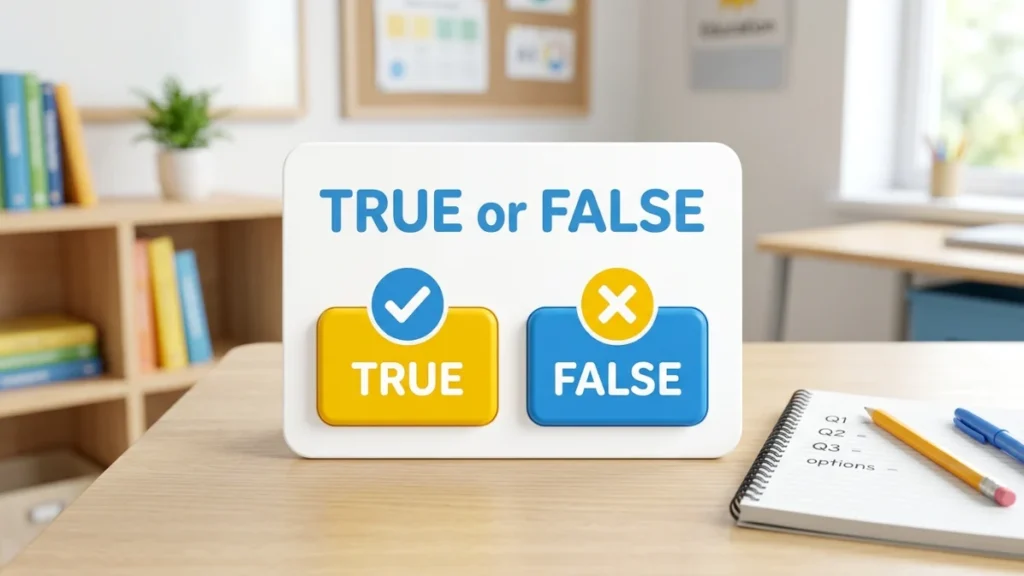

True or false looks simple. You read a statement, decide whether it’s correct, and choose one of two answers: true or false.
That’s it.
However, this simple format does more than test memory. It helps people check facts, spot weak assumptions, practice critical thinking, and learn faster. Teachers use true or false questions in classrooms. Quiz creators use them in trivia games.
Trainers use them in workplace assessments. Friends use them as icebreakers. Even logic, coding, and fact-checking depend on the same basic idea: a statement can be true, false, or sometimes unclear until verified.
A good true or false question doesn’t just ask someone to guess. It gives them a statement worth thinking about.
For example:
Statement: The human heart has four chambers.
Answer: True.
That works because the statement is clear, factual, and easy to verify.
Now compare it with this:
Statement: Dogs are better than cats.
Answer: Not suitable for true or false.
That’s an opinion, not a fact. A strong true or false quiz needs statements that can be checked, proven, or corrected.
In this guide, you’ll learn what true or false means, how true or false questions work, how to write better ones, and how to use them in quizzes, worksheets, exams, games, surveys, and learning activities.
What Does True or False Mean?
True or false means a statement must be judged as either correct or incorrect.
If the statement matches the facts, the answer is true. If it does not match the facts, the answer is false.
A true or false question usually appears as a sentence, not an open-ended question. The reader checks the statement and chooses one of two possible answers.
Here’s a simple example:
| Statement | Answer | Why |
|---|---|---|
| Water freezes at 32°F. | True | At standard pressure, water freezes at 32°F or 0°C. |
| The sun rises in the west. | False | The sun appears to rise in the east. |
| A triangle has four sides. | False | A triangle has three sides. |
| The English alphabet has 26 letters. | True | Modern English uses 26 letters. |
The phrase true or false works in several settings:
- True or false quiz
- True or false test
- True or false game
- True or false worksheet
- True or false challenge
- True or false trivia
- True or false assessment
In each case, the idea stays the same. Someone reads a statement and decides whether it is accurate.
True or False as a Binary Choice
A true or false question uses a binary choice. That means there are only two possible answers.
The answer is either:
- True
- False
This format connects to the idea of Boolean logic, where values often appear as true or false. In everyday language, you don’t need to know programming or formal logic to understand it. You already use this idea when you decide whether something is right or wrong, correct or incorrect, fact or fiction.
Here’s the basic structure:
Statement → Check the facts → Choose True or False
For example:
The Pacific Ocean is larger than the Atlantic Ocean.
↓
Check the fact.
↓
True.
This binary format makes true or false questions quick to answer. That’s why they work well in classrooms, quizzes, games, and practice tests.
However, the simplicity can also create a problem. Some statements need more context. A poorly written statement may confuse the reader because it is partly true, opinion-based, outdated, or too vague.
A good true or false statement should be:
- Clear
- Factual
- Specific
- Easy to verify
- Focused on one idea
- Free from confusing wording
How True or False Questions Work
True or false questions follow a simple pattern.
First, the writer gives a statement. Then, the reader evaluates it. Finally, the answer key confirms whether the statement is true or false.
A strong format looks like this:
| Part | Purpose |
|---|---|
| Statement | Gives the fact or claim to evaluate |
| Answer options | Offers True or False |
| Correct answer | Confirms the right choice |
| Explanation | Shows why the answer is right |
Here’s an example:
Statement: The Great Wall of China can be seen clearly from the Moon with the naked eye.
Answer: False.
Explanation: This is a common myth. The wall is not clearly visible from the Moon without aid.
That explanation matters. Without it, the reader may only memorize the answer. With it, they understand the reason.
This is where true or false learning becomes more powerful. The format can move beyond guessing and turn into real knowledge building.
True or False Examples
Examples make the format easier to understand. Below are several true or false examples across different topics.
Easy True or False Examples
| Statement | Answer |
|---|---|
| A square has four equal sides. | True |
| Fish can breathe underwater using gills. | True |
| The color red is darker than black. | False |
| There are seven days in a week. | True |
| A baby cat is called a puppy. | False |
Easy true or false questions work well for kids, beginners, warm-up quizzes, and quick classroom reviews.
General Knowledge True or False Examples
| Statement | Answer |
|---|---|
| Mount Everest is the tallest mountain above sea level. | True |
| The human body has 206 bones in most adults. | True |
| Australia is both a country and a continent. | True |
| The Sahara Desert is located in South America. | False |
| Lightning is hotter than the surface of the sun. | True |
General knowledge true or false questions are great for trivia nights, family games, and classroom competitions.
Science True or False Examples
| Statement | Answer |
|---|---|
| Plants make food through photosynthesis. | True |
| Sound travels faster than light. | False |
| Humans need oxygen to survive. | True |
| The Earth is the third planet from the Sun. | True |
| All metals are magnetic. | False |
Science true or false questions help students test facts, correct myths, and build stronger reasoning.
History True or False Examples
| Statement | Answer |
|---|---|
| The Declaration of Independence was adopted in 1776. | True |
| World War II ended in 1945. | True |
| The Roman Empire began in North America. | False |
| Abraham Lincoln served as a U.S. president. | True |
| The first modern Olympic Games took place in Athens. | True |
History true or false questions work best when dates, people, places, and events are specific.
Funny True or False Statements
Funny true or false questions can make a quiz more engaging.
| Statement | Answer |
|---|---|
| Bananas grow upside down. | True |
| Octopuses have three hearts. | True |
| Cows can walk downstairs easily. | False |
| A group of flamingos is called a flamboyance. | True |
| Humans glow slightly in the dark, but our eyes can’t see it. | True |
These questions feel surprising, which makes them memorable. That’s the sweet spot for trivia.
True or False Questions With Answers
Here’s a ready-to-use true or false quiz with answers.
| True or False Statement | Answer |
|---|---|
| The Earth has one natural moon. | True |
| Spiders are insects. | False |
| The capital of Japan is Tokyo. | True |
| A leap year usually has 366 days. | True |
| The boiling point of water is 100°C at standard pressure. | True |
| The Amazon River is in Africa. | False |
| Humans have five senses only. | False |
| Venus is the hottest planet in our solar system. | True |
| Shakespeare wrote “Romeo and Juliet.” | True |
| Gold is a chemical element. | True |
| Penguins can fly. | False |
| The Atlantic Ocean is the largest ocean on Earth. | False |
| A hexagon has six sides. | True |
| Sound cannot travel through a vacuum. | True |
| The Statue of Liberty was a gift from France. | True |
| The human brain stops working during sleep. | False |
| The Nile River flows through Egypt. | True |
| Bats are blind. | False |
| The speed of light is faster than the speed of sound. | True |
| A tomato is botanically a fruit. | True |
A good true or false quiz should mix easy, medium, and hard questions. If every statement is obvious, people get bored. If every statement is tricky, they get frustrated.
Balance keeps the quiz fun.
True or False Quiz Ideas
A true or false quiz can fit almost any topic. You can use it for school, work, parties, websites, social media, or test prep.
True or False Quiz for Kids
Kids need simple, visual, and familiar statements.
Good topics include:
- Animals
- Colors
- Shapes
- Food
- Weather
- Basic science
- Story characters
- Classroom rules
Examples:
| Statement | Answer |
|---|---|
| A circle has no corners. | True |
| A dog says meow. | False |
| Ice is cold. | True |
| The sun shines at night. | False |
Keep the wording short. Kids should focus on the idea, not struggle with the sentence.
True or False Quiz for Adults
Adults usually enjoy questions with surprising facts, practical knowledge, or humor.
Good topics include:
- Health myths
- Food facts
- Travel
- Money
- History
- Pop culture
- Workplace knowledge
- Technology
Example:
| Statement | Answer |
|---|---|
| Coffee beans are actually seeds. | True |
| The Great Wall of China is one continuous wall. | False |
| Honey never spoils when stored properly. | True |
| Wi-Fi stands for “Wireless Fidelity.” | False |
Adult quizzes work best when the statements feel fresh, not recycled.
True or False Trivia Quiz
Trivia needs variety. A strong true or false trivia quiz often includes multiple categories.
| Category | Example Statement | Answer |
|---|---|---|
| Sports | The FIFA World Cup is held every four years. | True |
| Movies | The first “Toy Story” movie was released in 1995. | True |
| Science | Humans share DNA with bananas. | True |
| Geography | Canada has more lakes than any other country. | True |
| Food | White chocolate contains cocoa solids. | False |
Trivia should feel like a game, not homework. Add explanations after each answer to keep people interested.
True or False Classroom Quiz
Teachers use true or false questions to check understanding quickly.
A classroom quiz can help with:
- Warm-up activities
- Lesson reviews
- Exit tickets
- Group competitions
- Homework checks
- Exam preparation
For example, after a lesson on planets:
| Statement | Answer |
|---|---|
| Mars is known as the Red Planet. | True |
| Jupiter is smaller than Earth. | False |
| Neptune is farther from the Sun than Earth. | True |
Classroom true or false questions work even better when students explain their answers.
True or False Game Ideas
A true or false game can turn simple statements into a fun activity.
Fact or Fiction Game
In this game, players decide whether each statement is fact or fiction.
Example:
Statement: Sharks existed before trees.
Answer: True.
This format works well for science, nature, and history facts.
Stand Up or Sit Down
Read a statement aloud.
- Players stand if they think it’s true.
- Players sit if they think it’s false.
This game works well in classrooms because it gets students moving.
Team True or False Challenge
Split players into teams. Each team writes True or False on a board. Award points for correct answers.
To make it more exciting:
- Add a timer
- Use bonus rounds
- Let teams explain answers
- Include hard challenge questions
Two Truths and One False Statement
This twist works well as an icebreaker.
Each person writes three statements about themselves:
- Two true statements
- One false statement
The group guesses which one is false.
Example:
- I have visited three countries.
- I can play the guitar.
- I once met a movie star.
This game helps people learn about each other without making the activity feel forced.
Speed Round True or False
Give players 30 seconds to answer as many statements as possible.
This works well for:
- Online quiz games
- Social media challenges
- Classroom reviews
- Family game nights
Quick rounds create energy. Keep the statements short.
True or False in Education
Teachers use true or false questions because they are simple, fast, and flexible.
However, the best true or false questions do more than check memorized facts. They help students separate accurate information from common mistakes.
For example:
Statement: All mammals live on land.
Answer: False.
Why: Whales and dolphins are mammals that live in water.
This question teaches more than one fact. It also corrects a misconception.
Benefits of True or False Learning Activities
| Benefit | Why It Helps |
|---|---|
| Quick assessment | Teachers can check understanding fast |
| Easy grading | Answers are simple to mark |
| Strong review tool | Students revisit key facts |
| Good for discussion | False statements can reveal misconceptions |
| Flexible format | Works for many subjects and age groups |
| Low pressure | Students can answer quickly |
True or false learning activities also help students practice statement evaluation. That skill matters outside school too. People use it when reading news, comparing claims, checking product information, or judging social media posts.
True or False Tests and Assessments
A true or false test asks students or participants to judge whether statements are correct.
This format appears in:
- School exams
- Practice tests
- Training assessments
- Safety quizzes
- Certification reviews
- Online learning modules
True or false questions work best when the goal is to test basic knowledge, definitions, rules, or factual accuracy.
Strengths of True or False Tests
| Strength | Explanation |
|---|---|
| Fast to answer | Test-takers can complete many questions quickly |
| Easy to score | Each answer has one clear result |
| Good for broad review | Many topics can fit into one test |
| Simple format | Students understand the instructions easily |
Limits of True or False Tests
True or false tests also have weaknesses.
A student has a 50% chance of guessing the correct answer. That means a true or false test may not always prove deep understanding.
Also, some statements can become confusing if they include more than one idea.
Example:
Statement: The Earth orbits the Sun and has two moons.
This statement contains one true idea and one false idea. The Earth orbits the Sun, but it has one natural moon. The statement should be marked false, yet it may confuse students.
A better version:
Statement: The Earth orbits the Sun.
Answer: True.
And:
Statement: The Earth has two natural moons.
Answer: False.
One statement. One idea. One clear answer.
True or False Worksheets
A true or false worksheet is a printable or digital activity where learners mark statements as true or false.
A strong worksheet usually includes:
- Clear title
- Simple instructions
- List of statements
- True/false answer column
- Space for corrections
- Answer key
- Optional explanation section
Here’s a useful worksheet layout:
| Statement | True | False | Correct the False Statement |
|---|---|---|---|
| The Earth is the third planet from the Sun. | ☐ | ☐ | |
| A spider has six legs. | ☐ | ☐ | |
| Water can exist as solid, liquid, and gas. | ☐ | ☐ |
The “correct the false statement” column makes the worksheet stronger. It stops students from guessing and pushes them to think.
For example:
False statement: A spider has six legs.
Correction: A spider has eight legs.
That correction turns a simple answer into active learning.
How to Write Good True or False Questions
Writing good true or false questions takes more skill than it seems.
A weak question feels lazy. A strong one feels clear, fair, and useful.
Use Clear Statements
Good true or false statements should be easy to understand.
Weak:
Some animals kind of sleep in unusual ways.
Better:
Dolphins sleep with one half of their brain active.
The better version gives a specific claim.
Focus on One Idea
Avoid packing two or three facts into one statement.
Weak:
The Moon orbits Earth and Mars has rings.
Better:
The Moon orbits Earth.
Mars has rings.
The second statement is easier to evaluate.
Avoid Vague Words
Words like often, sometimes, many, and usually can make questions harder to judge.
That doesn’t mean you can never use them. Just use them carefully.
Weak:
Many birds are colorful.
This is too broad.
Better:
Male peacocks have colorful tail feathers.
Now the statement is specific.
Be Careful With Absolute Words
Words like always, never, all, and none often make false answers too easy.
Example:
All birds can fly.
This is false because penguins, ostriches, and emus cannot fly.
Absolute words can work, but they should serve a purpose. Don’t use them as cheap tricks.
Make False Statements Believable
A false statement should not be silly unless the quiz is for young kids or humor.
Weak:
The moon is made of pizza.
Better:
The Moon produces its own light.
The second statement is false, yet it tests a real misconception.
Add Explanations
Explanations make true or false questions more educational.
Example:
Statement: Humans breathe in oxygen and breathe out carbon dioxide.
Answer: True.
Explanation: The body uses oxygen during respiration and releases carbon dioxide as waste.
This gives the learner a reason, not just a result.
Common Mistakes in True or False Questions
Many true or false quizzes fail because the statements are unclear, outdated, or unfair.
Here are the biggest mistakes to avoid.
| Mistake | Why It Hurts | Better Approach |
|---|---|---|
| Vague wording | Readers can’t judge the statement clearly | Use specific facts |
| Two facts in one statement | One part may be true while another is false | Split into two statements |
| Trick wording | It frustrates learners | Test knowledge, not confusion |
| Opinion-based claims | Opinions can’t be proven true or false | Use factual claims |
| Outdated facts | Answers may change over time | Check facts before publishing |
| No answer key | Learners can’t confirm results | Include answers |
| No explanation | Learning stays shallow | Add short explanations |
A good true or false quiz should feel fair. It can be challenging, but it shouldn’t feel like a trap.
True or False vs Multiple Choice
Both test knowledge, but they work differently.
| Feature | True or False | Multiple Choice |
|---|---|---|
| Answer options | 2 | Usually 3–5 |
| Guessing chance | 50% | Often 20–33% |
| Best for | Quick fact checks | Deeper detail testing |
| Grading | Very easy | Easy |
| Difficulty level | Easy to medium | Easy to advanced |
| Writing effort | Lower | Higher |
| Student reasoning | Limited unless explained | Stronger with good options |
True or false works better when you need speed.
Multiple choice works better when you need more nuance.
For example, this true or false question checks a basic fact:
Statement: The heart pumps blood through the body.
Answer: True.
A multiple choice version can test more detail:
Which organ pumps blood through the body?
A. Liver
B. Heart
C. Kidney
D. Lung
Both formats work. The right choice depends on your goal.
True or False vs Fact or Fiction
True or false and fact or fiction are closely related.
Both ask the reader to judge whether a statement is accurate.
The difference is mostly style.
| Format | Best Use |
|---|---|
| True or false | Tests, worksheets, exams, learning activities |
| Fact or fiction | Trivia, games, social media, fun facts |
“Fact or fiction” sounds more playful. “True or false” sounds more educational.
Example:
True or False: Octopuses have three hearts.
Fact or Fiction: Octopuses have three hearts.
Both mean the same thing. The second one feels more like a game.
True or False for Critical Thinking
True or false questions can build critical thinking when they ask people to explain their answers.
Without explanation, a learner may guess.
With explanation, the learner must think.
Try this format:
| Statement | Answer | Explain Why |
|---|---|---|
| All insects have eight legs. | False | Insects have six legs. Spiders have eight legs, but spiders are not insects. |
This turns a simple question into a reasoning task.
Teachers can also ask follow-up questions:
- What word made the statement false?
- How would you rewrite it to make it true?
- What fact supports your answer?
- What common myth does this statement test?
That’s where true or false becomes powerful. It teaches people to slow down, check the claim, and support their answer.
True or False in Surveys and Questionnaires
True or false can work in surveys, but only for certain questions.
It works well when the response is factual or binary.
Example:
I have completed the training module.
True / False
It does not work well for opinions.
Weak survey item:
This course was helpful.
True / False
A better format would be:
| Statement | Better Answer Options |
|---|---|
| This course was helpful. | Strongly agree, Agree, Neutral, Disagree, Strongly disagree |
True or false gives limited data. Use it when you need a clean yes/no-style answer. Use rating scales when you need depth.
Best True or False Topics
True or false questions work across many topics. The best topics depend on your audience.
| Audience | Best Topics |
|---|---|
| Kids | Animals, colors, food, school, weather |
| Students | Science, history, grammar, math, geography |
| Adults | Health myths, money, travel, culture, technology |
| Trivia players | Weird facts, pop culture, sports, movies |
| Employees | Safety rules, compliance, procedures, training |
| Online users | Fun facts, viral myths, quick challenges |
Strong topics usually include facts people think they know. That creates curiosity.
For example:
Statement: Humans use only 10% of their brains.
Answer: False.
Many people have heard the myth. That makes the answer more interesting.
Sample True or False Quiz
Use this sample true or false quiz for practice, classrooms, trivia nights, or online content.
Mixed True or False Questions
| Statement | Answer |
|---|---|
| The human body has four lungs. | False |
| The Pacific Ocean is the largest ocean on Earth. | True |
| Bees can recognize human faces. | True |
| The Eiffel Tower is located in Rome. | False |
| A group of lions is called a pride. | True |
| Mercury is the closest planet to the Sun. | True |
| The square root of 64 is 8. | True |
| Sound travels faster in water than in air. | True |
| The capital of Canada is Toronto. | False |
| An adult human usually has 32 teeth. | True |
| The chemical symbol for oxygen is O. | True |
| A year has exactly 365 days every time. | False |
| The human heart is located on the right side of the chest. | False |
| The Mona Lisa was painted by Leonardo da Vinci. | True |
| The Earth is flat. | False |
| Cheetahs are the fastest land animals. | True |
| A kilogram is heavier than a pound. | True |
| The moon controls ocean tides along with the sun’s gravity. | True |
| A rainbow usually has seven commonly named colors. | True |
| Antarctica is the coldest continent. | True |
| All snakes are venomous. | False |
| The piano is a string instrument. | True |
| There are 60 seconds in one minute. | True |
| The Statue of Liberty is in New York Harbor. | True |
| Camels store water in their humps. | False |
Answer Explanations for Selected Questions
Bees can recognize human faces — True.
Studies have shown that bees can learn visual patterns that allow them to recognize face-like images.
A year has exactly 365 days every time — False.
A common year has 365 days, but a leap year has 366 days.
The piano is a string instrument — True.
A piano has keys, but it produces sound when hammers strike strings.
Camels store water in their humps — False.
Camel humps store fat, not water. That fat helps them survive when food is limited.
True or False Questions for Kids
Kids enjoy true or false questions when they are short, clear, and fun.
| Statement | Answer |
|---|---|
| A cow gives milk. | True |
| A bird has feathers. | True |
| A banana is usually blue. | False |
| A fish can live in water. | True |
| A car has wings like a bird. | False |
| A spider has eight legs. | True |
| A rainbow appears after rain and sunlight. | True |
| Ice cream is hot. | False |
| A tree has roots. | True |
| A pencil is used for writing. | True |
For kids, avoid tricky wording. The goal is learning, not confusion.
Hard True or False Questions
True or false questions should test deeper knowledge, not strange wording.
| Statement | Answer |
|---|---|
| The Great Wall of China is visible from the Moon with the naked eye. | False |
| Some metals are liquid at room temperature. | True |
| The shortest war in recorded history lasted under one hour. | True |
| Lightning can strike the same place more than once. | True |
| The human body contains more bacterial cells than human cells by a large margin. | False |
| Bananas are berries in botanical terms. | True |
| Strawberries are true berries in botanical terms. | False |
| There are more possible chess games than atoms in the observable universe. | True |
| The North Star is the brightest star in the night sky. | False |
| Glass is a very slow-moving liquid. | False |
Hard questions work because they challenge assumptions. They should still be fair and verifiable.
Funny True or False Questions
Funny true or false questions make quizzes more relaxed.
| Statement | Answer |
|---|---|
| A shrimp’s heart is in its head. | True |
| Wombat poop is cube-shaped. | True |
| Sloths can hold their breath longer than dolphins. | True |
| Some turtles can breathe through their rear end. | True |
| A chicken once lived for months without most of its head. | True |
| Humans are the only animals that laugh. | False |
| Goats have rectangular pupils. | True |
| Cats can taste sweetness. | False |
| Butterflies taste with their feet. | True |
| An ostrich’s eye is bigger than its brain. | True |
These questions work well as icebreakers because they make people react.
True or False Practice Test
A true or false practice test helps learners prepare for exams. It can also help them review weak areas.
Practice Test Format
| Statement | True | False |
|---|---|---|
| Photosynthesis helps plants make food. | ☐ | ☐ |
| The U.S. has 60 states. | ☐ | ☐ |
| A noun can name a person, place, thing, or idea. | ☐ | ☐ |
| The Earth takes about 24 hours to rotate once. | ☐ | ☐ |
| Water is made of hydrogen and oxygen. | ☐ | ☐ |
Answer Key
| Statement | Answer |
|---|---|
| Photosynthesis helps plants make food. | True |
| The U.S. has 60 states. | False |
| A noun can name a person, place, thing, or idea. | True |
| The Earth takes about 24 hours to rotate once. | True |
| Water is made of hydrogen and oxygen. | True |
Practice tests should include explanations for false answers. This helps students correct mistakes before the real exam.
How to Make a True or False Quiz
A great true or false quiz needs planning.
Start with the audience. A quiz for children should not feel like a college exam. A quiz for adults should not feel too basic.
Use this simple process:
- Pick a topic.
- Decide the difficulty level.
- Write clear factual statements.
- Mix true and false answers.
- Add an answer key.
- Add explanations for learning value.
- Test the quiz before publishing.
Ideal True and False Balance
Try not to make every answer true or every answer false.
A good quiz often uses a balanced mix.
| Quiz Length | Suggested True Answers | Suggested False Answers |
|---|---|---|
| 10 questions | 5 | 5 |
| 20 questions | 10 | 10 |
| 30 questions | 15 | 15 |
You don’t need perfect balance every time. However, a balanced quiz feels fairer and reduces pattern guessing.
True or False Answer Keys
An answer key is essential.
Without an answer key, the quiz feels incomplete. Readers need confirmation.
A good answer key can be simple:
| Question | Answer |
|---|---|
| 1 | True |
| 2 | False |
| 3 | True |
A better answer key includes explanations:
| Statement | Answer | Explanation |
|---|---|---|
| Penguins can fly. | False | Penguins are birds, but they cannot fly. |
| The Earth orbits the Sun. | True | Earth completes one orbit around the Sun in about one year. |
Explanations improve trust. They also help readers remember the fact.
True or False for Online Content
True or false content performs well online because it is quick and interactive.
People like content that lets them test themselves.
You can use true or false formats in:
- Blog posts
- Social media captions
- Instagram stories
- YouTube community posts
- Email newsletters
- Learning platforms
- Quiz websites
- Classroom portals
Example social media format:
True or False?
Bananas are berries.Answer: True. Botanically, bananas qualify as berries.
This format works because it creates a tiny curiosity gap. People want to guess before they see the answer.
True or False in Fact-Checking
True or false questions connect closely to fact-checking.
A fact-checker looks at a claim and asks:
- Is this accurate?
- Is this misleading?
- What evidence supports it?
- What context is missing?
- Does the statement need correction?
Not every claim fits neatly into true or false. Some claims are partly true, outdated, exaggerated, or missing context.
For simple quizzes, true or false is fine.
For serious fact-checking, you may need more labels:
| Label | Meaning |
|---|---|
| True | The claim is accurate |
| False | The claim is incorrect |
| Partly true | Some parts are accurate |
| Misleading | The claim leaves out important context |
| Unverified | There isn’t enough evidence yet |
This is important because real-world information can be messy. A classroom quiz can use simple true or false answers. Public claims often need deeper review.
True or False and Boolean Logic
In logic and computing, true and false connect to Boolean values.
A Boolean value has two possible states:
- True
- False
For example:
Is 10 greater than 5?
True
Is 3 greater than 9?
False
In programming, Boolean logic helps systems make decisions.
Simple example:
If user is logged in = true
Show dashboard
If user is logged in = false
Show login page
This shows how the simple true or false idea powers much bigger systems. Search filters, apps, forms, games, and security checks often use binary decisions behind the scenes.
True or False in Grammar and Language Learning
True or false questions also help with grammar practice.
Example:
| Statement | Answer |
|---|---|
| A verb shows action or state of being. | True |
| Every sentence must end with a question mark. | False |
| “Their,” “there,” and “they’re” have the same meaning. | False |
| An adjective describes a noun. | True |
Language teachers can use true or false exercises to test vocabulary, grammar rules, reading comprehension, and listening skills.
For reading practice, students can read a short passage and answer true or false statements based on the text.
Example:
Passage: Maya wakes up at 7 a.m. She eats breakfast before school.
Statement: Maya wakes up at 8 a.m.
Answer: False.
This checks comprehension, not just memorization.
True or False for Training and Workplace Learning
Businesses use true or false assessments in employee training because they are fast and easy to grade.
They work well for:
- Safety rules
- Company policies
- Compliance training
- Product knowledge
- Customer service procedures
- Onboarding quizzes
Example:
| Statement | Answer |
|---|---|
| Employees should report workplace hazards immediately. | True |
| Passwords should be shared with coworkers when needed. | False |
| Customer complaints should be ignored if they seem minor. | False |
In workplace learning, explanations matter. People need to understand the rule, not just pass the quiz.
True or False Icebreaker Questions
True or false icebreaker questions help people start conversations.
They work well in:
- Classrooms
- Team meetings
- Workshops
- Online groups
- Parties
- Training sessions
Examples:
| Statement | Answer Type |
|---|---|
| I have traveled outside my country. | Personal true/false |
| I prefer coffee over tea. | Personal true/false |
| I have broken a bone before. | Personal true/false |
| I enjoy public speaking. | Personal true/false |
These are not factual quiz questions. They are personal statements. The answer depends on the person.
That makes them great for connection, not assessment.
True or False Challenge Questions
A true or false challenge adds pressure, competition, or difficulty.
You can create challenge rounds like:
- 10 questions in 60 seconds
- Sudden death round
- No explanation until the end
- Hard facts only
- Myth-busting round
- Team battle
- Winner stays in
Example challenge question:
Statement: Hot water can freeze faster than cold water under certain conditions.
Answer: True.
Challenge questions should feel surprising but not unfair. Nobody enjoys losing to a badly worded question.
True or False Statement Evaluation
Statement evaluation means checking whether a claim is accurate.
This skill matters in school, work, and daily life.
A strong evaluator asks:
- What exactly does the statement claim?
- Is it factual or opinion-based?
- Can it be checked?
- Is any part unclear?
- Does the wording include absolutes like “always” or “never”?
- Is the claim outdated?
- What evidence supports or disproves it?
Example:
Statement: All healthy adults need exactly eight hours of sleep.
This statement is too absolute. Many adults do well with different sleep durations. A better true or false version would be:
Statement: Many adults need about seven or more hours of sleep per night.
That version is more accurate and fair.
True or False Questions for Test Preparation
True or false practice questions help students review facts before exams.
They work especially well for:
- Definitions
- Key dates
- Scientific facts
- Formulas
- Rules
- Vocabulary
- Historical events
However, students should not rely only on true or false practice. Since guessing is easy, they should also use short answers, explanations, flashcards, and practice essays.
A smart study method looks like this:
Read the statement
↓
Choose true or false
↓
Explain why
↓
Correct false statements
↓
Review missed topics
That final step matters most. Wrong answers show where learning needs more attention.
FAQs
What does true or false mean?
True or false means a statement must be judged as correct or incorrect. If the statement matches the facts, it is true. If it does not match the facts, it is false.
What is a true or false statement?
A true or false statement is a sentence that can be checked for accuracy. For example, “The Earth orbits the Sun” is a true statement. “The Earth has two moons” is a false statement.
How do you answer true or false questions?
Read the full statement carefully. Check whether every part of it is accurate. If the whole statement is correct, choose true. If any important part is incorrect, choose false.
Are true or false questions good for learning?
Yes, true or false questions can support learning when they are clear and include explanations. They help students review facts, catch misconceptions, and practice quick reasoning.
What are true or false questions with answers?
They are quiz questions that include a statement, the correct answer, and sometimes a short explanation. Example: “A triangle has three sides. Answer: True.”
What is another name for true or false?
Common alternatives include fact or fiction, right or wrong, correct or incorrect, yes or no, and binary choice questions.
Is true or false the same as yes or no?
Not exactly. True or false usually evaluates a statement. Yes or no usually answers a direct question. However, both use two answer choices.
What makes a good true or false question?
A good true or false question is clear, factual, specific, and focused on one idea. It should avoid vague wording, unfair tricks, and opinion-based claims.
How can teachers use true or false worksheets?
Teachers can use true or false worksheets for warm-ups, reviews, exit tickets, homework, reading comprehension, and test preparation. Adding a “correct the false statement” section makes the worksheet more useful.
What are some easy true or false questions?
Examples include “A square has four sides,” “Fish live in water,” and “The sun is a star.” These work well for kids and beginners.
Conclusion
True or false is one of the simplest question formats, but it remains useful because it works almost anywhere. You can use it in quizzes, games, worksheets, exams, surveys, training sessions, and classroom activities.
The best true or false questions do more than ask people to guess. They help readers check facts, correct mistakes, and explain their thinking.
Keep each statement clear. Focus on one idea. Avoid opinion-based claims. Add explanations whenever possible.
That’s how a simple true or false quiz becomes more than a quick game. It becomes a smart learning tool