
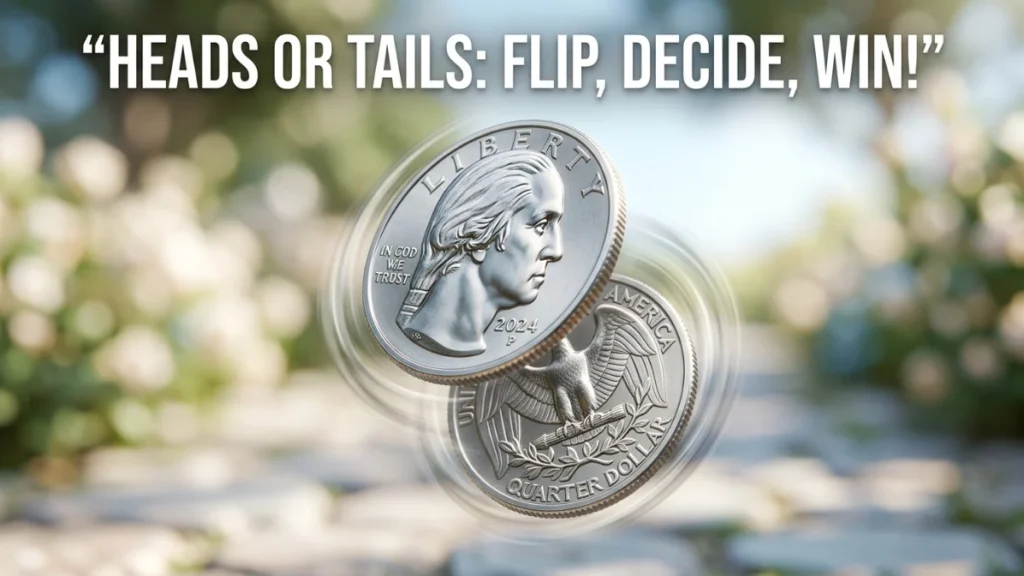

When you need a quick, fair decision, nothing beats the simplicity of heads or tails. From centuries-old traditions to modern online apps, flipping a coin remains a trusted method for resolving disputes, making choices, and adding a dash of chance to games and contests.
Experts in probability and decision theory agree: a well-flipped coin gives a truly random, unbiased outcome, making it a practical tool whether you’re a sports referee, gamer, or everyday decision-maker.
In this guide, you’ll learn the meaning, rules, probability, and modern digital adaptations of heads or tails backed by mathematical insight and real-world examples to help you make decisions confidently.
What is Heads or Tails?
Heads or tails is one of the simplest yet most widely used methods for making decisions. At its core, it’s a binary choice: a coin has two sides—heads (usually the side with a face) and tails (usually the opposite side with a design or symbol).
People have used heads or tails for centuries. From settling disputes in ancient Rome to modern sports and games, it has served as a quick, impartial decision-making tool. Essentially, it’s a way to let chance decide when human judgment is either biased or unnecessary.
Key points about heads or tails:
- A coin has two distinct sides: heads and tails.
- Each flip is ideally independent, meaning past flips don’t influence the next one.
- It’s widely used in games, contests, sports, and casual decisions.
Example: Deciding who serves first in a tennis match. Instead of arguing, the referee flips a coin. The player calling correctly serves first.
How Does a Coin Toss Work?
Flipping a coin may seem simple, but understanding the mechanics gives insight into its fairness.
A standard coin toss involves:
- Holding the coin flat between the thumb and index finger.
- Tossing it vertically into the air with a flick of the thumb.
- Letting the coin land on a flat surface or catching it in hand before revealing the top side.
Heads is the side with the face of a notable figure or symbol. Tails is the reverse, often featuring a crest, landmark, or emblem.
| Term | Description |
|---|---|
| Heads | Side with a face or principal emblem |
| Tails | Side opposite heads with symbol/design |
| Toss | The act of flipping the coin in the air |
| Flip | The motion that gives the coin rotation and randomness |
The coin’s outcome is largely random, assuming no bias in flipping. This randomness makes it a trusted decision-making tool, especially for a 50/50 choice.
Rules of the Heads or Tails Game
Although heads or tails is simple, having clear rules ensures fairness. The rules vary slightly depending on context:
- Basic rule: One participant calls “heads” or “tails” while the coin is in the air.
- Reveal: The coin lands or is caught and revealed. If the call matches the top side, the caller wins.
- Variations:
- In sports, the referee may toss the coin to decide team sides or first move.
- In betting, participants place wagers before the toss.
- In games, multiple flips may be used to decide multiple outcomes or challenges.
Heads or Tails Game Example:
- Player 1 calls heads.
- Player 2 automatically gets tails.
- The coin is flipped.
- Winner: the player whose choice matches the coin’s top side.
This ensures a binary, fair decision without personal bias.
Probability of Heads or Tails
A core reason people trust heads or tails is its predictable probability. With a fair coin:
- Probability of heads: 50%
- Probability of tails: 50%
Mathematically:P(Heads)=21=0.5 P(Tails)=21=0.5
However, in real-life conditions, slight biases may occur due to:
- Coin weight imbalance
- Uneven tossing force
- Surface irregularities
Even so, these biases are usually negligible. For casual decisions, games, and online coin flips, it’s considered perfectly fair.
Table: Probability of Multiple Flips
| Number of Flips | Probability of All Heads | Probability of All Tails |
|---|---|---|
| 1 | 50% | 50% |
| 2 | 25% | 25% |
| 3 | 12.5% | 12.5% |
| 4 | 6.25% | 6.25% |
This table highlights the exponential decrease in probability for repeated outcomes.
Using Heads or Tails for Decision Making
Heads or tails isn’t just a game. It’s a powerful decision-making tool in real life.
Common uses:
- Choosing who goes first in board games or sports.
- Selecting a random participant for a task or prize.
- Settling disputes or conflicts without bias.
- Quick decisions when no strong preference exists.
Practical tip: Always announce your choice before flipping to maintain fairness.
Example:
Imagine a group deciding where to eat. Two options remain: Pizza (heads) or Sushi (tails). One person calls heads. The coin flips and lands on tails. Sushi wins, and everyone agrees. Simple, quick, and impartial.
Heads or Tails Variations and Challenges
Heads or tails has evolved into creative challenges and games, both offline and online.
- Offline challenges:
- Best of three flips to determine a winner.
- Team selection for sports games.
- Fun social challenges like “first to call correctly drinks water.”
- Online variations:
- Virtual coin flips on apps or websites.
- Randomized outcomes for digital games.
- Integration into decision-making apps for binary choices.
Challenge Idea:
“Flip until you get three consecutive heads. Can luck stay consistent?”
These variations make the classic game engaging and versatile.
Digital Tools and Online Coin Flip Options
The digital era has brought online coin flips. Apps and websites offer:
- Heads or tails generators
- Virtual coin flips with animation
- Random decision-makers for work or gaming
Benefits of digital coin flips:
- Instant and convenient
- Eliminates physical coin biases
- Useful for remote teams or online competitions
Example Apps and Features:
| Tool | Feature | Use Case |
|---|---|---|
| Heads or Tails Online | Single flip, animated | Quick decisions |
| Random Coin Generator | Multiple flips, results history | Statistical experiments |
| Decision Maker App | Integrates flip + options | Team selection |
Digital tools maintain the 50/50 fairness while adding convenience.
Heads or Tails in Gambling and Betting
Coin flips are also a popular betting mechanism:
- Casual bets: e.g., “Winner of coin toss gets $5.”
- Professional sports: Determines kickoff or field choice.
- Online gambling: Simulated coin tosses in games of chance.
Important to know: While theoretically 50/50, risk exists if coins or simulations are biased.
Table: Coin Toss Odds vs. Wager
| Scenario | Odds | Potential Outcome |
|---|---|---|
| Single flip | 50/50 | Win/Lose equal chance |
| Best of 3 flips | 12.5%-87.5% | Odds shift slightly due to multiple flips |
| Series betting | Varies | Risk compounds with repeated wagers |
Heads or tails remains a simple luck-based system, but gambling should always consider risk management.
Tips for Making Heads or Tails Fair and Random
To ensure true randomness, follow these tips:
- Use a standard, balanced coin.
- Flip consistently with vertical motion.
- Catch the coin instead of letting it roll.
- For digital flips, choose trusted online apps.
- Avoid biased calls: don’t call after seeing coin’s mid-air orientation.
Pro Tip: For experiments or probability studies, record multiple flips to analyze outcomes.
FAQs
What does heads or tails mean?
It’s a simple binary choice using a coin. One side is heads, the other tails.
Is heads or tails really 50/50?
Yes, with a fair coin and proper toss, each side has an equal 50% chance.
How do you play heads or tails online?
Use a coin toss generator or virtual app. Call your side, flip, and see the result.
Can heads or tails help in serious decisions?
Yes, when a quick impartial decision is needed. Avoid using it for high-stakes legal or financial matters.
What are the odds of heads or tails in multiple flips?
The probability multiplies: for 2 consecutive heads: 0.5 × 0.5 = 0.25 (25%).
Conclusion
Heads or tails is more than a childhood game. It’s a trusted tool for decision-making, probability learning, gambling, and fun challenges. Its simplicity, fairness, and instant results keep it relevant in both physical and digital forms.
Whether you’re flipping a coin in real life or using a virtual generator, heads or tails proves luck and chance still hold a place in our daily choices.
Key Takeaways:
- Simple but effective decision-making tool
- Equal probability ensures fairness
- Multiple applications: games, sports, betting, digital decisions
- Online tools make it accessible anytime, anywhere
Try it today and see how a simple coin toss can solve disagreements, pick winners, or just add a bit of fun to your day!