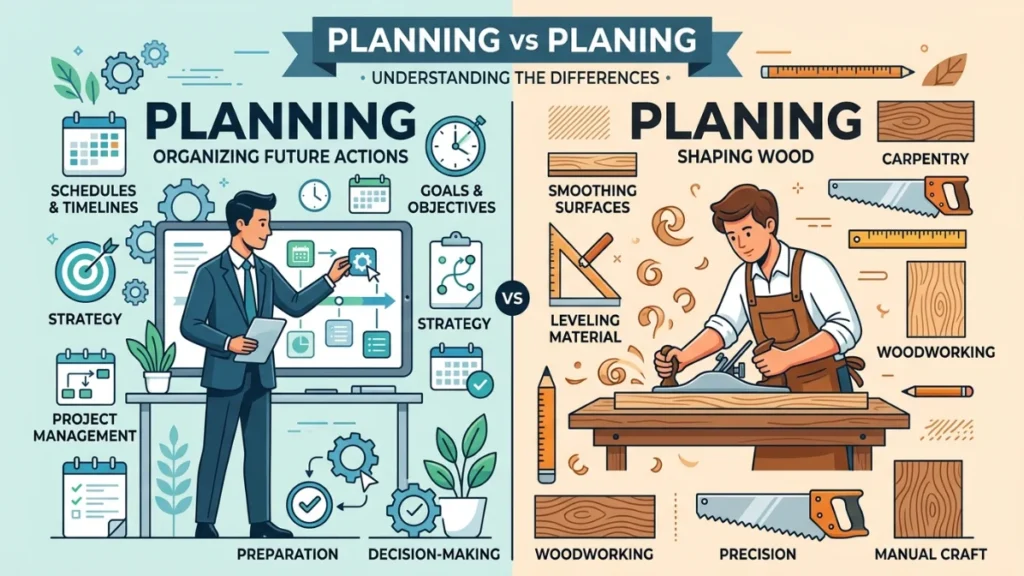

Planning means preparing or organizing something for the future. Planing means smoothing or shaping wood with a tool. Planning is far more common in everyday English.
I once wrote “project planing” in an important document and did not notice the mistake until a client pointed it out. At first, I thought both spellings were acceptable because they look almost identical. After researching the difference, I learned that planning relates to organizing future actions, while planing is mostly used in woodworking and aviation.
Since then, I have paid close attention to the double “n” in planning. That small spelling change completely changes the meaning of the word. If you also get confused between planning and planing, this guide will help you understand the difference clearly and avoid mistakes in professional and everyday writing.
Quick Answer
Planning means organizing, preparing, or thinking about future actions.
Planing means smoothing or shaping a surface, usually wood, with a tool called a plane.
Examples
We are planning a business meeting next week.
The carpenter is planing the wooden board.
Planning vs Planing Meaning
Although the words look similar, their meanings are very different.
Planning
Planning comes from the verb plan.
It means preparing steps, strategies, or actions before doing something.
Examples
She is planning her vacation.
The company is planning a new marketing campaign.
Good planning improves productivity.
Planing
Planing comes from the verb plane.
It means smoothing, shaping, or leveling a surface using a tool or machine.
Examples
The carpenter is planing the table surface.
Workers spent hours planing the wood.
The machine is used for planing metal sheets.
Planning vs Planing Difference
| Word | Meaning | Common Usage | Industry |
|---|---|---|---|
| Planning | Organizing future actions | Very common | Business, education, daily life |
| Planing | Smoothing or shaping surfaces | Less common | Woodworking, manufacturing |
Key Point
Planning relates to preparation and organization.
Planing relates to shaping or smoothing materials.
Grammar Rule Depth
The confusion often happens because both words are formed differently.
Planning
The verb plan doubles the letter “n” before adding “ing.”
Plan → Planning
This follows a common English spelling rule for short verbs ending in consonant vowel consonant patterns.
Examples
run → running
sit → sitting
plan → planning
Planing
The word plane already ends with “e.”
When adding “ing,” the final “e” is removed.
Plane → Planing
Examples
drive → driving
write → writing
plane → planing
Why People Confuse Planning and Planing
There are several reasons for the confusion.
Similar Spelling
The words differ by only one letter.
Similar Pronunciation
In fast speech, the difference is difficult to hear.
Lack of Awareness
Many people know the word planning but are unfamiliar with planing.
Typing Errors
Writers often accidentally remove one “n” while typing quickly.
The Origin of Planning and Planing
Planning Origin
The word plan comes from the Latin word planum, meaning flat surface or design.
Over time, it developed the meaning of creating arrangements or strategies.
Planing Origin
The word plane comes from tools used to smooth wood.
Carpenters traditionally used hand planes to create flat surfaces.
The term later became associated with shaping and smoothing materials.
Planning in Everyday English
Planning is one of the most commonly used words in English.
It appears in business, education, personal life, and professional communication.
Personal Planning
People plan vacations, weddings, budgets, and schedules.
Examples
We are planning a family trip.
She spent weeks planning the event.
Business Planning
Companies use planning for growth and strategy.
Examples
The team is planning next year’s budget.
Strategic planning helps businesses succeed.
Academic Planning
Students often plan study schedules and assignments.
Examples
Careful planning improves exam performance.
The teacher discussed lesson planning.
Planing in Technical Contexts
Unlike planning, planing is mostly technical.
Woodworking
Carpenters use planes to smooth wooden surfaces.
Examples
The carpenter is planing the edge of the board.
Planing creates a smooth finish.
Manufacturing
Machines can plane metal and industrial materials.
Examples
Workers are planing steel surfaces for construction.
Industrial planing improves precision.
Aviation Meaning
Planing can also describe movement across water.
Example
The boat was planing across the lake at high speed.
Planning vs Planing in Professional Writing
Choosing the wrong spelling can create confusion.
Incorrect Example
The company is planing a new project.
Correct Version
The company is planning a new project.
Why It Matters
In business writing, using the wrong spelling may appear unprofessional.
Planning is extremely common in reports, emails, proposals, and presentations.
Planning vs Planing in Emails
Correct Examples
We are planning a meeting for Monday.
The manager is planning new strategies.
Incorrect Examples
We are planing a meeting for Monday.
The manager is planing new strategies.
Planning vs Planing in Social Media
Social media users often confuse these words because of fast typing.
Correct Usage
Planning my dream vacation today.
I am planning my weekend already.
Technical Usage
The carpenter is planing wood for the new table.
Planning vs Planing in News Writing
Journalists usually use planning in political, economic, and social topics.
Examples
The government is planning new reforms.
City officials are planning transportation improvements.
Planing appears mainly in manufacturing or technical reports.
Example
Workers are planing wooden panels in the factory.
Common Mistakes with Planning vs Planing
Mistake 1 Using Planing Instead of Planning
Incorrect
We are planing a conference next month.
Correct
We are planning a conference next month.
Mistake 2 Forgetting the Double N
Many writers forget that planning requires double “n.”
Mistake 3 Confusing Technical and General Meaning
Some people think both words are interchangeable.
They are not.
Related Words and Expressions
Planning Related Words
planner
planned
strategic planning
financial planning
project planning
Planing Related Words
plane
hand plane
surface planing
wood planing
Real World Examples of Planning
Business Example
Successful companies depend on long term planning.
Travel Example
Good planning makes trips less stressful.
Education Example
Lesson planning helps teachers stay organized.
Event Example
Wedding planning requires attention to detail.
Real World Examples of Planing
Carpentry Example
The carpenter spent hours planing the wooden door.
Construction Example
Workers are planing boards for the roof.
Manufacturing Example
The machine handles large scale metal planing.
Which Word Should You Use
Your choice depends entirely on context.
Use Planning When
Talking about preparation, organization, schedules, or future actions.
Examples
planning a trip
planning a business strategy
planning an event
Use Planing When
Talking about woodworking, shaping, or smoothing surfaces.
Examples
planing wood
planing metal
planing boards
Memory Trick for Planning vs Planing
Use this simple trick.
Planning Has Double N
Think of planning as needing “extra preparation,” so it gets an extra “n.”
Planing Has One N
Planing is linked to the tool called a plane.
Planning vs Planing Usage Trends
Planning is far more common worldwide.
It appears frequently in:
Business writing
Academic writing
Professional communication
Online searches
Planing appears mostly in:
Woodworking
Manufacturing
Technical industries
Comparison Table
| Feature | Planning | Planing |
|---|---|---|
| Main Meaning | Organizing future actions | Smoothing surfaces |
| Commonness | Very common | Less common |
| Used In | Business, education, daily life | Carpentry, manufacturing |
| Root Word | Plan | Plane |
| Grammar Rule | Double consonant before ing | Remove final e before ing |
Planning Idioms and Expressions
Planning Ahead
Thinking about future needs early.
Example
Planning ahead saves time and money.
Strategic Planning
Creating long term goals.
Example
Strategic planning improves business growth.
Financial Planning
Managing money carefully.
Example
Financial planning helps avoid debt.
Planing Tools and Equipment
Hand Plane
A manual woodworking tool.
Electric Planer
A power tool for smoothing wood quickly.
Industrial Planing Machines
Large machines used in manufacturing.
Why Correct Spelling Matters
Using the correct spelling improves:
Professionalism
Clarity
Readability
Credibility
Mistakes in spelling can confuse readers and reduce trust in your writing.
Exercises
Exercise 1 Choose the Correct Word
The company is ______ a new strategy.
Answer: planning
The carpenter is ______ the wooden surface.
Answer: planing
She spent weeks ______ her wedding.
Answer: planning
Workers are ______ boards for construction.
Answer: planing
Exercise 2 Correct the Sentence
We are planing a business meeting next week.
Answer: We are planning a business meeting next week.
The carpenter is planning the wooden table.
Answer: The carpenter is planing the wooden table.
FAQs
What is the difference between planning and planing?
Planning means organizing future actions, while planing means smoothing or shaping surfaces using a plane tool.
Is planing a real word?
Yes. Planing is a real word commonly used in woodworking and manufacturing.
Why does planning have double n?
Planning follows the English spelling rule that doubles the final consonant before adding ing to short verbs like plan.
When should I use planing?
Use planing when discussing woodworking, shaping, or smoothing surfaces.
Is planning more common than planing?
Yes. Planning is far more common in everyday English and professional writing.
Can planing relate to aviation?
Yes. In aviation and boating, planing can describe movement across a surface.
How can I remember the difference?
Remember that planning needs extra preparation, so it has an extra “n.”
Conclusion
Understanding the difference between planning vs planing is important because these words may look similar, but they have completely different meanings. Planning relates to preparing, organizing, and thinking about future actions. It is widely used in business, education, travel, and daily life. Planing, on the other hand, is mainly a technical term used in woodworking, manufacturing, and sometimes aviation.
The confusion usually happens because both words are close in spelling and pronunciation. However, remembering the grammar rule makes the difference much easier. Planning doubles the “n” because it comes from the verb plan, while planing removes the final “e” from plane.
Using the correct spelling improves clarity and professionalism in writing. Whether you are creating business reports, emails, academic assignments, or technical content, understanding this distinction helps you avoid common mistakes and communicate more effectively.