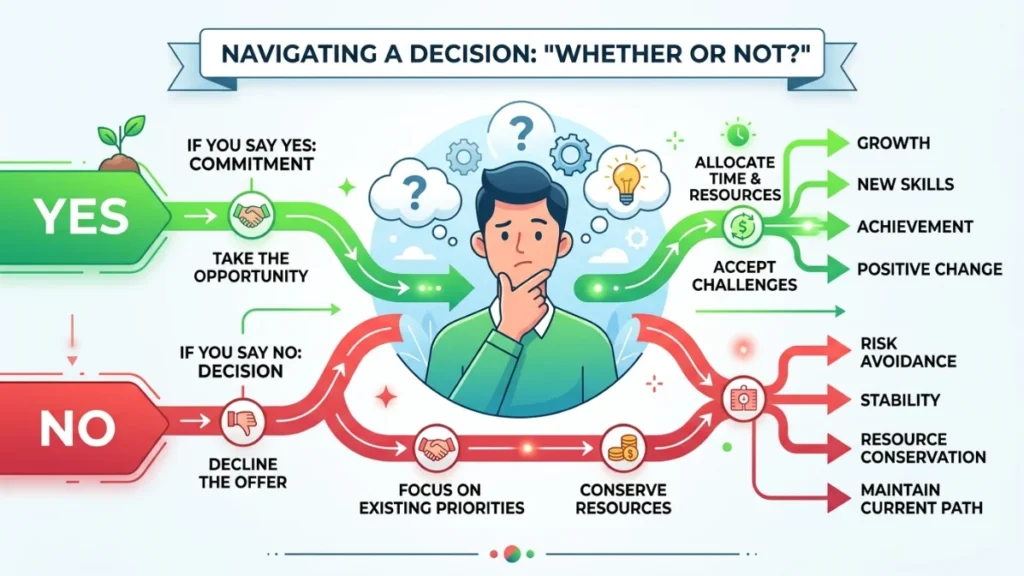

Whether or not means regardless of a condition or possibility. It is used when discussing choices, uncertainty, or situations where the result remains the same.
I used to confuse whether or not while writing emails and articles because sometimes I added it everywhere, even when it was unnecessary. I noticed my sentences became longer and harder to read.
After studying grammar rules and practicing real examples, I learned that whether or not is useful when showing uncertainty, alternatives, or situations where outcomes do not change.
Once I understood this rule, my writing became clearer and more natural. If you also struggle with whether or not, this guide explains everything in simple language with examples and easy rules.
Whether or Not Quick Answer
Whether or not means regardless of something happening or not happening.
It is commonly used when discussing:
- Uncertainty
- Alternatives
- Conditions
- Possibilities
Examples
I do not know whether or not she will come.
We are going outside whether or not it rains.
What Does Whether or Not Mean
The phrase whether or not is used when discussing two possibilities.
Usually these possibilities are:
Something happens.
Something does not happen.
The phrase introduces uncertainty or shows that both outcomes are possible.
Simple Meaning
Whether = if something happens
Whether or not = regardless of which possibility happens
Examples
I am unsure whether or not he received the email.
She must decide whether or not to accept the offer.
Whether or Not Difference From Whether
Many people wonder whether whether and whether or not are the same.
Sometimes they are.
Sometimes they are not.
Comparison Table
| Phrase | Meaning | Example |
|---|---|---|
| Whether | Introduces alternatives | I wonder whether he called |
| Whether or Not | Shows both outcomes possible | I wonder whether or not he called |
Example
Without “or not”
I don’t know whether she is coming.
With “or not”
I don’t know whether or not she is coming.
Both are correct.
The second version emphasizes both possibilities.
Grammar Rules for Whether or Not
Understanding grammar makes this easier.
Rule 1
Use whether or not when discussing alternatives.
Example
We must decide whether or not to continue.
Rule 2
Use it after verbs showing uncertainty.
Common verbs include:
know
wonder
decide
consider
remember
Example
She wondered whether or not he was serious.
Rule 3
Do not overuse it.
Sometimes whether alone is enough.
Incorrect style:
I don’t know whether or not we should or not leave.
Correct:
I don’t know whether we should leave.
The Origin of Whether or Not
The word whether comes from Old English.
Originally, it meant which of two choices.
Over time, English speakers started adding or not for extra emphasis.
This created the phrase whether or not, which became common in spoken and written English.
The phrase remained popular because it clearly shows uncertainty.
Why People Confuse Whether or Not
There are several reasons.
It Looks Similar to If
Many learners replace whether with if.
People Overuse It
Some writers add or not even when unnecessary.
Long Sentences Cause Confusion
Complex sentences make choosing easier said than done.
Whether or Not vs If
This is one of the biggest grammar problems.
Simple Rule
Use if for conditions.
Use whether for alternatives.
Examples
Correct
I don’t know whether he arrived.
Correct
If it rains, we will stay home.
Incorrect
I don’t know if or not he arrived.
Whether or Not in Questions
The phrase commonly appears in indirect questions.
Examples
I wonder whether or not she knows.
He asked whether or not the meeting changed.
They discussed whether or not to invest.
Whether or Not in Everyday Examples
Emails
Please confirm whether or not you will attend.
Social Media
I cannot decide whether or not to buy this.
News Writing
Officials announced they are evaluating whether or not changes are necessary.
Business Writing
Management discussed whether or not the project should continue.
Whether or Not in Formal Writing
Formal writing frequently uses this phrase.
Examples include:
Academic papers
Legal documents
Business reports
Research papers
Example
Researchers analyzed whether or not participants changed behavior.
Whether or Not in Conversation
Daily speech uses the phrase naturally.
Examples
Are you sure whether or not he called?
I still cannot decide whether or not to go.
We are leaving whether or not you come.
Common Mistakes With Whether or Not
Mistake 1 Using If Instead
Incorrect
I don’t know if or not she called.
Correct
I don’t know whether or not she called.
Mistake 2 Adding Extra Words
Incorrect
Whether or not if he comes.
Correct
Whether or not he comes.
Mistake 3 Unnecessary Usage
Incorrect
Tell me whether or not yes.
Correct
Tell me yes or no.
Related Words and Expressions
These expressions are similar.
whether
if
regardless
either way
in any case
regardless of
Whether or Not Usage Patterns
Common structures include:
whether or not + subject + verb
whether or not + infinitive
whether or not + clause
Examples
whether or not she agrees
whether or not to continue
whether or not they succeed
Why Writers Use Whether or Not
Writers use it because it:
Creates clarity
Shows alternatives
Expresses uncertainty
Improves precision
Makes formal writing stronger
Tips to Remember Whether or Not
Simple trick:
If there are two possibilities, use whether.
If the outcome stays the same regardless, use whether or not.
Example
We are going whether or not it rains.
The outcome stays the same.
Exercise 1 Choose the Correct Option
I do not know ______ she will come.
Answer: whether
We are leaving ______ it rains.
Answer: whether or not
She wondered ______ to accept the offer.
Answer: whether
Exercise 2 Correct the Sentence
I don’t know if or not he arrived.
Answer:
I don’t know whether or not he arrived.
Whether or not if she agrees.
Answer:
Whether or not she agrees.
FAQs
What does whether or not mean?
It means regardless of which possibility happens.
Is whether or not grammatically correct?
Yes. It is completely correct when discussing alternatives or uncertainty.
Can I use if instead of whether?
Sometimes yes, but not always. Whether is preferred when discussing alternatives.
When should I use whether or not?
Use it when showing uncertainty or both possible outcomes.
Can whether be used without or not?
Yes. In many cases whether alone is enough.
Is whether or not formal English?
Yes. It appears frequently in professional and academic writing.
Why do people confuse whether and if?
Because both can introduce uncertain situations, but their grammar rules differ.
Conclusion
Understanding whether or not becomes easier when you focus on its main purpose: showing alternatives, uncertainty, or situations where outcomes do not change. Many writers struggle because they overuse the phrase or confuse it with if. I faced the same problem until I realized that whether introduces possibilities while whether or not emphasizes both outcomes.
The phrase is extremely useful in professional writing, emails, academic work, and everyday communication. Learning when to use it improves clarity and makes sentences easier to understand.
Remember this simple rule: if two possibilities exist and both matter, whether or not may be the correct choice. With practice and examples, using this phrase becomes natural and effortless.