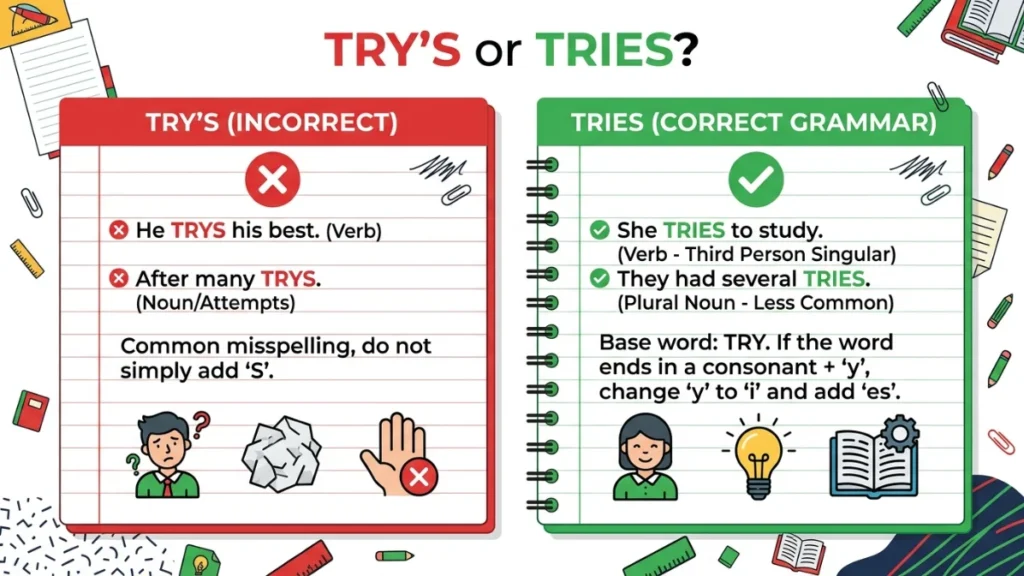

Tries is the correct spelling of the verb try in third person singular form. Trys is incorrect in standard English. Example: She tries every day to improve her English.
I once wrote “he trys hard” in an email and did not notice the mistake until grammar tools highlighted it. At first, I thought both spellings looked acceptable because many English words simply add “s” in the third person form. After checking grammar rules and practicing examples daily, I understood why tries is correct and trys is wrong.
Since then, I have never confused the two again. If you also hesitate while writing trys or tries, this guide will help you understand the rule clearly with simple explanations, examples, grammar patterns, and real world usage.
Trys or Tries Quick Answer
Tries is the correct spelling.
Trys is incorrect in standard English grammar.
Use tries when talking about a third person subject in the present tense.
Examples
- She tries her best every day.
- He tries to stay calm during meetings.
Incorrect example:
- She trys her best every day.
Trys or Tries Meaning
The confusion comes from the verb try.
The word try means:
- To attempt something
- To make an effort
- To test or examine something
When using the verb with he, she, or it in the present tense, the spelling changes from try to tries.
Examples
- He tries to wake up early.
- She tries new recipes every weekend.
- The company tries different marketing strategies.
Why Tries Is Correct
English spelling rules explain why tries is correct.
When a verb ends in a consonant + y, the y changes to i before adding es.
Pattern
try → tries
cry → cries
fly → flies
This is a standard grammar rule in English.
Incorrect Pattern
try → trys ❌
The spelling trys breaks the grammar rule.
Trys vs Tries Difference
| Word | Correct or Incorrect | Meaning |
|---|---|---|
| Tries | Correct | Third person form of try |
| Trys | Incorrect | Not accepted in standard English |
Key Point
Always use tries in formal and professional writing.
Grammar Rule Depth
Understanding the grammar rule helps remove confusion permanently.
Rule for Verbs Ending in Y
If a verb ends in:
- consonant + y → change y to i and add es
- vowel + y → simply add s
Examples of Consonant + Y
| Base Verb | Correct Form |
|---|---|
| Try | Tries |
| Cry | Cries |
| Carry | Carries |
| Study | Studies |
Examples of Vowel + Y
| Base Verb | Correct Form |
|---|---|
| Play | Plays |
| Enjoy | Enjoys |
| Stay | Stays |
This difference is important because many learners apply the wrong pattern.
The Origin of the Word Try
The word try comes from Old French and later entered Middle English.
Originally, it meant:
- To test
- To examine
- To attempt
Over time, the word became one of the most commonly used English verbs.
Because it ends with consonant + y, it follows the standard spelling transformation rule used in English grammar.
Why People Write Trys Instead of Tries
Many learners make this mistake for simple reasons.
Confusion With Regular Verbs
Most English verbs only add s.
Examples:
- runs
- walks
- speaks
Because of this pattern, people assume:
try → trys
Pronunciation Confusion
Both spellings sound similar when spoken quickly.
Lack of Grammar Awareness
Many learners do not know the consonant + y rule.
Real World Usage of Tries
The word tries appears frequently in daily English.
At Work
- She tries to finish projects on time.
- The manager tries to improve communication.
At School
- He tries hard in mathematics.
- The student tries new learning methods.
In Relationships
- She always tries to help her friends.
- He tries to understand others.
In Sports
- The player tries to score before halftime.
- The team tries different strategies during matches.
Tries in Everyday Examples
Emails
- She tries to respond quickly to all messages.
- The company tries to solve customer problems fast.
News
- The government tries to reduce inflation.
- The organization tries to improve healthcare services.
Social Media
- He tries to post videos every day.
- She tries new fashion styles weekly.
Formal Writing
- The research team tries several testing methods.
- The company tries innovative solutions for growth.
Verb Forms of Try
Understanding all forms improves grammar accuracy.
| Verb Form | Example |
|---|---|
| Base Form | try |
| Third Person Singular | tries |
| Past Tense | tried |
| Past Participle | tried |
| Present Participle | trying |
Example Sentences
- I try to exercise daily.
- She tries her best every time.
- They tried a new system yesterday.
- We are trying to solve the issue.
Common Mistakes With Trys or Tries
Mistake 1 Using Trys
Incorrect:
- He trys too hard.
Correct:
- He tries too hard.
Mistake 2 Forgetting the Y Rule
Incorrect:
- She studys every night.
Correct:
- She studies every night.
Mistake 3 Confusing Tense Forms
Incorrect:
- Yesterday he tries again.
Correct:
- Yesterday he tried again.
Try vs Tries
Many learners also confuse try and tries.
| Word | Usage |
|---|---|
| Try | Used with I, you, we, they |
| Tries | Used with he, she, it |
Examples
- I try every day.
- They try to learn quickly.
- She tries very hard.
- He tries to stay focused.
Related Grammar Words
Learning similar patterns helps reinforce the rule.
Similar Verb Changes
| Base Verb | Correct Form |
|---|---|
| Fry | Fries |
| Reply | Replies |
| Deny | Denies |
| Supply | Supplies |
These verbs follow the same spelling rule as try.
Tips to Remember Tries
Simple Memory Trick
If the verb ends in consonant + y:
- remove y
- add ies
Example
try → tries
Easy Reminder
“He, she, it” usually changes the verb form.
- He tries
- She tries
- It tries
British English vs American English Usage
Unlike some English spelling differences, tries is correct in both British and American English.
There is no regional variation here.
| Region | Correct Spelling |
|---|---|
| American English | tries |
| British English | tries |
| Canadian English | tries |
| Australian English | tries |
The spelling trys is incorrect everywhere in standard English.
Why Correct Spelling Matters
Using the wrong spelling can affect professionalism.
In Professional Writing
Incorrect grammar may reduce credibility.
Example:
- He trys to solve customer complaints. ❌
Correct:
- He tries to solve customer complaints. ✅
In Academic Writing
Grammar accuracy is important for grades and clarity.
In Digital Communication
Correct spelling improves readability and trust.
Tries in Spoken English
In spoken English, people usually pronounce tries clearly.
Examples:
- She tries very hard.
- He tries to stay positive.
Because pronunciation sounds natural, the mistake mainly appears in writing rather than speech.
Usage Trends and Popularity
Language tools, dictionaries, and search data show that:
- tries is the accepted form
- trys appears mainly in grammar mistakes
Professional writers, teachers, and editors consistently use tries.
Common Expressions With Try
Try Your Best
- She tries her best every day.
Try Again
- He tries again after failure.
Try Something New
- The company tries new marketing ideas.
Try Hard
- The athlete tries hard during practice.
Real Life Sentence Examples
- My brother tries to wake up early.
- The teacher tries to explain clearly.
- She tries different recipes every weekend.
- The company tries to improve customer service.
- He tries to learn English every day.
- The child tries to tie his shoes.
- The coach tries new strategies during games.
- She tries to remain calm under pressure.
Exercise 1 Choose the Correct Word
Fill in the blanks with trys or tries.
She ______ to finish work early.
Answer: tries
He ______ his best every day.
Answer: tries
The company ______ different marketing ideas.
Answer: tries
Exercise 2 Correct the Sentence
Rewrite the sentence correctly.
He trys to stay positive.
Answer: He tries to stay positive.
She trys new recipes every week.
Answer: She tries new recipes every week.
The student trys hard in class.
Answer: The student tries hard in class.
Advanced Grammar Explanation
Why Y Changes to I
English spelling rules often change final y to i before adding endings.
This helps maintain pronunciation and spelling consistency.
Compare Similar Patterns
| Incorrect | Correct |
|---|---|
| studys | studies |
| crys | cries |
| trys | tries |
This pattern is deeply rooted in English grammar structure.
Trys or Tries in Formal Writing
Formal writing always requires the correct form.
Business Writing
- The company tries to improve productivity.
Academic Writing
- The researcher tries multiple methods.
Journalism
- The government tries to control inflation.
Using trys in formal writing looks unprofessional and grammatically incorrect.
Related Words From Try
| Word | Meaning |
|---|---|
| Tried | Past tense of try |
| Trying | Making an effort |
| Retry | Attempt again |
| Trial | A test or examination |
These related words share the same root meaning connected to effort or testing.
FAQs
Is trys a real word?
No. Trys is not accepted in standard English grammar. The correct spelling is tries.
Why is tries correct instead of trys?
Because verbs ending in consonant + y change y to i before adding es.
What is the rule for try and tries?
Use try with I, you, we, and they. Use tries with he, she, and it.
Is tries used in British English?
Yes. Tries is correct in both British and American English.
What is the past tense of try?
The past tense of try is tried.
Why do learners confuse trys and tries?
People often assume all verbs simply add s, but verbs ending in consonant + y follow a different rule.
Can I use trys in informal writing?
No. Tries is the correct spelling in both formal and informal English.
Conclusion
Understanding the difference between trys or tries is simple once you know the grammar rule. The correct spelling is always tries when using the verb try with he, she, or it in the present tense. The spelling trys is incorrect because English grammar changes consonant + y endings to ies.
This rule also applies to many other verbs such as cry, study, and carry. Learning this pattern improves grammar accuracy, writing clarity, and professional communication. Whether you are writing emails, essays, reports, or social media posts, using tries correctly makes your English look polished and reliable.
A helpful reminder is: if a verb ends in consonant + y, replace the y with ies. Once you practice this rule regularly, choosing the correct spelling becomes automatic.