
Many writers, editors, and students often pause at the words “canceled” and “cancelled.” Which spelling is correct? Does it depend on your location? Does it change the meaning?
The truth is, both words share the same meaning but differ in regional spelling conventions. Understanding their correct usage ensures your writing appears professional, polished, and error-free.
In this guide, we’ll break down everything about canceled or cancelled—from definitions and grammar rules to real-world examples, style guide preferences, and common mistakes. By the end, you’ll never second-guess which spelling to use again.
What Does Canceled Mean?
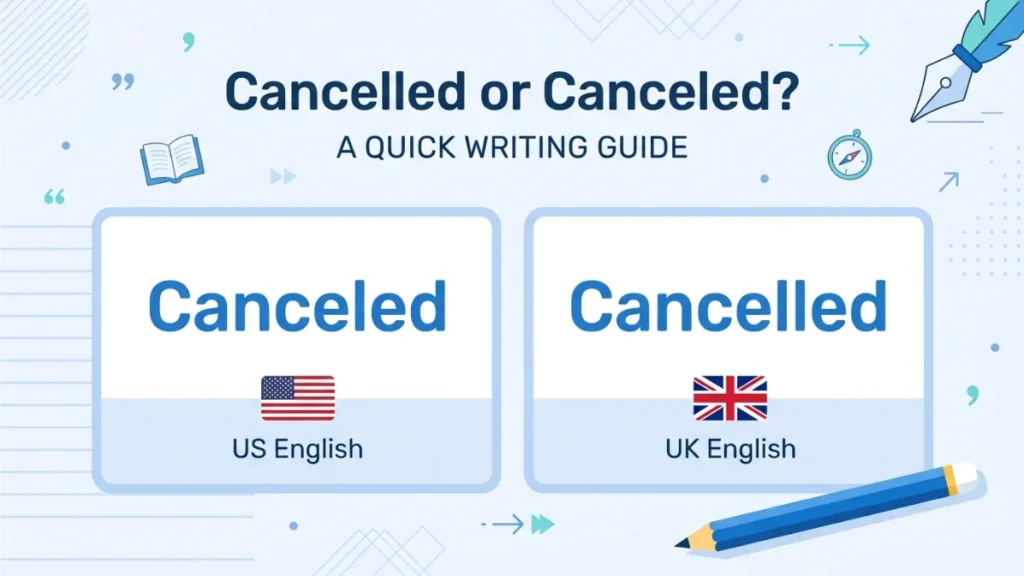
Canceled is the standard spelling in American English. It represents the past tense of the verb “cancel,” meaning to call off or annul something.
Common Uses of Canceled
- Flights: “The flight was canceled due to a snowstorm.”
- Meetings: “Your 10 AM meeting has been canceled.”
- Appointments and Orders: “The online order was canceled because of payment issues.”
- Events: “The concert was canceled after the venue lost power.”
Canceled in Sentences
- “All non-essential meetings were canceled to reduce office crowding.”
- “Her trip to New York was canceled at the last minute.”
- “The sports game was canceled due to heavy rain.”
In the US, canceled is preferred in newspapers, academic writing, business communication, and most publications.
What Does “Cancelled” Mean?
Cancelled is the preferred spelling in British English. It carries the same meaning as canceled—to stop or revoke something previously scheduled.
Common Uses of Cancelled
- Flights: “The train was cancelled due to maintenance work.”
- Meetings: “The board meeting was cancelled because of a public holiday.”
- Appointments: “The doctor’s appointment was cancelled due to unforeseen circumstances.”
- Events: “The wedding ceremony was cancelled after the venue flooded.”
Cancelled in Sentences
- “The football match was cancelled because of the storm.”
- “Her presentation was cancelled last minute.”
- “The annual fair was cancelled due to government restrictions.”
In the UK and countries following British conventions like Australia and Canada, cancelled is standard in official documents, newspapers, and academic writing.
Canceled vs Cancelled – The Key Differences
The main difference between canceled and cancelled is regional spelling.
| Feature | American English | British English |
|---|---|---|
| Spelling | canceled | cancelled |
| Continuous Form | canceling | cancelling |
| Style Guide Example | AP Style: canceled | Oxford: cancelled |
| Common Usage | US publications, business, casual writing | UK publications, formal documents, newspapers |
| Double Consonant Rule | Rarely doubles consonant after vowel | Usually doubles consonant if verb ends in a single vowel + consonant |
Explanation of the Double Consonant Rule
In British English, verbs ending with a single vowel + consonant often double the consonant when adding -ed or -ing.
- Cancel → Cancelled / Cancelling
- Travel → Travelled / Travelling
In American English, this doubling is often simplified.
- Cancel → Canceled / Canceling
- Travel → Traveled / Traveling
This rule explains why American writers favor canceled while British writers use cancelled.
Is It “Canceled” or “Cancelled”?
The choice depends on three factors:
- Audience location – US vs UK readers.
- Style guide – AP, Chicago, Oxford, or your organization’s style guide.
- Consistency – Whatever you choose, stick with it throughout your document.
Style Guide Preferences
- AP Style (American news writing): canceled
- Oxford Style (British publishing): cancelled
- Chicago Manual of Style (US): canceled
Consistency is key. Mixing both in one document can confuse readers and appear unprofessional.
Cancelled or Canceled in Different Contexts
Travel and Bookings
Travel companies, airlines, and booking platforms often follow regional spelling rules.
| Context | US English | UK English |
|---|---|---|
| Flight | Canceled flight | Cancelled flight |
| Hotel Booking | Canceled reservation | Cancelled reservation |
| Travel Events | Canceled tour | Cancelled tour |
Tips:
- Use canceled for US audiences, cancelled for UK or international audiences using British spelling.
- Always follow the airline or hotel’s published spelling when referencing official materials.
Business and Meetings
- Corporate emails:
- US: “Your meeting has been canceled.”
- UK: “Your meeting has been cancelled.”
- Appointments:
- US: “Your appointment with Dr. Smith is canceled.”
- UK: “Your appointment with Dr. Smith is cancelled.”
Pro tip: When writing emails, maintain the audience’s spelling conventions to avoid minor errors that appear careless.
Education and School Writing
- US Schools: “The class was canceled due to teacher absence.”
- UK Schools: “The class was cancelled due to teacher absence.”
Students should use the regional spelling matching their curriculum or teacher’s preference.
Verb Forms of Cancel
Understanding verb forms is crucial for proper usage.
| Tense | American English | British English | Example Sentence |
|---|---|---|---|
| Present | cancel | cancel | “I cancel my appointments early.” |
| Present Continuous | canceling | cancelling | “They are canceling/cancelling the workshop.” |
| Past | canceled | cancelled | “The flight was canceled/cancelled yesterday.” |
| Past Participle | canceled | cancelled | “The event has been canceled/cancelled.” |
Note: Always match the verb form to the regional spelling convention.
Pronunciation and Common Misunderstandings
Despite the different spellings, canceled and cancelled are pronounced identically: /ˈkæn.səld/.
Common Misconceptions
- Some believe “canceled” is informal; it is not. It is fully accepted in US writing.
- Others think “cancelled” is outdated in British English; it remains the standard.
- Pronunciation never affects spelling choice—only the style and region matter.
Tips for Correct Usage
- Know your audience: Use US spelling for American readers, UK spelling for British readers.
- Follow style guides: AP Style, Oxford, Chicago, or internal corporate guidelines.
- Use grammar and spellcheck tools: Ensure consistent usage in emails, blogs, and documents.
- Check verb forms: Remember cancel → canceled/cancelled, canceling/cancelling.
- Consistency matters: Mixing “canceled” and “cancelled” in the same document can confuse readers.
Quick Checklist:
- Audience = US → canceled
- Audience = UK → cancelled
- Style guide override? Follow the guide
- Examples consistent? ✅
- Verb forms correct? ✅
Examples of Correct Usage Across Different Scenarios
| Scenario | US English | UK English |
|---|---|---|
| Flight | Canceled flight | Cancelled flight |
| Meeting | Canceled meeting | Cancelled meeting |
| Appointment | Canceled appointment | Cancelled appointment |
| Event | Canceled event | Cancelled event |
| Order | Canceled order | Cancelled order |
| Plans | Canceled plans | Cancelled plans |
Practical Tip: In professional writing, always double-check your document with a dictionary or style guide to ensure correct spelling.
FAQs
Which is correct, canceled or cancelled?
Both are correct; it depends on regional spelling rules.
Is cancelled wrong in American English?
Yes, in the US, “canceled” is preferred; “cancelled” is rare.
Is canceled wrong in British English?
It is not incorrect, but British publications generally prefer “cancelled.”
Why is canceled spelled differently in the US?
American English simplified spellings in the 19th century for consistency and efficiency, often dropping double letters.
How do I spell canceled/cancelled correctly in essays?
- Match the regional convention (US → canceled, UK → cancelled).
- Check your style guide if required.
- Keep verb forms consistent throughout the text.
Related Terms and Variations
- Canceling vs Cancelling – Continuous tense, regional difference.
- Cancellation vs Cancelation – Noun form, American English prefers cancellation with double L often.
- Canceled status vs Cancelled status – Used in corporate or booking systems.
- Event cancellation, travel cancellation, booking cancellation – Common in travel and hospitality.
- Business cancellation emails – Follow regional spelling for professionalism.
Conclusion
The difference between canceled and cancelled is straightforward once you know the regional rules and style guide preferences.
- Use canceled for American English, cancelled for British English.
- Maintain consistency across documents, emails, and publications.
- Check verb forms, continuous tense, and noun forms for accurate usage.
- When in doubt, consider your audience, style guide, and purpose.
By understanding these nuances, you’ll ensure clarity, professionalism, and confidence in your writing.